
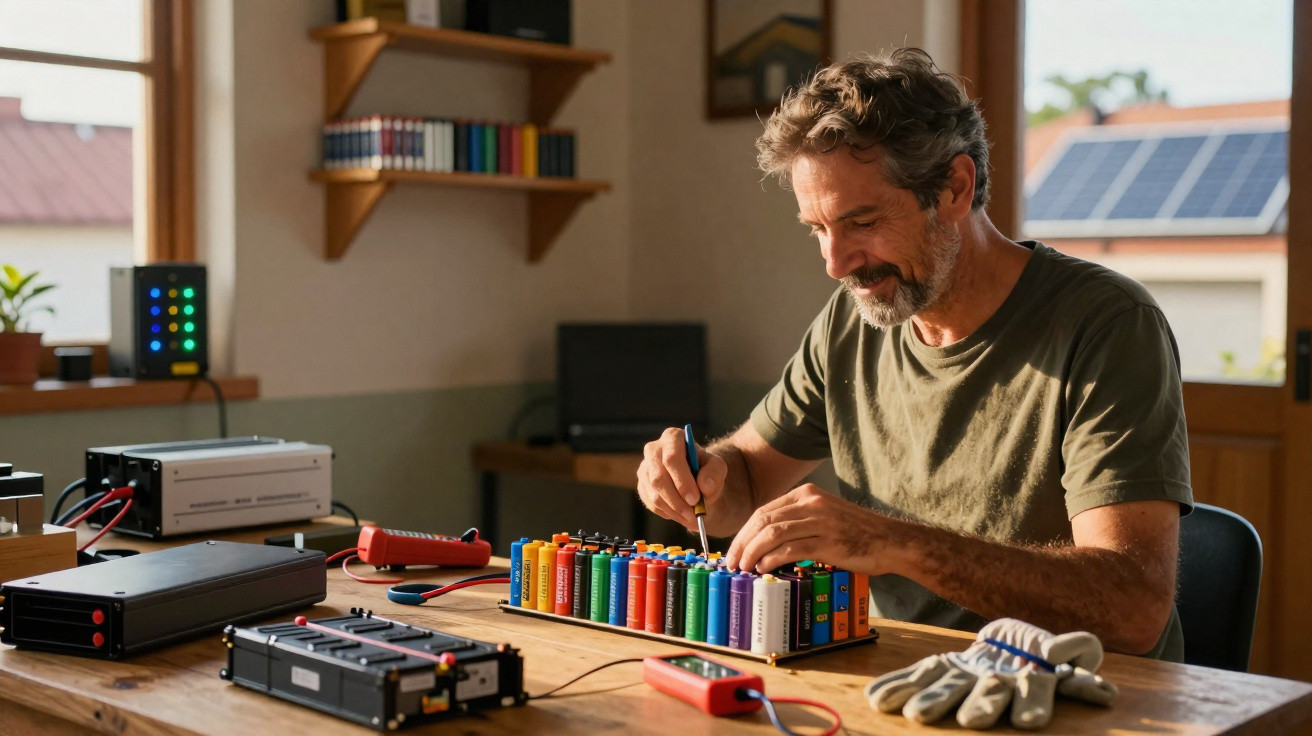
On a small property far from the city, a resident set out to challenge the logic of electricity bills by using discarded technology.
What began as curiosity became an energy-independence project: a homemade system using hundreds of discarded laptop batteries to keep a house running almost independently of the conventional electricity grid.
From electronic waste to a household energy source
Since 2016, this alternative-energy enthusiast has supplied his property with an unlikely combination: more than 650 used laptop batteries, solar panels and a control system designed by himself. The aim is straightforward yet ambitious: to minimise reliance on the electricity supplier.
A collection of batteries that would otherwise have gone into the bin now keeps the lighting, equipment and some household appliances running every day.
The system’s core is housed in a small shed around 50 metres from the house. Inside are the reconditioned batteries, arranged in blocks and linked to charge controllers and an inverter, which turns the stored energy into electricity suitable for ordinary sockets.
How the project began in 2016
Before experimenting with laptop batteries, the resident already had a basic solar installation: a few panels, an old forklift battery, a controller and an inverter. It was enough to reduce the electricity bill, but not to provide independence.
The turning point came when he realised that businesses, repair shops and users were discarding laptop batteries that still contained reusable cells. He then began “collecting” these batteries and testing every cell individually.
He started with around 650 used batteries to build blocks of roughly 100 Ah each, creating a large modular energy “bank”.
For the main connections, he chose thick copper cables to reduce energy losses and heat build-up. Over time, the installation expanded to more than a thousand batteries in total, including those in operation as well as those kept as spares or replacements.
A shed turned into an improvised power station
The shed operates as a small energy station, bringing together three main components:
- the solar panels on the roof, which generate the power;
- battery blocks arranged on shelving;
- electronic equipment for control, safety and energy conversion.
The panels charge the batteries during daylight hours. At night, or on overcast days, the home is supplied by the energy stored in them. According to the resident, the system has operated for almost a decade without major incidents, such as fires or swollen batteries, thanks to careful sizing and constant monitoring.
The role of repurposed laptop batteries
Laptop batteries generally consist of lithium-ion cells connected in series and parallel. When a battery is considered “dead” for use in a computer, some of its cells often still have useful life remaining.
The process he follows involves:
- opening discarded batteries and separating the cells;
- testing each cell’s capacity, voltage and internal resistance;
- disposing of faulty cells correctly;
- grouping only cells with similar performance into new modules.
These modules are linked together to create large energy banks, able to store much of the solar panels’ daily output and provide hours of autonomy.
What this experience shows about energy independence
The case demonstrates that technical knowledge, patience and access to electronic scrap can deliver practical results. This is not a simple “trick”, but a system developed as a long-term hobby that ultimately became an energy solution.
The initiative highlights an often-overlooked potential: extending the working life of lithium components that, in many cases, may still have years of use left.
For anyone considering a similar approach, several aspects stand out:
| Aspect | Advantage | Challenge |
|---|---|---|
| Battery cost | Raw material is almost free, obtained from discarded items | Time is needed to source, test and select batteries |
| Environmental impact | Reduces electronic waste and the use of new batteries | Faulty cells must be disposed of correctly |
| Safety | A properly sized project reduces risks | Assembly errors can cause overheating and short circuits |
| Technical complexity | Allows extensive system customisation | Requires electrical and electronic knowledge |
Risks, limitations and essential precautions
Working with lithium-ion cells is never straightforward. Short circuits, overcharging or physical damage can result in overheating and even fire. This sort of home project is only suitable for people who understand current, voltage and protection systems, and who know how to use measuring equipment.
Key precautions include:
- fitting fuses or circuit breakers to every battery group;
- preventing overcharging with good-quality controllers;
- monitoring module temperatures, particularly on hot days;
- keeping the system away from living areas and ensuring suitable ventilation.
Despite the resident’s positive results, industry professionals generally recommend that new, certified battery systems should be the main option for most people, even though the initial investment is higher.
How this solution relates to the future of energy
While major companies invest in batteries claimed to last for decades without recharging, examples like this point to a parallel route: making better use of what has already been manufactured. Rather than waiting for perfect technology, it is possible to obtain more usage cycles from equipment that has already been discarded.
In rural settings, remote communities or places with an unreliable grid, hybrid systems based on repurposing can serve as a bridge, cutting diesel-generator use and making supply more predictable. In urban areas, the idea can inspire smaller solutions, such as battery banks for emergencies or educational projects.
What terms such as Ah, inverter and charge controller mean
A few concepts make the project easier to understand:
- Ah (ampere-hour): indicates how much charge a battery can store. A 100 Ah module, for instance, can theoretically supply 10 A for 10 hours.
- Charge controller: equipment that manages the energy flowing from solar panels to batteries, preventing overcharging and extending battery life.
- Inverter: converts the batteries’ direct-current energy into alternating current, the form used in most homes.
By combining these elements, the resident turned a simple shed into a practical distributed-energy laboratory, powered by technology that many would consider obsolete.
For readers considering the possibilities, the most realistic option is not to copy the solution exactly, but to view discarded batteries as a resource that can still be used responsibly in experimental, community or educational projects focused on the energy transition.






Comments
No comments yet. Be the first to comment!
Leave a Comment