
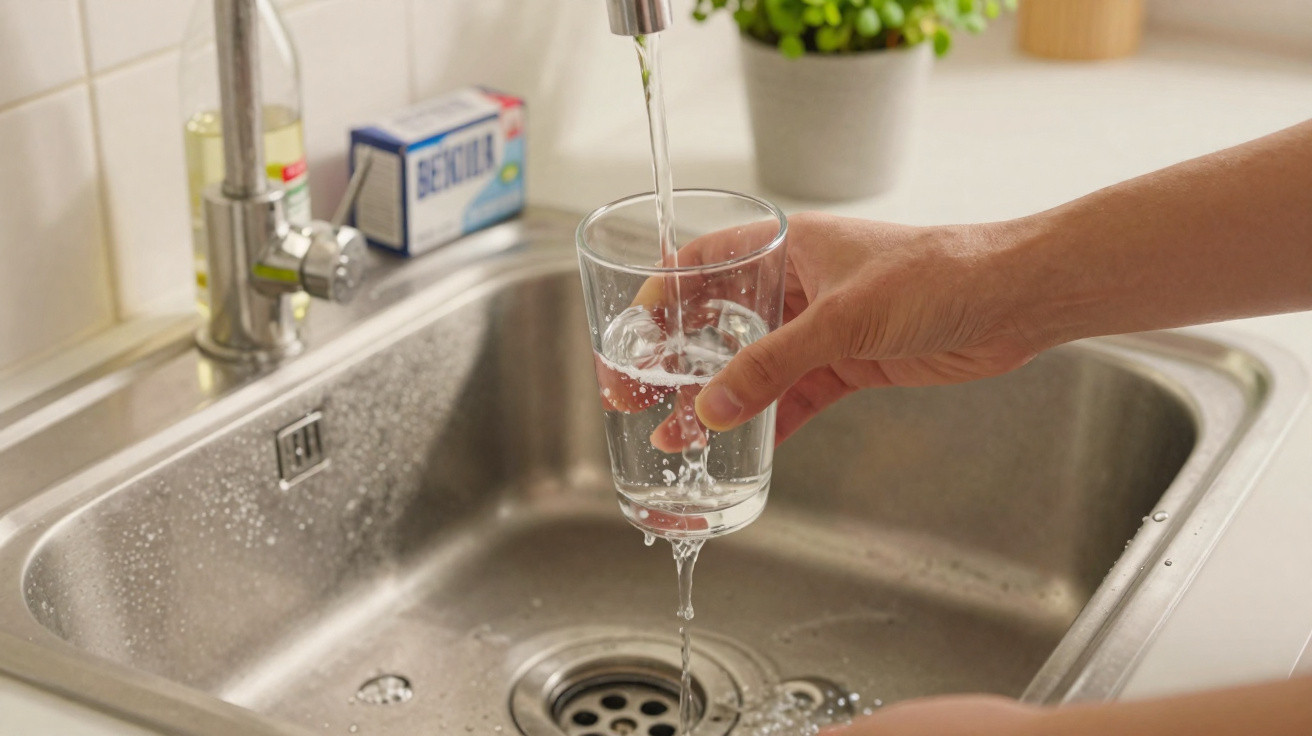
The sink had become a shallow pool of grey water, with cold pasta spirals floating by the plughole like deserted lifeboats. It is the sort of ordinary household mishap that hardly warrants paying for a plumber, yet can still spoil your day. You open the cupboard and reach automatically for the vinegar and baking soda, as though instinct has taken over. Then you hesitate.
You have performed this bit of kitchen chemistry before. There is foam, fizz and that pleasing miniature-volcano effect – yet 30 minutes later, the water remains. Perhaps it has dropped slightly, but it has not cleared. Your phone lies on the worktop, glowing with yet another “miracle cleaning hack” claiming it will transform your life with two ingredients and positive thinking.
This time, however, the headline says something else. No vinegar. No baking soda. Only a “half-glass trick” that seems almost absurdly easy. That is precisely why you open it.
Why classic DIY drain tricks keep failing
The vinegar-and-baking-soda routine has become almost sacred in today’s kitchens. People recommend it for everything from sinks and showers to unpleasant-smelling washing machines. Once poured in, it bubbles energetically and appears effective. Visually, it creates the impression that the drain is being scoured clean inside.
Yet that frothy display is largely carbon dioxide being released. It is performance rather than genuine force. Within the pipe, a blockage is usually a thick, greasy combination of soap residue, hair, food debris and fat. Surface fizz seldom penetrates its centre. Water may begin moving a little before stopping once more. You are back where you began, apart from a kitchen that smells of salad dressing.
In a small UK survey of household maintenance habits, over half of those questioned said they had used the same drain remedy as many as five times before abandoning it. That is not determination; it is a cycle. One tenant told me she would stand above the bathroom sink “like a scientist in a lab”, trying another vinegar-and-bicarbonate combination while privately knowing it was unlikely to make much difference.
Eventually, her landlord became fed up with the repeated requests and removed the U-bend. It contained a solid grey-brown mass of hair and hardened products that looked almost fossil-like. The fizz had never reached it. Water had worn a slim route across the top, enough to convince her that each attempt was doing something. The remainder of the blockage simply stayed put, becoming denser and more adhesive.
The causes of most household drain blockages are remarkably straightforward: heat, fat and time. Hot grease travels down the sink, reaches colder pipework and gradually solidifies like inexpensive candle wax. Soap adheres to it, food particles become trapped and hair binds the mixture together. Standing water is not only unpleasant; it is heavy, compressing that material further. A mild chemical reaction at the surface cannot reverse deposits that have accumulated over months or even years.
Your drain is indifferent to online trends. It reacts to heat, flow, contact time and gravity. The most useful method, therefore, is not necessarily the one that creates the best video, but the one that concentrates genuine power at the blockage for long enough to soften and break it down. This is where the half-glass idea makes its understated difference.
The half-glass trick for clearing stubborn drains
At its core, the method is disarmingly straightforward: use exactly half a glass of a strong, targeted liquid, applying it with the precision of a sniper rather than the force of a cannon. Do not flood the drain, pour at random or decide to empty the entire bottle just to see what happens. Pour half a glass slowly into a dry drain.
Depending on what you have at home, the liquid can be either a suitable drain-unblocking gel or a concentrated solution of washing soda – not baking soda – carefully dissolved in boiling water. Run the hot tap for one minute, then turn everything off. The important part follows: pour the half-glass slowly in a narrow stream, allowing it to run down the drain sides where the sludge tends to collect.
If conditions are favourable, subtle noises may begin after 10 to 15 minutes. You might hear a faint gurgle or a small sigh from the pipework, or notice the water level shift. Leave it undisturbed. Do not prod it with forks or start plunging yet. After 30 minutes, flush with a forceful stream of very hot water. Often, the backed-up water disappears all at once, followed by the satisfying hollow “whoosh” of success. One reader said she actually applauded alone in her kitchen when it worked.
The appeal of the half-glass trick lies not in magic but in control. A smaller amount of product stays where it is needed rather than dispersing and becoming diluted. You are soaking the blockage, not drowning it. Many people instinctively use too much, assuming that “more product = stronger fix”, then send costly chemicals down the pipe without allowing sufficient contact with the blockage itself.
This approach makes you work with the drain rather than fight it. A modest volume remains more concentrated, coats the pipe walls and attaches to greasy, sticky deposits. Waiting before flushing gives it time to soften the build-up instead of simply passing over it. The final surge of hot water does more than rinse: it moves the softened matter onwards, breaking the blockage into pieces small enough for the pipe to carry.
“Once I started using half a glass instead of half a bottle, everything changed,” admits Laura, a 39-year-old mum who used to keep three different ‘miracle’ drain products under her sink. “I realised I’d been washing money down the drain while my pipes stayed dirty.”
There are several very common errors that nearly everyone makes. One is pouring too quickly. Another is becoming impatient and adding unrelated products. Then there is mixing bleach with other cleaners “just this once” because the blockage looks severe. Let us be honest: nobody really does this every day, and that is how people end up improvising.
- Use no more than half a glass, and never combine chemical brands or types.
- Begin only when the drain is dry, with no standing water above the plughole.
- Wait at least 20–30 minutes before flushing with very hot water.
- Never mix bleach with anything acidic or unidentified.
- If the same point blocks every month, have the U-bend inspected once rather than trying 15 times.
Why the low-drama half-glass trick is so satisfying
There is something unexpectedly reassuring about a solution that does not demand attention. There is no dramatic foam, no questionable online shortcut and no five-stage ritual at midnight. It takes only half a glass, a brief wait and results that you can both hear and observe. During a hectic weekday, that calm efficiency can feel like a small gesture of self-respect.
At a deeper level, this approach opposes the way we often deal with housework. We commonly tackle issues in large, anxious bursts, carrying out major cleans after ignoring warning signs for weeks. Here, effectiveness comes from a small and intentional action: enough product, enough time and enough heat. It is not heroic; it is simply reliable.
A half-glass of clear liquid is hardly spectacular on screen. Few people would watch a 30-second sink video in which “nothing much happens”. Nevertheless, this is exactly the sort of understated method people share in real life: from neighbour to neighbour, parent to child and colleague to colleague. It is the one you recall when water starts rising again and that familiar, quiet apprehension sets in.
| Key point | Detail | Benefit for the reader |
|---|---|---|
| Target the blocked area | Half a glass poured slowly into a dry pipe | Maximises action on the blockage rather than in the sewers |
| Contact time | Wait 20–30 minutes before flushing with very hot water | Allows the product to properly soften deposits |
| Less product, greater effect | No overuse and no dangerous mixtures | Saves money, improves safety and makes drains more reliable |
FAQ
- Can I use this half-glass trick with just hot water and no product? Hot water by itself may help when a blockage is recent and mainly greasy, but it rarely resolves older or mixed blockages. The trick is most effective with a proper drain gel or a correctly dissolved washing soda solution.
- Is washing soda the same thing as baking soda? No. Washing soda (sodium carbonate) is more powerful and more alkaline than baking soda (sodium bicarbonate). Handle it carefully and ensure it is fully dissolved in hot water before using it.
- How often should I repeat the half-glass method? For a persistent blockage, you may repeat it once after 24 hours. If the same drain blocks every few weeks, there may be a deeper pipe issue requiring a physical inspection.
- Can I try this trick on shower and bathtub drains? Yes, it is suitable for most bathroom drains, particularly those blocked by hair and soap scum. First make sure the area is as dry as possible, then always finish with very hot water.
- What if the water doesn’t move at all after trying? If there is no improvement whatsoever, the blockage is probably too compact or located too far along the pipe. At that stage, a drain snake or professional plumber is safer than adding more chemicals.
Comments
No comments yet. Be the first to comment!
Leave a Comment