
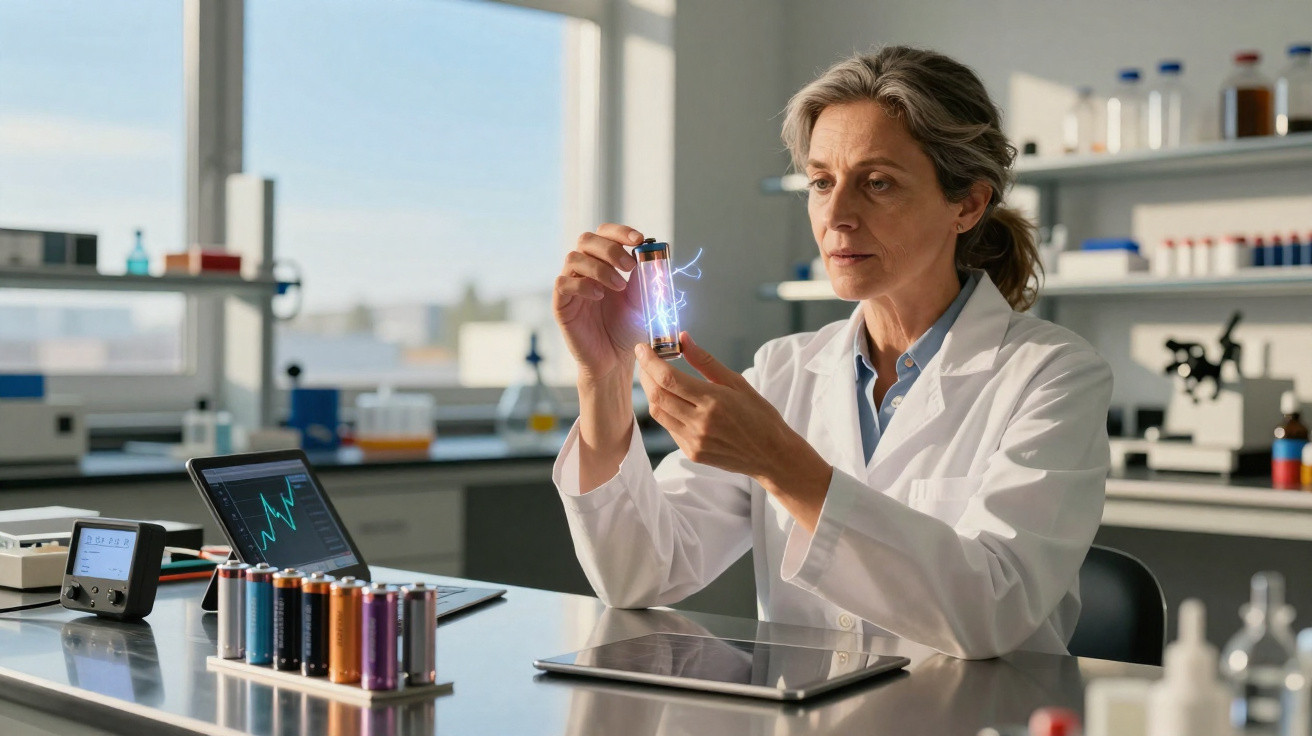
Helena Braga, a researcher and lecturer at the Faculty of Engineering of the University of Porto (FEUP), explained on Expresso’s O Futuro do Futuro podcast that self-charging batteries could arrive soon, as well as how they operate.
In 2020, her team established the foundations for an innovative battery capable of recharging itself by combining “negative capacitance and negative resistance” within a single cell.
Although such batteries are currently difficult to find in industrial applications, Helena Braga believes they “could be coming soon”.
How does this technology work?
According to the lecturer, self-charging batteries have the same basic components as lithium-ion batteries: an anode, a cathode and an electrolyte.
The electrolyte is the medium through which ions travel between the battery’s anode and cathode, which are its electrodes. By transferring electrical charges, it produces an electric current and enables chemical energy to be converted into electrical energy.
In self-charging batteries, “the task of putting the ions in the right place happens spontaneously inside the electrolyte”.
How does that happen? The electrolyte used in these batteries is solid and also ferroelectric. This means that “spontaneously, at a certain temperature - without needing to use energy -, one area of the material will develop a positive charge and another area will acquire a negative charge; and positive and negative charges separated by a certain distance result in stored energy”. This could reduce the costs associated with using the electricity grid.
As well as being solid, these batteries use sodium ions, or salt, because sodium is one of the most abundant materials. The use of sodium in batteries is not entirely new, although the existing versions use a liquid electrolyte.
While it is still too early to fit these batteries in cars, Helena Braga is confident that this could happen.
What is the future of batteries?
Self-charging batteries are only the tip of the iceberg. On the podcast, the lecturer also mentioned another type of battery that may arrive soon: wireless batteries. As their name suggests, these would allow charging to take place remotely.
According to the researcher, these will be “the future of the future of batteries”, although they are not the only development. Solid-state batteries containing electrolytes with sodium and potassium are, in her words, “a present with one foot in the future”.
These batteries may eventually exceed the capacity offered by lithium-ion batteries. However, the scientist acknowledges that liquid-state batteries will probably not be discarded.
Competition will lower prices
Manufacturing costs are among the biggest challenges facing the battery industry, and Helena Braga also has a view on the issue.
“Europe is trying to reach the level of development of Asia.”
Helena Braga, Researcher and Lecturer
She says that 39 battery gigafactories are planned across Europe, while China has already begun restricting the construction of new gigafactories within its borders: “prices will fall with competition”.
Regarding the range of today’s electric cars, the researcher considers that they already offer substantial range. She cites the Lucid Air Grand Touring as an example, with a range of up to 832 km.
“A car with a range of 1000 km will be close with these new technologies.”
Helena Braga, Researcher and Lecturer
Source: Expresso





Comments
No comments yet. Be the first to comment!
Leave a Comment