
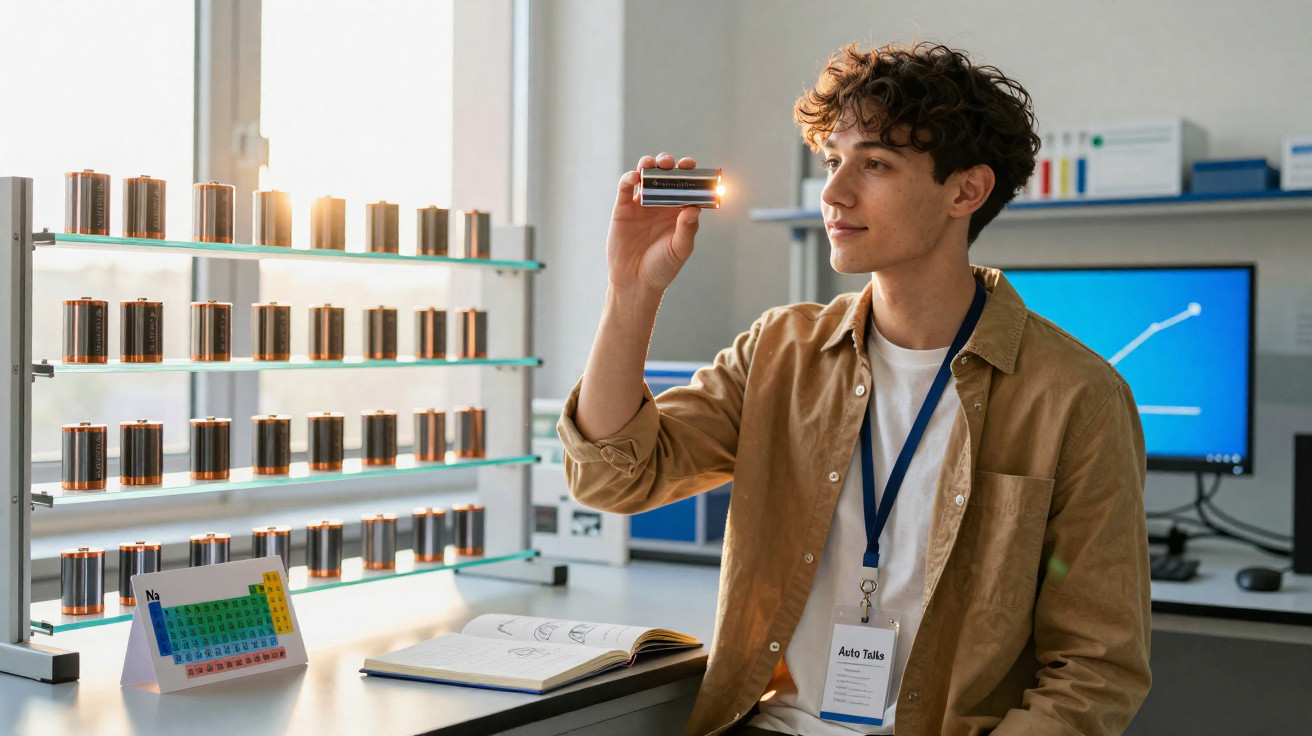
Until now, the potential for sodium-ion batteries to replace the more widespread lithium-ion units appeared very limited. CATL has now shifted the odds.
The Chinese giant recently unveiled the second generation of its sodium-ion battery, and it represents a turning point - a revolution. Its energy density (175 Wh/kg) even exceeds that of LFP lithium-ion batteries, while costing 7.5 times less. Compared with Tesla’s 4680 cylindrical batteries, which use NMC chemistry, it is 10 times cheaper.
CATL has already begun mass production. What better time, then, to invite Dr Helena Braga, a researcher at the Faculty of Engineering of the University of Porto, back to discuss sodium batteries? She took to the stage at Auto Talks - Razão Automóvel’s new editorial format, launched at the ECAR Show - and helped us understand the technology and its potential:
Dr Helena Braga is an internationally recognised figure in battery development, notably for her work on solid electrolytes, a technology that also promises to transform the batteries of the future.
Her research drew the attention of John Goodenough (1922–2023) - Nobel Prize winner in Chemistry and one of the inventors of the lithium-ion battery - and she subsequently worked with him on solid-state battery research.
More recently, she introduced an innovative sodium-ion (salt-based) battery that can recharge itself. This was the subject that prompted a live Auto Rádio.
Sodium: a cheaper, more abundant alternative
Unlike conventional lithium-ion batteries, sodium batteries use an element that is a thousand times more abundant: salt. “There is far more salt than lithium on Earth,” Helena Braga said, adding that both elements are found in the same salt flats, yet lithium accounts for only 4% of what is extracted.
That abundance partly explains the stated price: just US$10 per kWh. This is substantially below the roughly US$75/kWh for LFP batteries - the technology favoured by China’s automotive industry - and around US$100/kWh for Tesla’s NMC 4680 cylindrical batteries (Source: Bloomberg NEF).
At Auto Talks, Dr Helena Braga gave another reason why these CATL sodium batteries are so inexpensive: they are anodeless, meaning they do not have a conventional anode - the negative electrode - fitted.
The anode is created during the first charging cycle. This brings major manufacturing advantages, as controlled-environment rooms are no longer needed to install the anode, unlike with lithium-ion batteries. There are further reasons behind such a low price, which can be seen or heard in the video above.
CATL sodium batteries: stronger performance and greater safety
Price is not the only advantage offered by CATL’s new generation of sodium batteries. They match the energy density of LFP batteries - around 175 Wh/kg - and are expected to deliver the same lifespan: 10,000 charging cycles.
They are also more tolerant of sub-zero temperatures, down to -40°C, and, because they do not include an anode, could be considerably safer. The reason lies in the unconventional architecture of these CATL batteries, which the Portuguese researcher suspects may be solid-state batteries, given their defining characteristics.
This Auto Talks also gave Dr Helena Braga the opportunity to discuss the international landscape for innovation and battery production, an area in which China is ahead of everyone else - including Europe. Why? Perhaps it can be summed up in a few words:
“We are very tied up in bureaucracy. Europe wants to accelerate on paper, but hesitates in practice. China shows how it is done: it invests, produces and takes risks.”
- Dr Helena Braga, FEUP researcher
The next Auto Talks is already in the diary
There is therefore no shortage of reasons to watch or listen to the latest Auto Talks, Razão Automóvel’s new editorial format, on the usual platforms: YouTube, Apple Podcasts and Spotify.





Comments
No comments yet. Be the first to comment!
Leave a Comment