
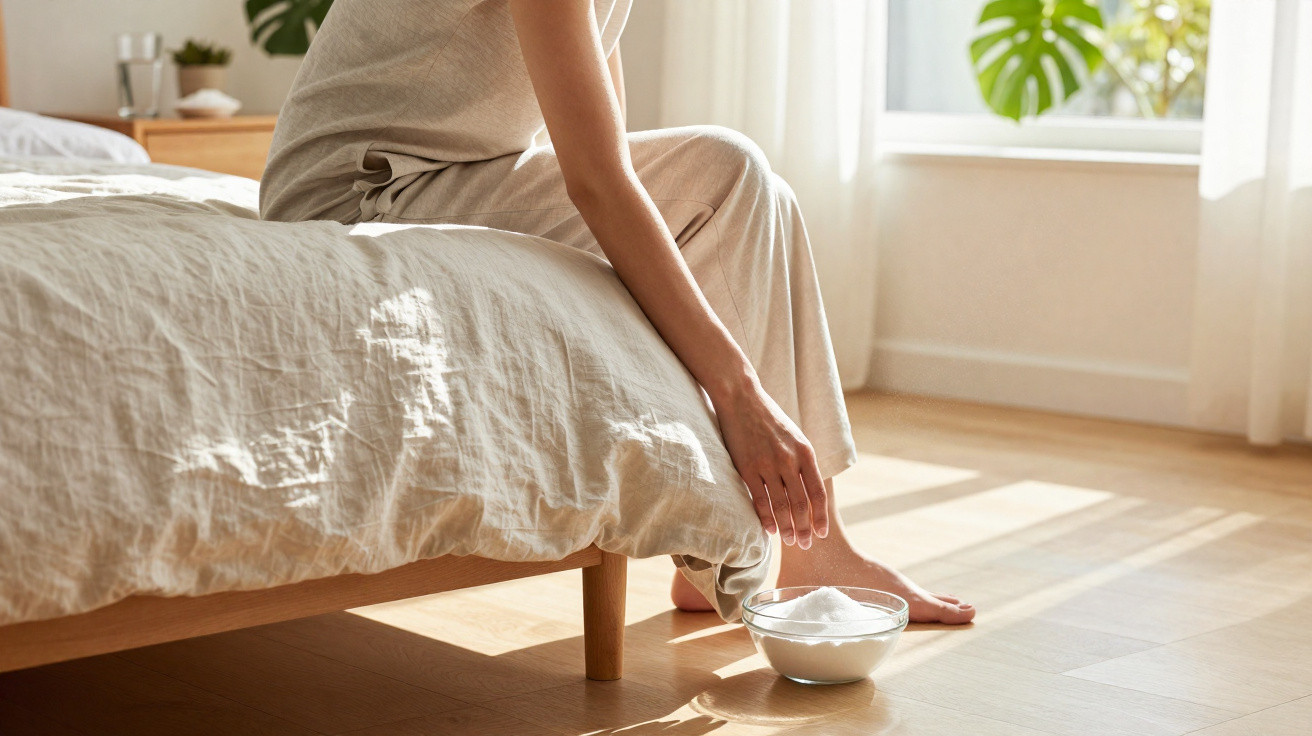
The first time I heard somebody suggest, “Just slip a bowl of baking soda under your bed,” I laughed. It seemed like the sort of TikTok tip that vanishes as quickly as it appears. But then I considered the stale odour in my bedroom, the mornings when I woke feeling groggy, and the dust bunnies beneath the frame acting as though they owned the place. Even after changing the bedding and leaving the window ajar, the air still seemed heavy.
One evening, driven more by curiosity than belief, I gave it a go. I put ordinary white powder in a small bowl and quietly tucked it near the headboard. There was nothing costly or magical about it.
By the third morning, the room did not smell “fresh” in a fragranced sense. It simply smelt like… nothing. Clean nothing.
That was the point at which I began to notice what this modest white powder was actually doing beneath the bed.
Why a bowl of baking soda under your bed can change the room
When you enter a bedroom that has not been aired for several days, you notice it before the smell reaches you. The atmosphere feels slightly denser, as if it is holding invisible particles your body detects even when you cannot see them. Mattresses, carpets, dust, perspiration and pet dander combine into a background odour we tend to stop registering in our own homes. Our noses adjust, but our sleep often does not.
A basic bowl of baking soda functions like a quiet sponge. Night after night, it draws in surplus moisture and captures persistent acidic odours clinging to textile fibres. You cannot hear it at work. Instead, you find the room seems lighter and less “used”. That can alter how you settle down to sleep.
Imagine a family living in a compact city flat, with a bedroom window looking out on a noisy road. Because of traffic and dust, they seldom open it overnight. Within a few months, the room develops its own recognisable scent: washing detergent, body warmth and a trace of food drifting in from the kitchen. They clean, use air freshener and change the sheets, yet the smell returns by evening.
One weekend, the mother comes across an old-fashioned online suggestion: put bowls of baking soda in stuffy rooms. She places one beneath every bed, using half a cup in each bowl. A week later, she realises she is relying less on aerosol spray. Her teenage son is less likely to complain that his room smells “like a locker”. She does not consciously think about the bowls each day. She simply finds the home easier to breathe in.
The reasoning is straightforward, almost dull. Baking soda, also known as sodium bicarbonate, is a gently alkaline powder. Many household odours are caused by acidic compounds in the air or attached to fabrics. The powder neutralises these acids, converting them into harmless salts without a smell. Its granular form also takes up a little moisture from the surrounding air.
That modest, localised shift is useful under a bed. Airflow is limited there, dust collects more readily, and the area is often warmer. A bowl of baking soda provides low-tech support for the air. It has no fragrance, fan or noise: just reduced odour, marginally drier air and an under-bed area that is a little less welcoming to mustiness and dust mites.
How to use baking soda under your bed without creating extra work
The process could hardly be simpler. Choose a clean, dry bowl or ramekin that is sturdy enough not to topple when the bed is moved. Add 4 to 6 tablespoons of baking soda, creating a decent layer across the base. Carefully slide it beneath the bed, preferably towards the middle or nearer the headboard, where your head rests at night.
Keep the bowl uncovered, with no lid or covering. Exposure to the air allows the baking soda to trap odours gradually. Every 3–4 weeks, remove the bowl, put the used powder in the bin and refill it with fresh baking soda. The old powder may appear slightly more clumped together, which indicates that it has been doing its job.
This little routine is easier to maintain when you attach it to something you already do. Replace the baking soda when you change the sheets, for instance, or when you vacuum the bedroom. After all, nobody genuinely carries out these tasks every day.
Some people prefer two bowls beneath a larger bed, with one beside the headboard and another nearer the foot. If pets like to sneak under the frame, position the bowls further into the centre so they are less appealing. You can also scatter a slim line of baking soda around the inside rim of the bowl to limit spills if the bed is knocked or children play nearby. Such small measures make the tip easier to live with.
A few frequent mistakes can undermine the effect. One is attempting to “boost” it by wetting the baking soda or combining it with water. Once damp, it hardens into a cake and loses much of its capacity to absorb odours. The aim is dry exposure to the air.
Another mistake is assuming a bowl of powder will make up for never cleaning beneath the bed. Baking soda is a helper, not a miracle worker. If there is a thick layer of dust, old socks and perhaps that lost piece of dog kibble under there, begin with a simple clean. People can become impatient too: where a mattress or carpet has held odours for years, allow a few weeks. Odour memory does not change overnight.
“Baking soda is one of those old-school products that quietly outperforms half the fancy stuff on the shelves,” says a home-care coach who swears by low-tech tricks. “You don’t feel like you’re doing much, but the air tells you the truth a few days later.”
- Use plain, unscented baking soda – Cooking-grade powder is sufficient, so special products are unnecessary.
- Start with small amounts – For a standard room, a shallow layer beneath the bed is enough.
- Refresh regularly – Replacing it once a month is generally sufficient for ongoing benefits.
- Avoid mixing with vinegar under the bed – The reaction is useful for cleaning drains, rather than for quiet overnight use.
- Combine with light airing – Opening the window for even a few minutes in the daytime enhances the effect.
From fresher air to more peaceful nights
When a room no longer smells “busy”, something subtle changes. You enter it without your body tensing, and the air appears neutral, gentle and less loaded. For some people, that alone allows their shoulders to relax slightly before bed. We do not often link the air quality beneath and around the bed with sleep quality. Yet for hours every night, our brains are breathing in whatever remains there.
You may not immediately sleep for twelve uninterrupted hours, nor wake up feeling as though you are in a mattress advert. Even so, many people say they fall asleep more quickly in a room free from yesterday’s odours. There are no artificial scents or heavy sprays lingering in the throat, only calmer air. This can reshape your relationship with the bedroom, turning it into a space that restores energy rather than drains it.
| Key point | Detail | Value for the reader |
|---|---|---|
| Odour neutralisation | Baking soda absorbs and neutralises acidic odours beneath and around the bed | A fresher bedroom without perfume or harsh sprays |
| Moisture balance | Dry powder lightly absorbs ambient humidity in a space with limited airflow | Reduced mustiness and more comfortable breathing at night |
| Low-cost habit | A simple bowl, a few tablespoons of powder, refreshed monthly | An easy, sustainable routine that improves home comfort over time |
FAQ:
- Question 1 How much baking soda should I put under my bed?
- Answer 1 A shallow bowl containing 4–6 tablespoons is enough for a standard bedroom. For a larger room or one with strong odours, use two bowls holding the same amount each, at opposite ends of the bed.
- Question 2 Is it safe if I have pets or small children?
- Answer 2 Baking soda is generally low-toxicity, although it is not intended to be eaten in large quantities. Keep the bowl where children and pets cannot readily reach it, ideally in the centre beneath the bed. If your pet enjoys crawling under there, choose a heavier, more stable container.
- Question 3 How often should I change the baking soda?
- Answer 3 For most homes, every 3–4 weeks is suitable. If the powder has clumped or bedroom odours return sooner, replace it more often, such as every two weeks during very humid seasons.
- Question 4 Can I add essential oils to the baking soda?
- Answer 4 Yes, a few drops can be added and mixed through, but bear in mind that baking soda’s main purpose is neutralising odours rather than merely concealing them. If using oils, apply them sparingly and test first so the scent does not become overwhelming while you sleep.
- Question 5 Will this replace airing out my bedroom and cleaning?
- Answer 5 No. Treat it as a quiet ally rather than a substitute. Regular airing, vacuuming under the bed and changing sheets remain essential. Baking soda supports those efforts by keeping the under-bed area drier and less smelly between cleans.

Comments
No comments yet. Be the first to comment!
Leave a Comment