
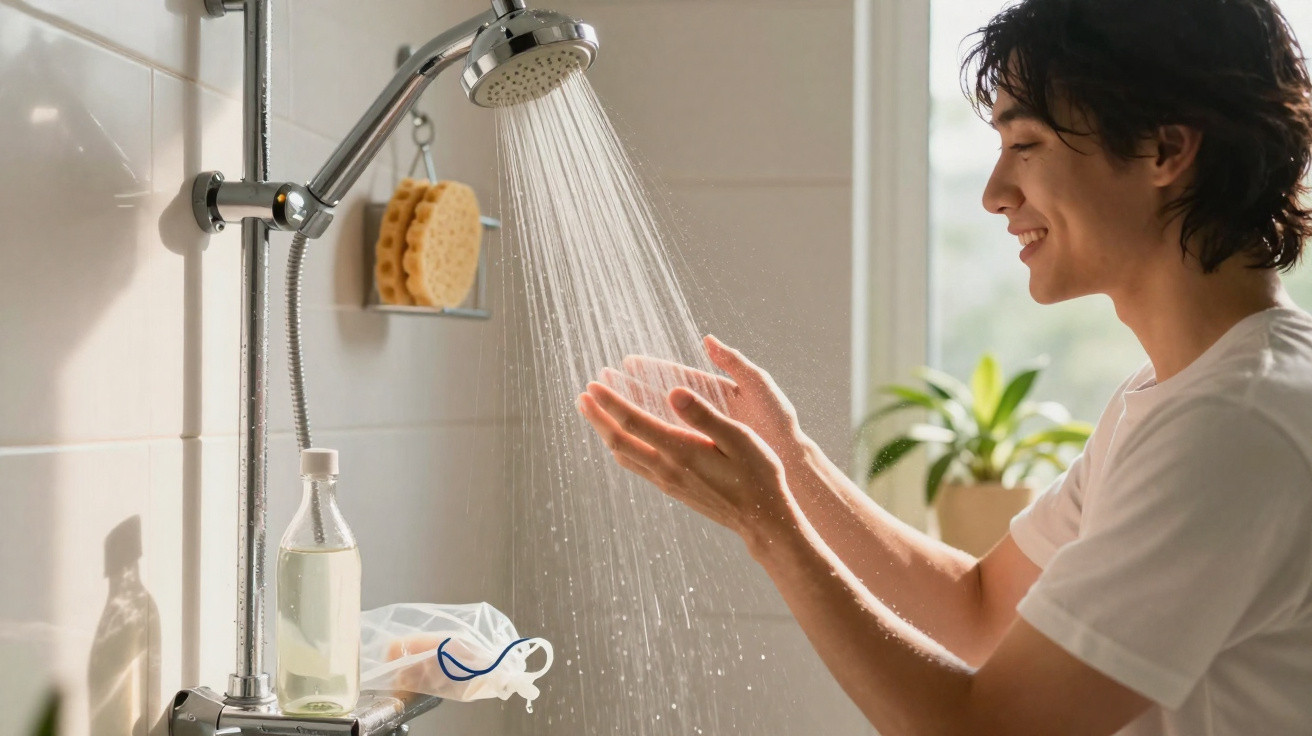
No tools, no plumber and no weekend stuck in DIY limbo. All you need is the faint tang of a chip shop and a rubber band.
It began on a weekday morning, with water emerging in the sort of trickle you would expect from an uninterested tap. Standing there with shampoo in my hair, I wondered when a perfectly decent shower had turned into a courteous mist. The nozzles were visibly crusted with chalk-white specks: harmless-looking, but anything but. I pressed a finger against one jet and felt almost no force. It was not pressure so much as a whisper. Later, prompted by instinct and a deadline, I searched the cupboard, took out white vinegar, filled a plastic bag, and secured it over the showerhead like a cap. It soaked while the day went on. By that evening, the shower sounded like rain hammering a tin roof. It was a small trick with a major result, thanks to one unusual detail.
The hidden cause of weak showers
Hard water is common in British homes, particularly throughout the South and East. Its minerals travel with the water before settling in the places that make their presence obvious: the kettle, taps and showerhead. This pale residue has a rather innocent name - limescale - yet it works like grit inside a clock. Openings become narrower and the water flow loses its force. It does not happen overnight; the change creeps in week after week, until your shower feels more like an apology than a wash.
Most of us have experienced stepping beneath the shower and feeling short-changed by our own bathroom. In my case, several jets were completely blocked, others sprayed in strange directions, and the centre stream was as fine as thread. Long-established water maps show that a large part of England lies in hard-water areas, while Londoners know kettle film all too well. A friend in Reading said she replaced her showerhead twice in one year before testing this vinegar soak. She insists it transformed hers from “barely a mist” to “hotel energy”.
Limescale may be persistent, but it is not invincible. The chalky layer is calcium carbonate, which sticks to the narrow channels inside the showerhead. Water can still reach the head, but resistance increases exactly where it has the greatest effect: at the tightest turns and smallest holes. The acetic acid in vinegar breaks down this coating on contact, lifting it from the surfaces and opening the jets again. What feels like greater “pressure” is actually reduced resistance and clearer routes for the water. Nothing changed in the pipes; the outlets changed.
The white vinegar + plastic bag method
This is the precise method. Half-fill a small food bag with distilled white vinegar - the standard 5% type. Place it over the showerhead so every nozzle sits below the vinegar, then secure the bag using a rubber band or hair tie. If the showerhead is easy to unscrew, it can instead be soaked in a bowl, but the bag approach requires less effort. Allow 45–60 minutes for light build-up, or 2–4 hours for heavily crusted showerheads. Rinse using warm water, gently brush the nozzles with an old toothbrush, and run the shower hot for a minute. The initial burst may eject small chalky flakes. That is the sound of victory.
A few small adjustments make the process more effective. Position the bag so that all nozzles remain submerged rather than left above the liquid. For brass, gold or nickel finishes, use brief soaking times and wipe the surface promptly afterwards. Never mix vinegar with bleach - not now, not ever. A wooden cocktail stick can dislodge stubborn particles from silicone nozzles without splitting them. If your hand shower has a filter washer where the hose connects, remove it and rinse it, as grit often collects there. Realistically, hardly anyone does this weekly. In hard-water areas, cleaning every couple of months is more than most households achieve, and it is generally sufficient.
Once I removed the bag, the chip-shop smell was unmistakable, but the jets appeared noticeably different: brighter and less dull. I switched on the water, and the spray struck my palm with a pleasing thud. It felt like I’d installed a new shower for the price of a sandwich.
“Vinegar won’t boost your incoming mains pressure,” a plumber told me, “but it frees the showerhead to deliver what your system already has. Clean head, clean flow.”
- Bag + vinegar soak: 1–4 hours depending on build-up
- Soft brush on nozzles: 30 seconds
- Hot flush after: 1–2 minutes
- Repeat: every 6–10 weeks in hard-water postcodes
What this small showerhead fix reveals about home care
There is a reason this trick took off on social media: it is inexpensive, fast and effective before your tea has even gone cold. It also pushes back against the belief that improving daily life requires costly gadgets or a service call. Once you free a blocked system - be it a showerhead, your brain or a calendar - everything runs more smoothly. The water did not merely feel more powerful; the whole morning felt easier. This is not magic, either. It is simply maintenance in a bag. Pass it on to the friend who keeps saying they will rip out their bathroom, or the renter who assumes they must put up with a drizzly shower. Sometimes the most sensible upgrade costs pennies and smells of vinegar.
| Key point | Detail | Benefit for the reader |
|---|---|---|
| Soak time matters | 45–60 minutes for light scale, up to 4 hours for heavy build-up | Matches the effort to the issue and saves time |
| Finish-friendly approach | Shorter soaks on brass/nickel; rinse and dry immediately | Protects costly fittings while still cleaning |
| Don’t mix chemicals | Never combine vinegar and bleach; rinse between products | Keeps the bathroom safe and the air breathable |
FAQ:
- Will vinegar damage my showerhead? Standard 5% white vinegar is suitable for short soaks on chrome and stainless steel. For brass, gold or nickel, keep the soak brief and wipe dry afterwards, or use diluted vinegar.
- How long should I soak it? Begin with 45–60 minutes. Severe limescale can require up to 4 hours. Check it halfway through; if the crust wipes away, the job is complete.
- Does this actually increase water pressure? It improves flow by removing blockages. Your mains pressure remains the same, but the shower can finally provide it. The difference can often feel dramatic.
- Can I use any vinegar? Distilled white vinegar is the best option. Malt vinegar has a stronger smell and may stain light-coloured silicone. Citric acid dissolved in warm water is a good alternative.
- How often should I do it? Every 6–10 weeks in hard-water areas. In regions with softer water, a quarterly clean is normally sufficient.



Comments
No comments yet. Be the first to comment!
Leave a Comment