
White tiles, gentle pop music and the light scent of citrus cleaner. Above the usual toilet roll, a second roll rested in a narrow transparent case, marked in bold blue lettering: “For your future self.”
A young office worker emerged just before I went in, quietly laughing as she photographed the arrangement. “Why didn’t we have this in 2020?” she said to her friend. They walked away, but her remark lingered like an unwritten headline.
Japan had, discreetly, done it again: taken an everyday item that most of us no longer notice and adjusted it just enough to seem almost revolutionary. It is a minor change in paper and cardboard, but one that reveals a great deal about modern life.
And it makes you wonder why nobody thought of it earlier.
Japan’s understated toilet paper revolution
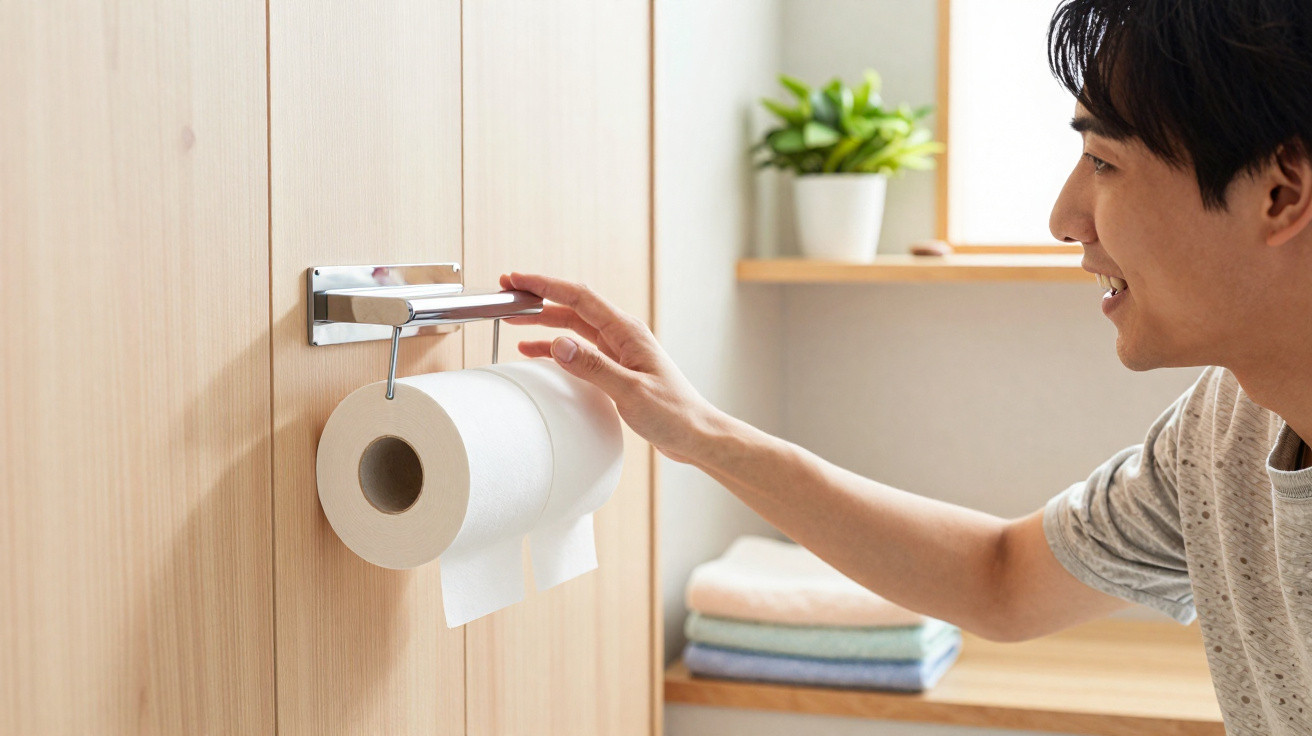
At first glance, Japan’s latest toilet-paper innovation appears unremarkable. It is still a white roll, still suspended on the wall, still quietly doing its job. The difference lies in its design and intended use. Many shops and public facilities now combine an ordinary roll with a “backup roll” in an intelligent, compact double-holder, keeping the spare sealed, hygienic and ready for use.
The concept seems almost too obvious. However, it addresses three common frustrations at the same time: finding an empty roll, wasting partly used rolls in busy washrooms, and panic-buying driven by memories of shortages. Instead of encountering a bare cardboard tube, people find a reassuring reserve already built into the wall.
At certain trial sites, the reserve is not even a conventional roll. It is an ultra-long new “mega core” version, designed to last up to three times as long while fitting the same holder. It occupies no additional space, needs replacing less often and creates fewer empty-roll emergencies. It is exactly the sort of understated engineering flourish Japan is known for.
One Tokyo supermarket chain recently released internal figures after fitting the double-holders and changing to longer rolls in staff and customer toilets. Within a month, maintenance teams said their refill rounds had fallen by nearly 40 percent. That meant fewer urgent reports of “no paper on the third floor” and less time struggling with jammed dispensers at busy times.
Customers noticed the change as well. Images of neatly stored spare rolls behind clear covers began appearing on Japanese social media, alongside comments such as “Where was this during the toilet paper wars?” and “This is the energy I need in my life.” A TikTok video showing a hand sliding a sealed reserve roll into place gained hundreds of thousands of views in only a few days, largely from overseas users asking, “Why don’t we have this?”
Manufacturers point to another benefit behind the scenes: fewer cardboard cores, reduced packaging and substantially fewer partially used rolls discarded in high-traffic toilets. Buying a 12-pack of the new mega rolls gives shoppers an amount that previously occupied the space of 24 or even 30 standard rolls. In compact city flats, that practical saving matters more than any sustainability-report buzzword.
In functional terms, the innovation is based on three principles: capacity, backup and clarity. The mega core roll adds capacity without requiring a different, oversized dispenser. The backup system, usually kept in a slender dust-proof compartment beside or above the main roll, quietly assures users that nobody will be caught out halfway through a toilet break. Straightforward labels, frequently in Japanese and English, explain the process: “Use this one first. When empty, pull here.”
This is more than a piece of hardware. The arrangement subtly shapes behaviour. Users are less inclined to leave a nearly finished roll because there is a clear next action: use the first one completely, then release the reserve. For facilities managers, this consistent pattern makes stock levels easier to predict and reduces the irritating situations where rolls are “90% used but not quite empty” and replaced unnecessarily.
The psychological effect is understated but genuine. Following the global toilet-paper panic of 2020, an organised and visible reserve speaks to a strong desire for security. It signals that somebody has planned ahead on your behalf. In a space as personal as a washroom, that small piece of foresight can feel surprisingly reassuring.
How Japan’s toilet paper idea quietly changes daily life
For households, the Japanese model is already encouraging simple imitation. One habit families are borrowing from convenience stores is assigning a small, clearly labelled place for a “next roll” within easy reach of the toilet. Rather than a haphazard pile beneath the sink, it is one clean, visible and almost ceremonial spare. Think of it as the domestic version of the double-holder.
Some households are even recreating the sealed-reserve design with transparent containers or simple wall-mounted boxes. The roll is visible, clearly unused, and-most importantly-you know precisely when to add another because the backup space is empty. That modest visual prompt brings more calm to a bathroom than any passive-aggressive message stuck to the door.
Japan’s mega rolls also point towards a wider change in thinking: shop a little more intelligently, store things a little more effectively and plan only one step ahead. Not five steps ahead, and not a doomsday store cupboard filled with paper. Just enough of a safety margin to make rushed mornings and late-night emergencies easier for everyone sharing a home.
This is where the emotional dimension becomes apparent. On a difficult day, discovering an empty roll can feel like one more tiny disaster added to everything else. In a television segment, someone in Osaka described how their elderly mother had once been left without paper in a station toilet and subsequently dreaded using public washrooms. After stations introduced the backup system, that anxiety diminished. “She still checks, but she doesn’t panic,” the daughter said.
More routinely, the innovation also deals with the low-level domestic disputes familiar to many couples and flatmates. Who “never” replaces the roll? Who leaves the last few miserable sheets for somebody else? The Japanese approach reframes the task: it is less about replacing rolls continuously and more about preserving a dependable reserve. That small adjustment reduces the tension surrounding a remarkably minor household object.
There is a sustainability element too. Longer-lasting rolls that work with existing holders mean fewer plastic-wrapped multipacks, fewer delivery journeys and less storage required in small homes. One Japanese brand estimates that its extended rolls reduce cardboard-core use by roughly a third over a year for a typical family. Those figures will not save the planet on their own, but they steer habits in a better direction without demanding any loss of comfort.
“We realized people weren’t just buying toilet paper,” explained a product manager from a major Japanese brand in a local interview. “They were buying the feeling of not running out.”
Viewed in that way, useful everyday measures become more obvious:
- Keep precisely one visible reserve roll in each bathroom instead of an untidy pile.
- Select higher-capacity rolls that still fit your holders, particularly in small flats.
- Replace arguments about who changed the roll with a shared rule: finish the first, prepare the second.
Let’s be honest: nobody really does this every day. No one inspects their bathroom supplies with military precision. Yet small, visible cues lessen the need for self-discipline in the first place. That is the Japanese arrangement’s hidden brilliance: it makes the simplest action the most sensible one as well.
Why the rest of the world is paying attention
The global interest is not solely in the physical product, but in what it suggests about preparedness. Memories of empty supermarket shelves remain fresh in many countries. When photographs of orderly Japanese washrooms with calm, visible backup rolls began spreading, they struck a chord far beyond specialists in hygiene design and retail management.
People saw a culture learning quietly from a frightening experience, then adapting a humble daily object so that the same anxiety would not return as sharply next time. It is the reverse of a flashy gadget launch: no app, subscription or QR code. Only a wall, a roll and a reserve.
The idea is particularly easy to share because it translates so readily. Nobody needs to import a Japanese toilet to adopt the principle. A clearly defined backup space, a better-fitting roll and a straightforward household rotation rule can create the same gentle sense of security. It is the kind of small improvement people enjoy posting with the caption, “Why did we wait so long for this?”
The innovation also prompts a quiet question about other aspects of daily life that are treated as unchangeable. If toilet paper, an old and unexciting product, can receive a useful upgrade in 2026, what else is sitting in plain sight waiting for someone to ask: “What if we just make this a little kinder to live with?” Kitchens, bin bags, light bulbs and even how waiting rooms provide tissues could all be reconsidered.
At a deeper level, Japan’s toilet-paper shift responds to a shared wish for kinder infrastructure: systems that do not shout or scold, but simply support us a little more when things go wrong. Perhaps that is why this story continues to circulate through feeds and group chats. It is not really about paper. It is about the feeling that, for once, the world has thought one step ahead for us.
| Key point | Detail | Why it matters to the reader |
|---|---|---|
| Backup roll system | A visible, clean second roll built into the holder | Reduces no-paper emergencies and household tension |
| Mega core design | Longer-lasting rolls that fit standard fixtures | Fewer refills, less storage space and lower waste over time |
| Behavioural nudge | Clear prompts that encourage users to finish one roll before releasing the next | Makes good habits easier and more dependable |
FAQ:
- What exactly is Japan’s new toilet-paper innovation? It combines higher-capacity “mega” rolls with smart double-holders that keep a sealed backup roll visible and ready, making a reserve an integrated feature rather than an afterthought.
- Can I get the same setup outside Japan? The exact hardware may not yet be available everywhere, but the principle can be copied with a wall-mounted spare-roll holder, a simple box or a visible shelf reserved for one backup roll.
- Is the new system really more eco-friendly? Brands say that longer-lasting rolls require fewer cardboard cores and less packaging per use, while waste from partially used rolls in public places falls significantly.
- Does this require special Japanese toilets to work? No. The idea concerns the roll format and holder design alone, rather than high-tech bidet seats or plumbing.
- Why are people online so excited about something so basic? It addresses a universal frustration-running out at the worst possible moment-and turns it into an elegant, straightforward solution that anyone can grasp at a glance.
Comments
No comments yet. Be the first to comment!
Leave a Comment