
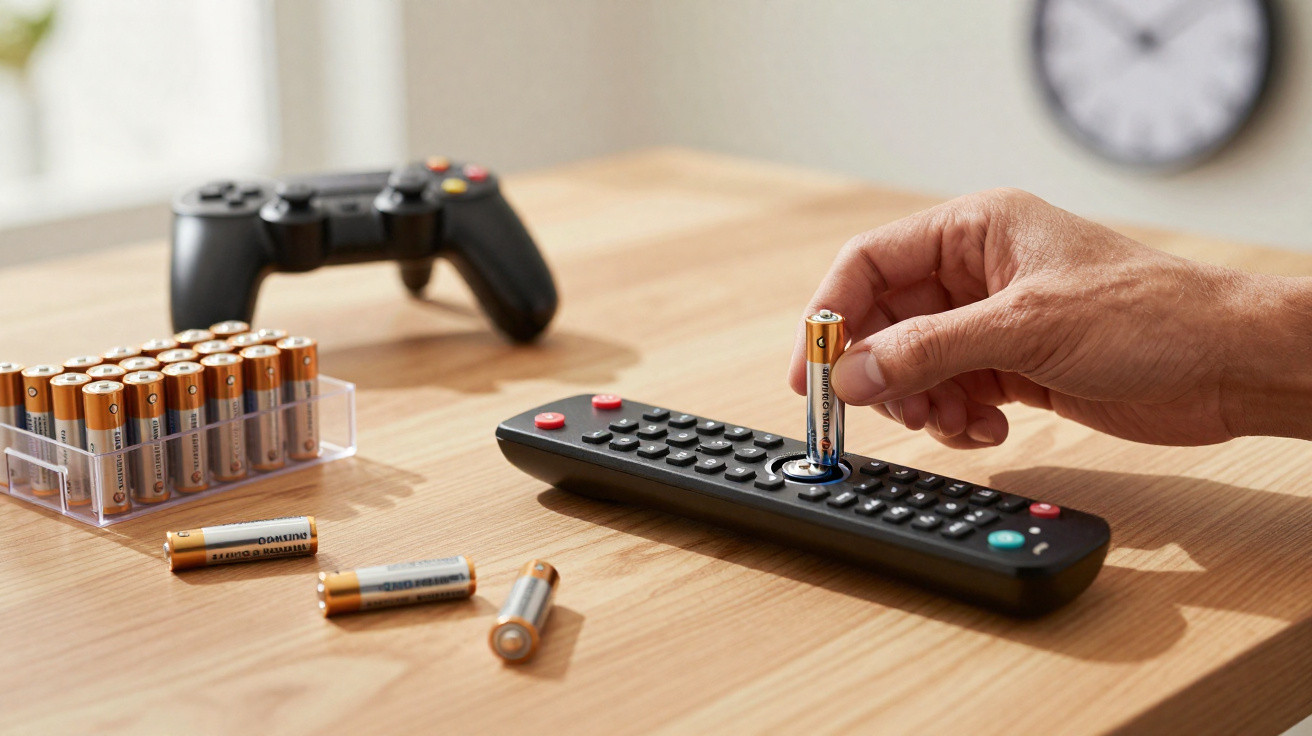
Modern battery size classifications and names emerged from the need to standardise components used in electronic equipment. As industry progressed throughout the 20th century, manufacturers and regulatory bodies recognised that allowing every company to use its own battery formats for radios, torches and other devices would be impractical. Establishing a single system helped organise the market, cut costs and make battery replacement easier at home and at work.
How does the battery letter system work?
Within this system, cylindrical batteries became the most familiar standard, used in remote controls, toys, clocks and countless portable devices. Each size was assigned a specific name linked to its physical dimensions and energy capacity.
The lettering system was designed to arrange sizes simply: A, B, C and D referred to cylindrical batteries from the smallest to the largest. As more compact formats became necessary, AA, AAA and AAAA were introduced, following the same miniaturisation logic as devices became smaller.
Watch a video from the YouTube channel Manual do Mundo about how cells and batteries work. It simply explains the differences in size, voltage and capacity:
https://www.youtube.com/watch?v=bFw0vN-G3oI
Why has the AA battery become so widely used every day?
The AA battery is now one of the most common formats in homes and offices, offering a balance between power and compactness. In many devices, two or four AA batteries provide sufficient power for long periods, particularly alkaline versions or rechargeable nickel-metal hydride (NiMH) cells.
Several factors help explain why this size has become standard across so many different products:
- Versatile use: suitable for devices with low to medium energy consumption.
- Global availability: sold in supermarkets, pharmacies, electronics shops and small local retailers.
- Range of technologies: available as alkaline batteries, rechargeable NiMH batteries and other modern variations.
- Broad compatibility: used in toys, wireless mice, TV remotes, portable torches and electronic instruments.
What changed in the use of A and B batteries over time?
Although most people are familiar with AA, AAA, C and D batteries, the older A and B battery types have almost disappeared from everyday use. They were common in valve radios and equipment from the earliest generations of domestic electronics, where different sets of batteries powered separate parts of the circuit.
As semiconductors advanced and components became smaller, devices began using less energy and required more compact formats. The AA battery gained ground because it suited new designs, while C and D batteries remained in niches requiring greater capacity. A and B batteries became limited to restoring vintage equipment and specialised hobbies.
How can you identify and store an AA battery correctly in devices?
When dealing with a new remote control or recently purchased toy, identifying the battery type is essential to prevent faults. The product itself normally states the required standard, with markings such as “2 x AA” beside the battery compartment, as well as instructions in the manual and on the packaging.
A sensible approach is to store AA and AAA batteries separately in dry, well-ventilated places, away from excessive heat, and not to combine new and used batteries in the same device. Removing batteries from equipment that will remain unused for long periods helps prevent leaks. Even as lithium batteries become more widespread in smartphones and laptops, the AA battery remains relevant in 2026, powering thousands of simple products that still rely on a standard created almost a century ago.






Comments
No comments yet. Be the first to comment!
Leave a Comment