
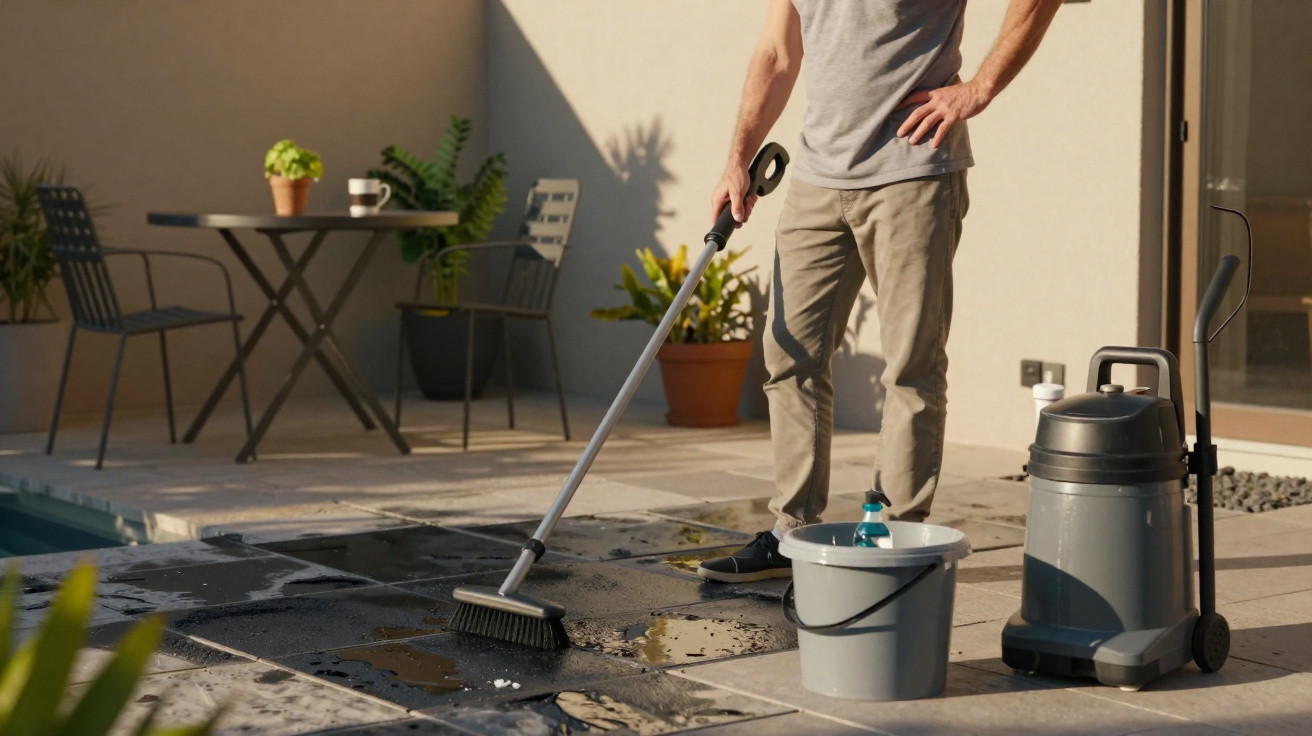
Paul did not notice the blue sky first when he opened the curtains. His attention went straight to the embarrassing grey state of the patio. Tiles that had once been pale and spotless now resembled an old washing-up sponge left in the sink for far too long. Algae, black marks, greasy barbecue footprints and a greenish coating had settled into the grout like unwelcome memories.
He went outside in his slippers with a coffee and felt a faint stickiness beneath his feet. The route to the shed, the garden steps and even the small paved area beneath the swing all looked faded, dark and worn out.
The sun had returned, friends were messaging about summer drinks, and his outdoor flooring looked rather like a greasy cooker hood.
He had to do something.
A blackened patio: when the ground looks older than the house
Paul’s experience is far from unusual. During the first year in a new home, you sweep the patio lovingly. You rinse it, protect it and practically have conversations with it. Then the winters accumulate, barbecues become more frequent, the dog races about, moss takes hold in the corners and, eventually, you properly look at the paving again.
That is when the shock arrives.
Beige stone has become charcoal grey. Concrete that was once pale and unfinished looks scorched. The small blocks on the route to the compost heap are nearly slippery underfoot. You crouch down and rub a finger across them. A black smear comes away, revealing a lighter strip beneath. Under all that build-up, you realise, the patio is still there. It has simply been buried.
Most of us know that moment when a patio resembles the “before” image in a cleaning-product advert. You search online for “clean blackened patio” and quickly disappear into a maze of conflicting recommendations. Pressure washer! No, never use a pressure washer: it damages everything. Bleach! No, it is harmful to pets and plants. Bicarbonate of soda, white vinegar, soda crystals, miracle cleaning products at £19.90 per litre.
The neighbourhood WhatsApp group is no more helpful. Patrick insists his pressure washer is “the best investment of his life.” Marie responds with photos of joints ruined by exactly that machine. One person refers to a mysterious “soft wash” approach spotted on TikTok, while another posts a link to a council leaflet about polluted run-off water.
By the time you put the phone down, the patio remains dirty. Your mind, meanwhile, is overflowing.
Behind this Babel of advice lies a straightforward fact. A patio is not merely a floor. It combines different materials, angles and tiny cracks, as well as living organisms. Spores, algae, lichens, pollution particles, barbecue grease and decaying leaves create the ideal mixture for a black, sticky and slippery film.
Every cleaning approach deals with certain enemies more effectively than others, but usually at a cost: time, money, risk to the surface or strain on your body. This is why views are so divided over “the easiest way” to clean it all. Easiest for whom? Your muscles, your budget, your Saturday afternoon, or your conscience when the foam disappears into the drain?
The simple truth is that there is no magic solution. What matters is finding the right balance.
Pressure washer or soft cleaning: the best approach for your patio and your back
A professional cleaner visiting Paul’s neighbourhood explained the difference with a single gesture. He placed one hand on the pressure-washer lance and the other on a bucket holding detergent and a long-handled brush. Then he said: “This is speed.” And, “This is control.”
The pressure washer is the Saturday-morning hero. Connect it, squeeze the trigger and the black streaks fly away in broad, satisfying strips. It is noisy, spray gets everywhere and your shoes end up soaked, but the result appears immediately. On tough, dense surfaces such as good-quality concrete or stone, it can be highly effective when used from a sensible distance.
However, on softer slabs, ageing joints or reconstructed stone, that same force can leave gouges, cause chips and strip the sand from between the blocks. Quick today, costly tomorrow.
The “soft” approach appears slower and more traditional, but it is also more sustainable. Use warm water, a suitable patio cleaner or soda crystals diluted in a bucket, a medium-bristled long-handled broom, and steady, patient strokes. The product helps dissolve grease and organic residue, while the broom provides gentle mechanical action; rinsing with a hose then brings the result together.
It is less dramatic than the viral pressure-washing clips. You will not lift off black layers in five seconds. Instead, work in sections, allow the product time to act and brush again. The effort can also be spread out: tackle the dirtiest areas today and finish the rest next weekend. It becomes a routine rather than a fight.
Your back will notice the difference. A long handle avoids the bent-over scrubbing that puts strain on the lower back.
The divide is not only about equipment. It also comes down to how much effort people can tolerate, how perfect they want the result to be and how they use their outdoor space. Someone hosting large barbecues every Sunday may want a rapid, dramatic transformation. A keen gardener may be content with a lightly weathered patio, provided the paths are not slippery.
The most sensible approach often brings both methods together. Use a pressure washer at low to medium pressure on robust surfaces such as driveways, thick concrete and stone steps, keeping the lance well away from the surface. Reserve soft cleaning with a detergent and brush for delicate joints, shaded corners and paths beside flowerbeds, where plants and soil are nearby.
In reality, nobody does this every day. The aim is to replace “a desperate major clean every five years” with “one proper spring clean, followed by two or three lighter sessions during the season”.
Clean a blackened patio without finishing the day on painkillers
The habit that makes the greatest difference is almost absurdly simple: remain upright. Many people tackle blackened paths while bent double, sponge in hand, as though they are in a cartoon punishment scene. Ten minutes later, the lower back starts complaining and the motivation vanishes.
Replace the sponge with a stiff- or medium-bristled broom on a long handle, preferably an adjustable one. Prepare a bucket of hot water with a dedicated outdoor cleaner or diluted soda crystals - gloves are useful here. Lightly dampen the surface with a watering can rather than blasting it with a powerful hose. Work in small squares, using long, measured strokes instead of frantic scrubbing.
You are walking rather than crouching. Your arms direct the work and your legs provide the effort. By late afternoon, the contrast is striking.
People often make two familiar mistakes. The first is attempting the entire job in one day. With a large patio, garden paths, steps and a pool surround, you might begin at 9 am full of enthusiasm and finish at 4 pm exhausted, having rushed the final 10 square metres simply because you want it over with.
The second is choosing a product that is too harsh or too concentrated in the belief that it will save time. On certain stones, bleach or undiluted vinegar can damage the surface, discolour joints and put plants under stress. Physically, hours spent kneeling on hard paving without a kneeling pad can lead to aching knees and a bad temper.
Dividing the task into sections, alternating activities - some sweeping, some rinsing and some tidying - and working at your own pace may not sound glamorous, but it is what makes an intimidating job manageable.
“Since I stopped doing my terrace like a commando raid once every three years, my back thanks me,” laughs Lucie, 49, who has a large patio and two winding paths around her vegetable garden. “I do one side in April, one in May. I don’t aim for showroom perfection. I just don’t want anyone to slip, and I want it to look cared for.”
Begin with a test area
Select a small, discreet corner and test your chosen approach there. This shows how the material responds, how much effort is required and helps prevent unpleasant surprises halfway across the patio.Choose tools that suit your body
An extendable handle, an ergonomic grip, knee pads if kneeling is unavoidable, and a lightweight hose rather than dragging 20 metres of rigid pipe can all make a real difference to your energy levels by the end of the task.Consider where the rinse water will go
Water, foam and dirt must run somewhere: the lawn, flowerbeds, a drain or the road. Select products suitable for your garden and local requirements, and plan the water flow before beginning.
Spotless versus liveable: the real purpose of cleaning a blackened patio
Once the first grey layer has gone, something unexpected happens. The patio appears to breathe again. Garden paths regain their original colour, joints become visible and the house looks younger from outside. You can suddenly imagine the summer table, children playing on the ground and deckchairs brought out from the shed.
The central question is not merely “pressure washer or not?” It is what degree of cleanliness you genuinely want, and what physical effort you are prepared to spend achieving it. A catalogue-perfect patio may look appealing, but it will not be sustainable if it means kneeling every month with a toothbrush to clean the grout. A slightly weathered patio that is safe, non-slippery and regularly maintained is much more realistic when life already feels busy.
Every homeowner eventually finds a compromise: one larger, more thorough annual clean, plus brief targeted sessions after a storm, a large meal or the return of green film in shaded spots. Between the fantasy of a “before and after” transformation and the reality of your back and diary, there is a middle ground in which the patio becomes what it should be: somewhere to live, rather than an endless item on the to-do list.
| Key point | Detail | Value for the reader |
|---|---|---|
| Choose the right method | Combine controlled pressure washing on resistant areas with soft cleaning on fragile zones | Limits damage to slabs and joints while cutting cleaning time |
| Protect your back | Work standing with long-handled tools, in small zones, over several sessions | Reduces fatigue and soreness so the job feels manageable |
| Accept a realistic result | Aim for safe, clean, “lived-in” rather than showroom perfection | Less pressure, more consistency, and an outdoor space you actually enjoy |
FAQ:
Question 1 Can a pressure washer really damage my patio or garden paths?
Yes, on some materials. Old concrete, reconstructed stone and sanded joints may be worn away by excessive pressure or by holding the nozzle too close. Use a fan nozzle, maintain some distance and test a corner first.Question 2 Is white vinegar a good idea for cleaning blackened slabs?
Vinegar may help with light limescale or soap residue, but using large quantities on stone or concrete can eventually dull or weaken the surface. It is better used for isolated marks than as a general patio cleaner.Question 3 What’s the gentlest method if I have pets and lots of plants nearby?
Use warm water, a mild labelled outdoor cleaner - or well-diluted soda crystals - with a broom, then rinse thoroughly. Avoid bleach and highly acidic mixtures. Keep pets away until the area has dried completely.Question 4 How often should I clean my patio to avoid the “black crust” effect?
A thorough deep clean once a year, ideally in spring, followed by two or three lighter treatments of the most exposed or shaded areas, is generally enough to prevent severe build-up.Question 5 My patio is slippery when wet. Is that from dirt or the material itself?
It is often a combination of both. Algae and fine organic residue create a “soap” effect on the surface. Cleaning lowers the risk, although some very smooth tiles remain slippery. In that case, consider anti-slip treatments or textured mats in important places such as steps.
Comments
No comments yet. Be the first to comment!
Leave a Comment