
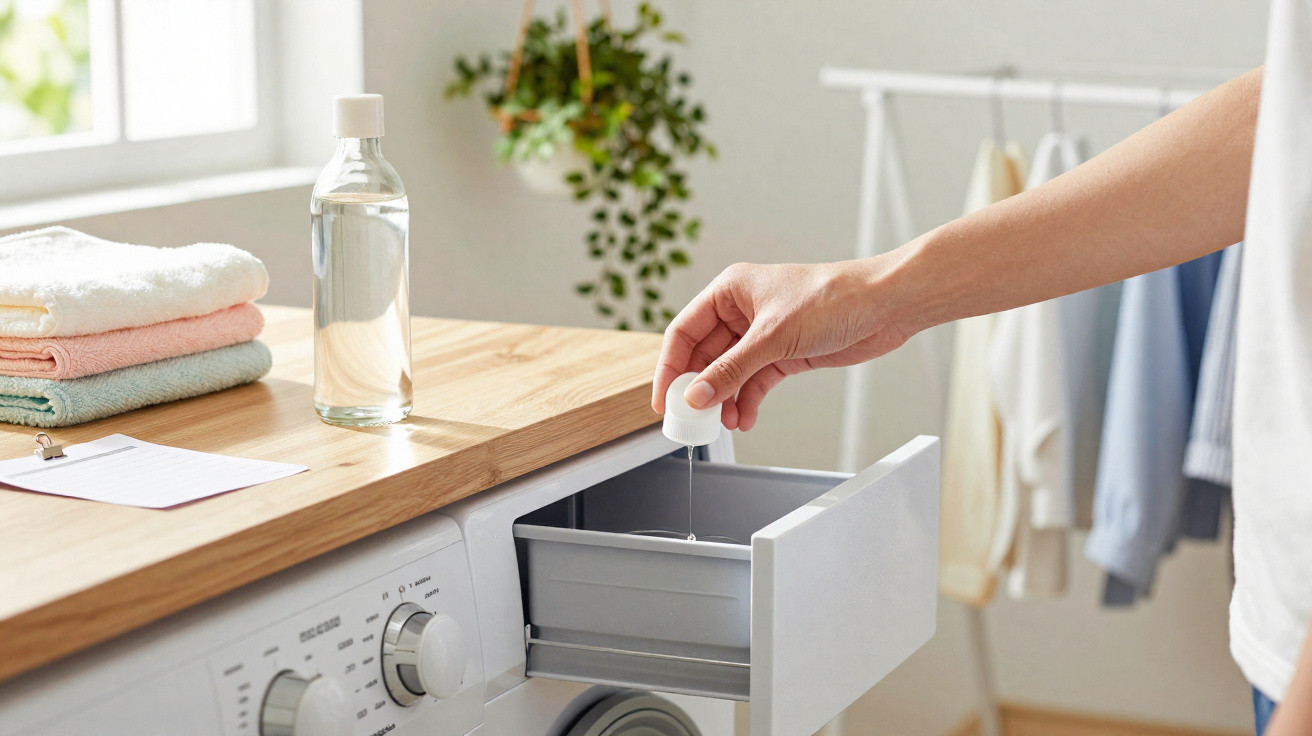
Everyone wants laundry that comes out genuinely fresh, with no trace of a damp gym bag. But today’s washing machines operate at lower temperatures, use less water and hold on to residue that quickly becomes sour. The answer is not cleaning tablets, costly gimmicks or spending all Saturday scrubbing. It is a small routine using an unassuming bottle probably already in your cupboard: the one you put on chips, not laundry. And it can be used with every wash.
Steam warms the hallway as the drum whirs and a pile of school shirts waits nearby. When the programme finishes, you lift a T-shirt to your face and notice it: a faint, swamp-like smell suggesting the washing machine needs attention. Pull back the rubber seal and there is that recurring grey layer of grime, still present however often you run a hot cycle.
I discovered this solution in an unglamorous setting: at a neighbour’s kitchen table, as she poured a capful from a 1-litre bottle of plain white vinegar. There was no fuss and no expensive label. She added it to the fabric softener drawer and said, “Every wash. Done.” It seemed far too minor to make a difference.
It did make a difference, and the science is oddly satisfying.
One capful of white distilled vinegar, a major difference
Modern washing machines are excellent at conserving water, yet they also retain residue brilliantly. Detergent leaves a fine sticky coating behind, which feeds smell-causing microbes and adheres to the drum, pipes and door seal. Adding one capful of white distilled vinegar to the rinse tackles the problem at its origin. It counteracts residual alkalinity, helps release the film and allows it to rinse away.
Consider Jenna from Leeds, who was convinced her washing machine was failing. Her towels smelled “like a cupboard in November,” and she could not afford a service visit that month. For one week, she used the capful method on six loads without changing anything else. The unpleasant smell began to disappear by the third load. After the sixth, the machine door smelled like... nothing at all. Her towels also dried more quickly. A modest amount brought a noticeable change.
The explanation is straightforward chemistry. Most laundry detergents are alkaline, while the acetic acid in vinegar moves rinse water closer to neutral. That change affects the residue, encouraging it to release from metal and rubber surfaces. A capful diluted in a drum of rinse water provides only a slight acidity, but it works quietly and reliably. Stainless steel is unaffected, as are plastics, while odours struggle to take hold.
How to add vinegar to your washing machine
Use one capful, roughly 10–15 ml, of plain white distilled vinegar. Before every wash, pour it into the fabric softener compartment so it is dispensed only during the rinse. If your machine has no dispenser, pause the cycle just before rinsing and pour it straight into the drum. The approach and small dose are the same for top-loading, front-loading and high-efficiency machines. If the washing machine already has a musty smell, first run an empty hot maintenance cycle with a cup of vinegar in the drum, then begin the capful-per-wash habit.
Use a small amount consistently. Never mix vinegar with chlorine bleach, not in the drawer, not in the same cycle. If you also use fabric softener, alternate between them: vinegar for one wash and softener for the next. Alternatively, leave out the softener, as many people find that towels are fluffier without it. Wipe the door seal weekly, leave the door slightly open between washes and clean the drawer each month. Realistically, nobody gives their washing machine a deep clean every day.
Some people are concerned about rubber seals. However, this is a very small dose delivered during the rinse rather than the main wash. One appliance technician described it like this:
“I see more damage from detergent overdosing than from a teaspoon of vinegar. Keep it small and keep it in the rinse-that’s the sweet spot.”
- Choose plain white distilled vinegar only, never malt or balsamic vinegar.
- Keep to 10–15 ml for each wash; using more is not more effective.
- Do not use it in a bleach load; use vinegar in the following cycle instead.
- If the washing machine is still under warranty, check the manual first.
- Leave the door and drawer open to air, as ventilation is half the solution.
The benefits you notice over time
There is an understated pleasure in a washing machine that smells of nothing. Your hallway is free from damp odours, while towels dry faster because residue is not weighing them down. Socks feel fresher around the toes. During a busy week, these unseen improvements count. You buy fewer washing machine cleaner tablets and no longer search for “why does my washing machine smell like eggs” at 11 p.m.
Most people have had to wash the same load twice in the hope that the smell will disappear. The capful routine breaks that cycle with something you can pour in before pressing Start. It is mild on clothes, considerate of the drum and well suited to the untidy reality of family laundry. For extra reassurance, make a hot maintenance wash a monthly habit rather than a dreaded cleaning task.
Perhaps that is why this tip travels from neighbour to neighbour rather than appearing in advertising. It is simply too ordinary to market. A bottle beneath your sink can keep a washing machine fresh, week after week. If everything else has failed, this may be the smallest experiment you try all year.
| Key point | Detail | Benefit for the reader |
|---|---|---|
| Ideal dose | 1 capful (10–15 ml) in the rinse every wash | A simple routine with no measuring jug or guesswork |
| Where to put it | Fabric softener drawer; it is released during the rinse | Protects fabrics and tackles residue at the right time |
| Precautions | Do not mix with bleach; use plain white vinegar only | Helps keep the machine safe and laundry hassle-free |
FAQ
- Will my clothes smell like vinegar? The smell disappears during the spin and evaporates as clothes dry. If you can still smell it afterwards, you have used too much; reduce the amount to one capful.
- Is this safe for rubber seals and hoses? Yes, at 10–15 ml in the rinse. The vinegar is heavily diluted when it reaches the seals. Most damage results from excessive detergent residue, rather than a small acidic rinse.
- Can I use it on every load, even delicates? Yes, for most fabrics. If you prefer to be cautious, avoid using it with silk and acetate, and never use it in a load containing chlorine bleach. It is suitable for cotton, synthetics and sportswear.
- Does vinegar replace fabric softener? It can do. Vinegar reduces residue and helps fibres feel smoother without leaving the coating that can make towels less fluffy. If you prefer scented fabric softener, alternate between the two.
- What if I don’t have white vinegar? Use distilled white vinegar only. Malt vinegar and apple cider vinegar may stain fabrics or leave smells behind. If you have run out, citric acid is a useful alternative: dissolve ½ teaspoon in water and add it to the softener drawer.




Comments
No comments yet. Be the first to comment!
Leave a Comment