
A simple reach for the kitchen cupboard is currently prompting discussion in German bathrooms – and quietly changing cleaning routines.
What initially sounds like a social-media gimmick is becoming an established household tip: toilet paper and vinegar. There is no costly specialist product or complicated set of instructions involved, only a surprisingly straightforward pairing. Many people are now asking whether it genuinely works and how it can be used safely.
The idea behind the toilet paper and vinegar trick
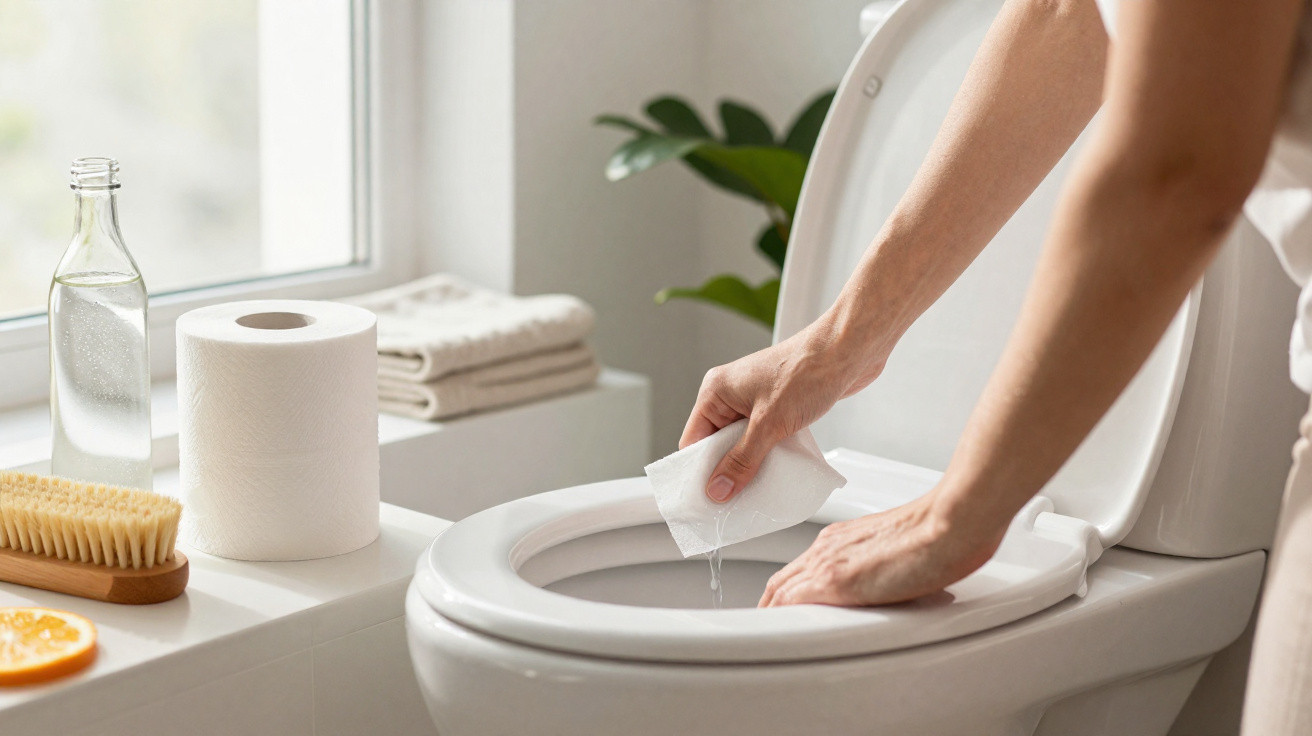
The principle behind this trend is easy to understand. Household vinegar is used with toilet paper to loosen limescale, urine scale and unpleasant odours in the toilet. The paper acts as a carrier and “sponge”, keeping the vinegar precisely where it needs to work: directly on the deposits.
The trick uses an old household ingredient – vinegar – in a new, targeted way: slowly, precisely and with very little scrubbing.
Users commonly say they use it particularly on stubborn marks below the water level or yellowish build-up around the ceramic rim. It may not look impressive, but in the best-case scenario the method saves time, money and the use of harsh chemicals.
How to use the trick step by step
Preparing the bathroom
Most versions require only a few items that are already found in many homes:
- Household vinegar or vinegar essence, diluted
- Toilet paper, preferably a slightly stronger type
- Rubber gloves
- Optionally, a small bowl or measuring jug
Anyone using vinegar essence should dilute it with water beforehand, generally at a ratio of 1:4 or 1:5. This keeps the mixture effective while making it less irritating and gentler on enamel and rubber seals.
Applying it around the toilet rim
The inside rim is a common problem area. Limescale builds up there quickly, yet it can be difficult to reach. This is where toilet paper is particularly useful.
A typical process is as follows:
- Put on rubber gloves.
- Tear or fold the toilet paper into long strips.
- Soak the strips in vinegar or diluted vinegar essence.
- Press the wet paper strips onto the inside rim of the toilet so that they stick in place.
- Leave them to work for several hours, ideally overnight.
- Remove the paper strips and flush the toilet.
The contact time determines how much work the vinegar can take off your hands. The longer the paper remains in position, the more limescale can loosen.
Treating the toilet bowl
Many people also use the trick inside the bowl itself. Darker deposits and urine-scale rings often collect just above the waterline. One approach is:
- Lower the water level slightly, using a cup or by pumping forcefully with the toilet brush.
- Shape toilet paper into small “parcels” and soak them in vinegar.
- Place or press these parcels directly onto the dirty areas.
- Leave them in place for several hours, then finish with the brush.
The effect comes not from force but from patience: the paper keeps the vinegar where cleaning products would otherwise quickly wash away.
Why vinegar works in the toilet
Vinegar contains acetic acid, which chemically attacks limescale deposits. Limescale, urine scale and many persistent marks are made up of mineral compounds that react to acids. This is exactly what the trick relies on: the acid gradually loosens the build-up layer by layer, while the paper serves as a “reservoir”.
In day-to-day use, this can bring several benefits:
- Less scrubbing with the toilet brush
- No need for strongly chlorine-based cleaners
- Reduced odours caused by ammonia and biofilms
There is another factor too: many people regard vinegar as a familiar ingredient. They know it from the kitchen and often feel more comfortable using it than chemical mixtures whose ingredients are difficult for most people even to pronounce.
Benefits compared with conventional toilet cleaners
The toilet paper and vinegar trick is based on simplicity. It differs noticeably from standard products sold in the cleaning aisle.
| Aspect | Vinegar + toilet paper | Conventional toilet cleaner |
|---|---|---|
| Cost | Very low; the products are usually already in the home | Regular repurchasing required |
| Odour | Vinegar smell, which fades after airing the room | Often heavily perfumed and sometimes irritating |
| Precision | Toilet paper holds vinegar exactly where needed | Cleaner runs off quickly, especially around the rim |
| Environmental aspect | Simple household substance that biodegrades well | Sometimes contains complex surfactants and fragrances |
Even so, one point remains clear: vinegar also has its limits with very heavy or old deposits. Such cases often require a combination of mechanical cleaning and specialist products.
Limits and risks of the toilet paper and vinegar trick
Although the trick sounds appealing, it is not entirely risk-free. Vinegar is still an acid. Using it at too high a concentration or soaking surfaces for too long can cause damage.
Do not combine vinegar with chlorine products or toilet blocks, as irritating fumes can form – clean one after the other rather than at the same time.
The following groups should take particular care:
- Homes with older toilets where the glaze already appears worn or damaged
- People with sensitive airways, because fumes may build up in small bathrooms
- Households with young children who could come across vinegar residue or soaked paper
Anyone who is uncertain should first test a small, inconspicuous area and reduce the contact time. Ventilating the room significantly reduces the smell.
Why the trick is going viral
The toilet paper and vinegar trend has emerged at a time when many people are rethinking their cleaning routines. Rising prices, greater environmental awareness and a desire to use fewer chemicals in everyday life are all contributing factors. It also has the appeal of being simple: anyone can try it without prior knowledge.
Ideas like this work particularly well on social-media platforms. The images are instantly understandable: a toilet, white paper strips around the rim and a bottle of vinegar beside it. The before-and-after effect can be shown in seconds. People who see a video of it can easily try it themselves.
Everyday practical scenarios
When guests are coming
A typical situation is unexpectedly announced visitors and little time for a major clean. In this case, many users apply vinegar-soaked toilet paper strips to the rim before going to bed and leave them overnight. In the morning, a quick pass with the brush is often enough to make the toilet look much better cared for.
A weekend routine instead of a cleaning marathon
Some users have developed set routines. They start the vinegar trick on Friday evening, allow it to work until Saturday morning, then spend five minutes on the finishing touches. This spreads out the task automatically, without having to spend hours in the bathroom at the weekend.
What to know about vinegar types and dilution
Shops sell different kinds of vinegar, some of which vary considerably:
- Household vinegar (5%): Milder and suitable for regular use and lighter dirt.
- Vinegar essence (20–25%): Highly concentrated and should always be diluted for use in the bathroom.
- Flavoured vinegars: Types such as balsamic vinegar are unsuitable for cleaning tricks because they can stain and leave sticky residue.
Anyone using vinegar essence really should dilute it. Over time, an excessively strong concentration can attack grout, rubber and certain metal components. For many homes, ordinary household vinegar is sufficient if it is given enough time to work.
Sensible combinations with other household remedies
Many people do not rely on vinegar alone, instead adding other everyday aids to the trick. Possible options include:
- Bicarbonate of soda or baking powder: Useful for odours. Add bicarbonate of soda to the bowl first, then pour in vinegar, allow it to fizz briefly, and then use the toilet paper.
- Washing-up liquid: A small squirt in the vinegar-and-water mixture can help lift greasy traces, for example around the rim.
- Rubber brushes: After the contact time, gentle brushing is often enough to remove the loosened residue.
One rule remains important: do not mix cleaning products indiscriminately. Anyone wanting to test different methods should flush and ventilate thoroughly between applications so that problematic reactions do not occur.
When other solutions make more sense
There are circumstances in which the toilet paper and vinegar trick reaches its limits, including:
- Drain pipes severely narrowed by urine scale in old buildings
- Brown iron deposits caused by water with a very high iron content
- Damage in the ceramic where dirt has become embedded
In these situations, a professional drain cleaner or specialist company may be the better option. The vinegar trick is then more suitable for prevention than for repairing damage that has built up over years.
The long-term effect of the trick
People who use this method regularly often report a side benefit: their overall cleaning routine becomes easier. Limescale rings develop more slowly because they are repeatedly tackled while still at an early stage. This reduces the number of major cleaning sessions involving prolonged work with a brush and aggressive products.
At the same time, some people become more aware of water hardness, grout quality and materials. Once they have seen how heavily limescale can build up, they also look differently at taps, shower heads and tile grout – and may partly apply the vinegar trick to other areas, naturally using an adjusted dilution.

Comments
No comments yet. Be the first to comment!
Leave a Comment