
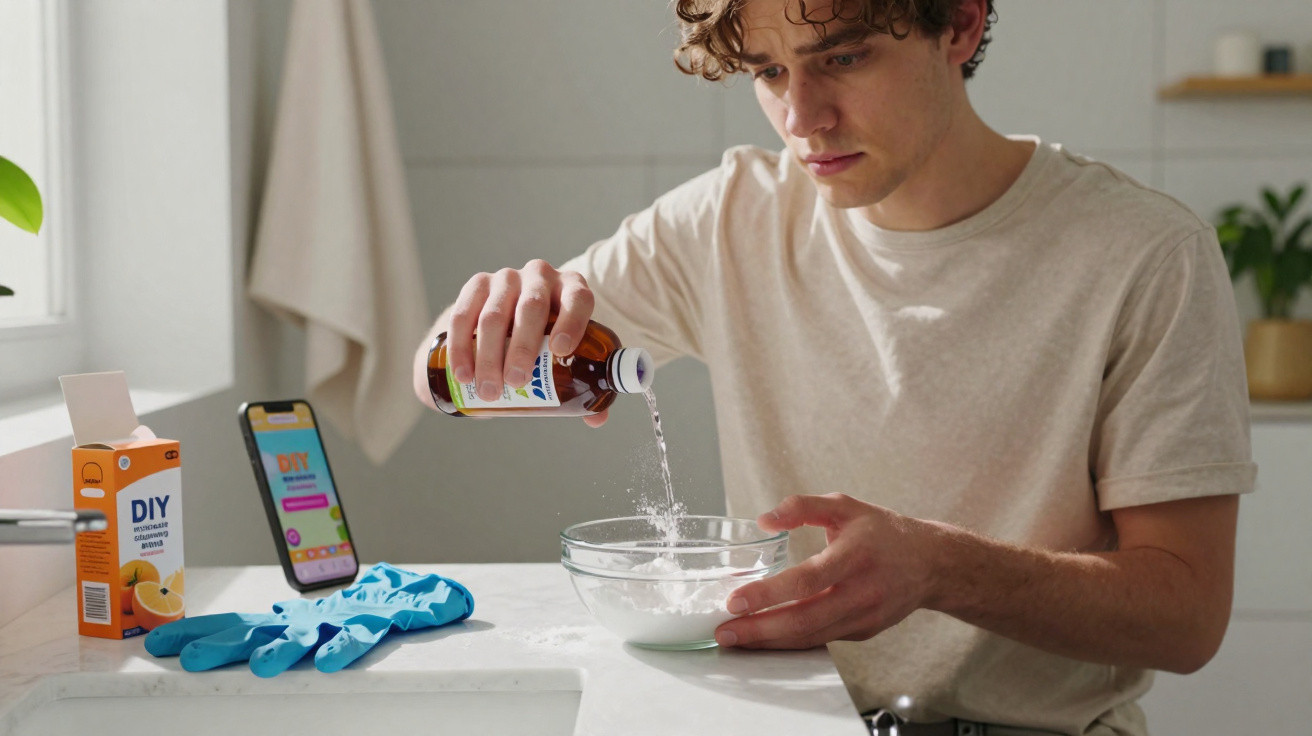
On TikTok and Pinterest, it can seem almost magical: a teaspoon of baking soda, a splash of hydrogen peroxide, and suddenly the sink is bright white, the grout looks pristine, teeth appear dazzling and the chopping board seems never to have encountered raw chicken. The clips are quick, satisfying and strangely hypnotic.
Away from the camera, dermatologists, toxicologists and dentists are wincing. They are dealing with burns, inflamed gums, worn enamel and wheezy asthma flare-ups that will never become a 12-second viral post. Beneath the trending audio and overhead filming, real people are suffering the consequences of “miracle” hacks never assessed like actual products.
The science now beginning to catch up with this craze presents a much less glamorous reality.
And it is not the story viewers believe they are seeing.
The “miracle duo” that moved from the kitchen cupboard to your body
Visit any chemist and hydrogen peroxide will be sitting unobtrusively on a lower shelf in its brown bottle, seeming harmless. A few aisles away, baking soda is tucked into the food section: an inexpensive, familiar box you may remember seeing in the fridge while growing up. Separately, both appear safe because they are so ordinary.
Online, that sense of familiarity has been exploited. Influencers combine them in ramekins and mason jars, describing the mixture as non-toxic, “chemical-free” and “safer than store-bought.” It froths and bubbles, creating the appearance of kitchen-counter science in your bathroom basin. That is often precisely where the problems start.
What dermatology clinics see is very different from the social-media version. A London dermatologist I spoke with described a patient who applied a baking soda–peroxide paste as a weekly “detox mask.” Initially, her skin felt smoother. Then the stinging started, followed by red areas and flaky skin that no quantity of moisturiser could repair.
In the United States, dental practices are treating teenagers who scour their teeth with the same combination “for that whitening filter effect.” One hygienist reported seeing scratches in enamel under the examination light: tiny channels through which sensitivity and decay can easily develop. Cleaning professionals are reporting comparable experiences, with clients suffering sore throats and irritated lungs after using homemade peroxide mixtures to scrub bathrooms in small, steamy rooms.
Scientists are unsurprised. Baking soda is alkaline and abrasive, while hydrogen peroxide is an oxidiser that can stress tissue and cells at higher concentrations or when used repeatedly. Combined, they can significantly alter the pH of skin or enamel and release extra oxygen. That may look dramatic, but it can also inflame delicate surfaces.
Products containing either ingredient that are subject to regulation undergo stability testing, irritation assessments and concentration controls. The viral bowl in your kitchen has no safety evidence, no accurate dosage and no meaningful instructions. The distance between “this foams in my sink” and “this is safe on my body” is far greater than most people appreciate.
Using baking soda and hydrogen peroxide safely without home chemistry
If you value the affordable, low-waste appeal of pantry cleaning, there is no need to bin everything. You simply need firm boundaries: use baking soda to scrub hard surfaces gently, and use hydrogen peroxide for specific disinfection jobs, seldom together and almost never on skin or teeth. Think of them as colleagues who should not share a desk.
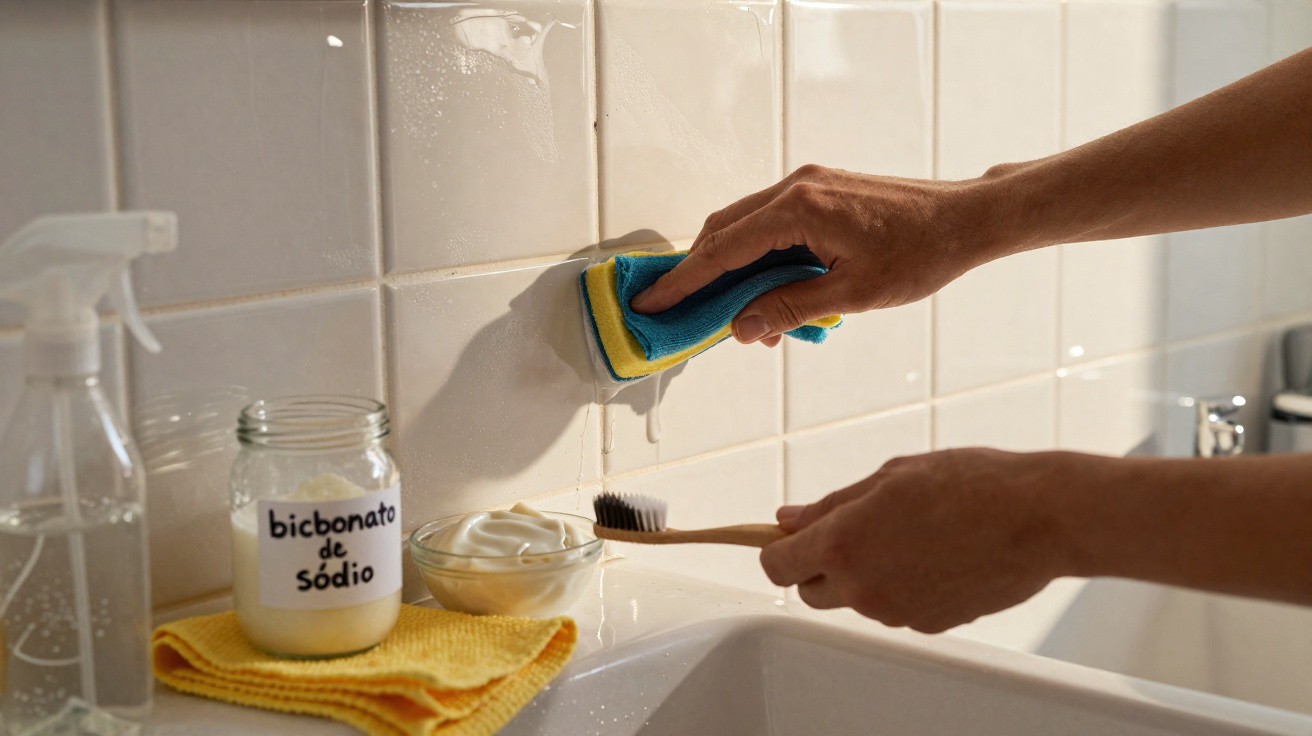
To brighten grout or clean chopping boards, apply diluted hydrogen peroxide by itself, spray it on, allow it time to work, then rinse and ventilate the area. For ingrained dirt, a straightforward paste of baking soda and water is generally sufficient, followed by thorough rinsing. Keeping their roles separate makes cleaning simpler while reducing risk.
The boundaries are stricter when it comes to your body. Dentists advise using peroxide-based whitening products formulated with stabilisers and clear time limits, rather than kitchen experiments. Baking soda toothpaste does exist, but its particle size and pH are controlled. A DIY teaspoonful mixed in a bowl is not.
For skin, dermatologists favour fragrance-free cleansers, evidence-based acne treatments and mild exfoliants. The burning sensation from a baking soda–peroxide mask is often micro-damage rather than detoxification. Honestly, few people do this every day. They use too much for a week, panic when their skin reacts, then stop quietly without ever telling the algorithm that it caused harm.
The experts I spoke to were notably sympathetic about why this trend became so popular. People are exhausted by lengthy ingredient lists and greenwashed marketing. They want control, simplicity and cheaper solutions at a time when everything feels overpriced.
“Baking soda and hydrogen peroxide are not evil,” says Dr. Marta R., a toxicologist who reviews household products for a European regulator. “They’re just being used wildly out of context. The problem is not the ingredient existing. The problem is a recipe gaining millions of views without any of the boring safety checks we demand from companies.”
- Keep each ingredient in its proper lane – use baking soda as a mild scrub on hard surfaces and peroxide as a disinfectant or stain remover, ideally diluted.
- Keep both away from skin and enamel in DIY “treatments” – particularly for children, people with sensitive skin, or anyone with damaged teeth or gums.
- Ventilate and protect yourself – gloves, open windows and brief contact times reduce irritation and fumes.
- Follow product labels rather than online hacks – commercial products containing these ingredients are tested for stability, dosage and long-term exposure.
- Pay attention to your body’s early warnings – stinging, tightness, coughing and unusual sensitivity are all signs to stop, not to “push through.”
Between viral hacks and real-world harm: where is the line?
Most of us know the feeling: a smug little beauty or cleaning trick appears in the feed and you wonder, “What if this actually works?” There is a quiet buzz in using a cheap box of powder and a generic bottle of peroxide to outsmart costly brands. It feels smart, perhaps even slightly rebellious.
But the research emerging on repeated exposure, tissue irritation and incorrectly used concentrations is like somebody gradually switching on the lights at a party. Suddenly, you notice the peeling paint, misty mirrors and the cough that lingers after “deep cleaning” day. The question becomes: when did the boundary between clever and careless become so indistinct?
The specialists criticising the baking soda–peroxide trend are not lecturing from an ivory tower. Many grew up with the same household remedies. They understand the reassurance of familiar names and the suspicion prompted by long chemical ones. Their frustration comes from seeing the internet turn old ingredients into new Franken-recipes that nobody has tested beyond a 30-second video.
This is where our role as users changes. It is not about becoming fearful of every hack, but about adding one quiet question before we pour and stir: who tested this, on what, and for how long? It is a question that rarely fits into a caption, yet it could protect a face, a set of teeth or a pair of lungs.
Perhaps the true “miracle duo” is less glamorous: curiosity and caution. It is not as clickable as bubbling grout or as gratifying as a dramatic before-and-after image, but it is much more sustainable. The next time you see that satisfying fizz in a bowl, you may still be tempted to try it.
You may also notice something else taking shape at the back of your mind: a quiet decision not to let your body become the test laboratory for someone else’s engagement statistics. Repeated in millions of kitchens and bathrooms, that small change could transform trends far faster than any new ingredient ever could.
| Key point | Detail | Value for the reader |
|---|---|---|
| Hidden risks of the “miracle duo” | New research connects repeated baking soda–peroxide use with irritation, enamel wear and respiratory problems. | Gives readers a reality check before they copy viral hacks on their bodies or in poorly ventilated spaces. |
| Safe, simple alternatives | Separate uses for baking soda and peroxide, with guidance on when regulated products are the better option. | Provides practical approaches to cleaning and care without losing the low-cost, minimalist appeal. |
| How to assess online recipes | Questions to ask include: who tested it, for how long, and on which surfaces or tissues? | Helps readers filter risky trends and protect themselves and their families. |
FAQ:
- Is it safe to brush my teeth with baking soda and hydrogen peroxide? Most dentists advise against regular use. The combination may be excessively abrasive and oxidising, gradually wearing away enamel and irritating gums.
- Can I use baking soda and peroxide on my face as a mask? Dermatologists strongly discourage it. The abrupt pH change and oxidative stress can harm the skin barrier and cause redness or burns.
- Is it okay to clean grout or tiles with the mixture? Infrequent use on hard, non-porous surfaces may not ruin your bathroom, but experts still favour using each ingredient separately with good ventilation.
- What concentration of hydrogen peroxide is safer for home use? Most households use 3% hydrogen peroxide for disinfecting. Stronger concentrations are intended for professional or specialist applications and carry a greater risk of burns and irritation.
- Are “natural” or DIY cleaning hacks always safer than store-bought products? Not necessarily. Many commercial products undergo stringent safety testing. Unregulated DIY mixtures may be harsher or less stable than they appear in a video.
Comments
No comments yet. Be the first to comment!
Leave a Comment