
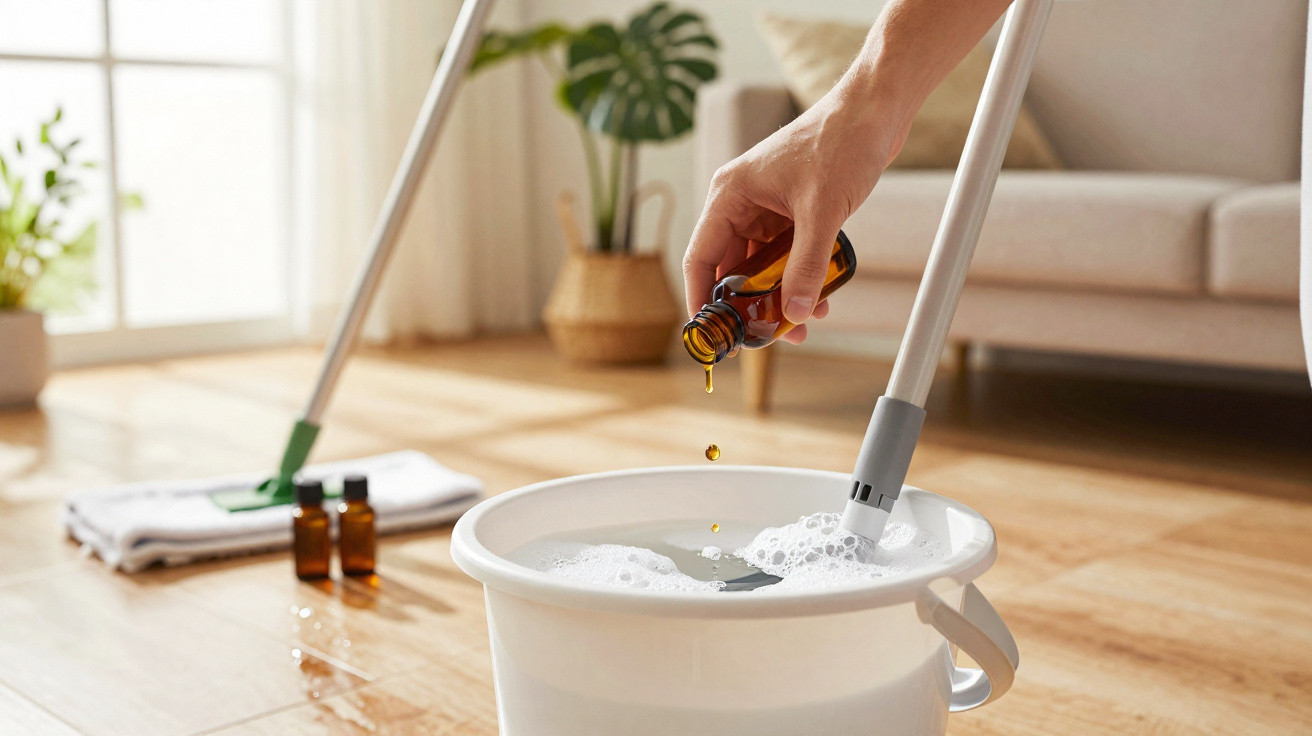
The bucket is half full already, the mop is propped against the wall, and a bottle of vinegar sits on the worktop while you hesitate.
Your floor is overdue a thorough wash, yet you can still recall the sharp, sour smell that hangs around long after you finish. A neighbour has their window open, and a gentle, fresh fragrance drifts indoors – the sort that brings to mind clean sheets and peaceful weekends.
You stir the bucket water, wishing your home could smell like that for once rather than “wet dog and detergent”. You have had enough of the usual suggestions involving lemon, vinegar and powerful cleaners. You are also fed up with artificial “ocean breeze” fragrances that resemble a perfumery.
What you want is something uncomplicated: two drops, no more, that genuinely make a difference. The answer is probably not what you expect.
The truth about mopping and why your house never smells “clean enough”
There is a familiar little let-down after mopping. The floor gleams, the room appears presentable and, for roughly ten minutes, everything smells “clean”. Then the effect disappears. The air becomes neutral again or, worse, turns into a blend of lingering cooking smells and laundry basket.
Many people fault the detergent and simply add more. They choose tougher formulas, extra foam and more perfume. It initially seems effective, but then a headache starts and your throat feels dry. The irony is uncomfortable: more cleaning, less comfort.
Usually, the real problem is not cleanliness. It is how fragrance works within a room.
On a Sunday morning in a small Manchester flat, a young mum called Claire decided to try a different approach. She was fed up with her kitchen smelling of the previous night's fried onions. A friend had told her about an unusual tip: two drops of essential oil in the mop bucket, nothing else fancy.
Claire rolled her eyes, but tried it anyway. She added two drops of lavender to a bucket of warm water and mild floor cleaner, then mopped quickly before the children returned with muddy shoes. An hour later, her sister came in and said, “Wow. Did you buy a new spray or something? Your place smells like a spa.”
The scent was not overpowering. It was simply present: soft, long-lasting and as though it naturally belonged in the home. She used the same method again two days later, with the same result. The onions did not stand a chance.
There is straightforward reasoning behind this minor miracle. Floors act as enormous fragrance diffusers. Mopping does more than clean a surface: it leaves behind a fine damp coating that dries gradually. Whatever is in that water – pleasant or unpleasant – will evaporate into the room.
Vinegar and lemon juice can neutralise odours, but each brings a powerful character of its own. They announce “I just cleaned!” rather than quietly suggesting “I live well here.” A carefully selected essential oil works differently. In a very small dose, combined with warm water and neutral cleaner, it lightly adheres to the floor before lifting into the air as a soft, gradual mist.
Your nose notices it whenever you pass through the room. It is not a punch in the face, but a background note – rather like the house breathing for itself.
The two drops trick: what to put in your bucket instead of vinegar
This is the simple step many people swear by: fill the bucket with warm water and your regular mild floor cleaner, then add exactly two drops of essential oil. Not a teaspoon or “a splash” – precisely two drops.
For a fresh, clean-home feel without excessive sweetness, many people choose eucalyptus or tea tree. Lavender and orange blossom are popular for cosy evenings and a more relaxed atmosphere. Gently stir the water using the mop, so that the drops do not remain on the surface like miniature islands of oil.
Mop as usual afterwards. There is no special process to follow. As the floor dries, the thin fragranced layer settles. Your home does not smell of “lavender product”; it simply feels as though it has taken a long, deep breath.
This is where most people make a mistake: they assume that “if two drops work, six will be amazing”. Instead, they get a headache, a sticky floor and a scent so powerful that it clashes with both perfume and dinner. Essential oils are highly concentrated. Use too much and the living room can begin to resemble the waiting room of an overenthusiastic aromatherapist.
Another frequent error is blending every available scent. A little peppermint, some jasmine and a touch of vanilla can quickly make a home smell like a melted candle shop. Pick one oil, or two at most, and stick with that combination for a while so your brain connects the scent with “my clean house”.
And, realistically, nobody mops every single corner perfectly every day. The aim is not to become a domestic superhero. It is to make real-life cleaning sessions work harder, last longer and feel more enjoyable.
“The biggest game-changer wasn’t cleaning harder,” says Sophie, who started using this trick during lockdown. “It was cleaning smarter. Two drops in the bucket and my flat felt like I’d spent hours on it, when I really hadn’t.”
Some practical combinations people enjoy include:
- Warm kitchen & living room: 1 drop sweet orange, 1 drop cinnamon, on tiled or sealed floors only.
- Calm bedroom hallway: 2 drops lavender for a gentle scent suited to the evening.
- Fresh bathroom: 1 drop eucalyptus, 1 drop tea tree for a “just showered” feel.
If you have pets or allergies, select mild, pet-safe oils and use only one drop for the first test. Your home should embrace you, not attack you.
Why this tiny gesture changes how your home feels for days
What tends to surprise people is not how strong the fragrance is on the first day, but how discreetly it remains. Two days later, you may open the door after work and still notice a trace of that clean, soft note somewhere between the hallway and kitchen.
There is no magic involved. Whenever somebody walks across the floor, their footsteps raise microparticles into the air again. A light breeze through an open window does much the same. In this way, your home keeps “releasing” the fragrance without you needing to pick up the mop.
In a busy life, this tiny, almost unnoticed form of comfort matters more than we often acknowledge.
There is a psychological element too. Scent acts like memory glue. The fragrance you choose becomes linked to your own sense of “home”: eucalyptus after a long commute, a trace of lavender as you scroll on the sofa, or a gentle citrus breeze while drinking coffee at the kitchen table.
On a difficult day, arriving to that familiar fragrance can feel like a reminder that this is your space and that it is under control, at least to some extent. On a good day, it lifts everything, making an ordinary Tuesday feel as though it belongs in a lifestyle magazine photograph – even with shoes left in the hallway.
Because the step is so small – just two drops – it also feels achievable. You do not need an entire “deep clean weekend” to alter your home's atmosphere. You need a bucket, five minutes and a scent that feels like you.
Viewed from a distance, it is almost amusing. So many cleaning hacks promise miracles through lengthy routines, complicated mixtures or costly products. Here, the answer is in a small bottle on the windowsill.
There is no vinegar odour trailing behind you and no sticky lemon residue. Instead, you get a floor that does more than shine: it speaks softly in the background long after the mop has dried.
The important question becomes less “How do I get my house spotless?” and more “What do I want it to smell like when I open the door tomorrow?” The answer fits into two drops.
| Key point | Detail | Benefit for the reader |
|---|---|---|
| Two drops are enough | Add 2 drops of essential oil to mop water with a mild detergent | Creates a lasting fragrance without an aggressive vinegar or lemon smell |
| Targeted scent choices | Eucalyptus, tea tree, lavender or citrus according to the atmosphere you want | Lets you tailor your home's ambience to your mood and each room |
| Simple step, long-lasting result | The floor acts as a slow diffuser whenever someone walks by or air moves through the room | Enjoy a pleasant scent for several days without extra effort |
FAQ:
- Can I use any essential oil in my mop bucket? Not quite. Choose pure essential oils and avoid very heavy, sugary fragrances that may become cloying. Begin with eucalyptus, lavender, lemon eucalyptus or sweet orange, and always test a very small amount first.
- Is this trick safe for pets and children? Use it carefully. Some oils are not suitable for cats, dogs or babies. Select very mild options, use only one drop and keep rooms well ventilated. If you are unsure, ask a vet or use unscented cleaner instead.
- Can I skip floor cleaner and use only essential oil and water? No. You still need a suitable cleaner to remove dirt and grease. Essential oil provides a subtle fragrance and sometimes a slight antibacterial boost; it is not a replacement for genuine cleaning products.
- Why avoid vinegar or lemon juice if they clean so well? They do clean and neutralise unpleasant odours, but leave a sharp, persistent smell that many people dislike. The purpose here is to create a gentle, pleasant background scent rather than make your home smell like a pickling factory.
- How often should I use the two drops trick? You can use it whenever you mop, or before guests arrive, after cooking strongly scented meals, or when you need a lift at home. The effect generally lasts a couple of days, and sometimes longer on cool, dry floors.
Comments
No comments yet. Be the first to comment!
Leave a Comment