
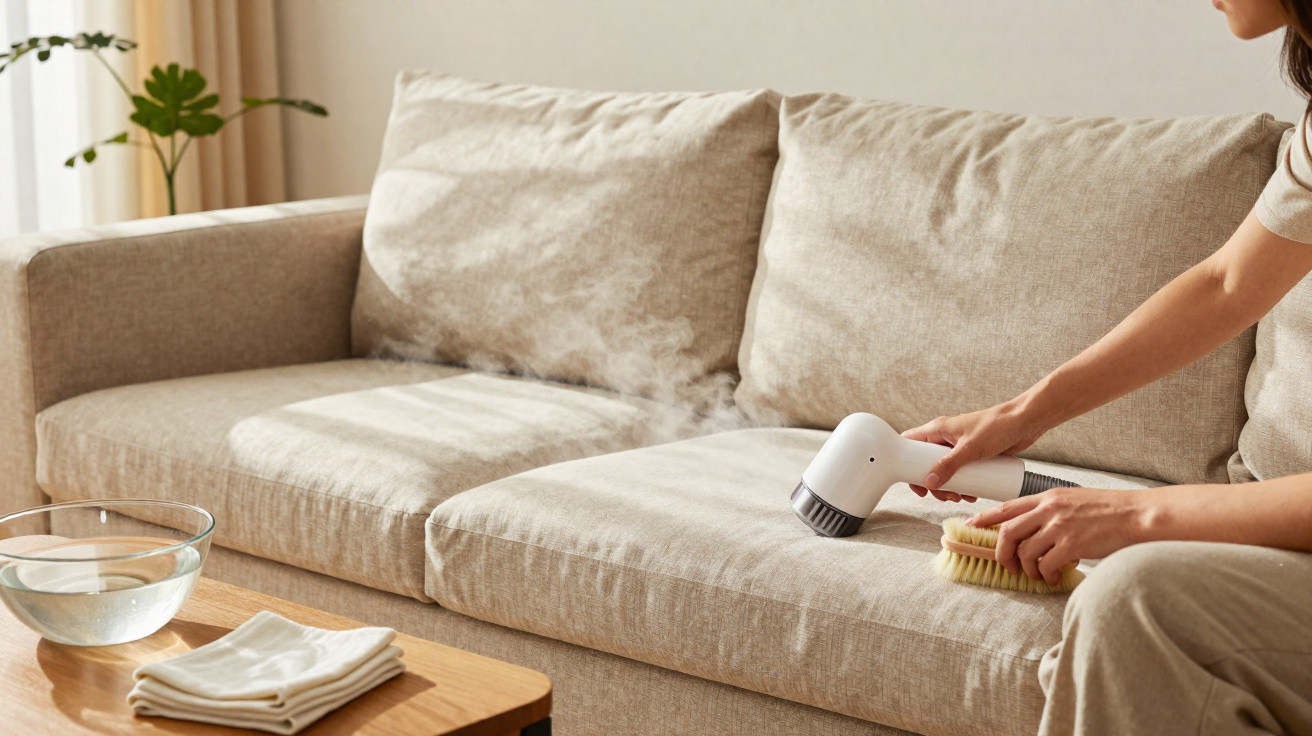
The colour looks flatter, the nap has been pressed down, and the cushions still bear the shape of last Sunday’s naps. You want to make it feel fresh again without spraying anything you would not want a toddler to lick.
Just after 7 p.m. in a compact city sitting room, the windows were slightly open and the blue hour made dust drift like slow-falling snow. Was it a repairman? No: it was an upholstery specialist carrying a modest kit-a handheld steamer, soft brush, clean towel and vacuum with a narrow nozzle. He grinned at the coffee mark on the armrest, laid the towel flat over the cushion and began tracing an almost invisible stream of steam. I watched the fabric revive. The nap rose, the grey film disappeared and the sofa released a fresh linen-like smell. The room smelled like rain, not chemicals. There was only water involved.
What makes a fabric sofa look “tired”
Stains are not the only issue. Microscopic dust, body oils and moisture can flatten fibres and make them cling together. In artificial indoor light, this creates a dull-looking veil even after vacuuming. Picture the nap as a field of miniature blades of grass. Following months of people, pets and snacks, those blades become flattened. The colour appears deeper, and the material no longer reflects light. It is not damaged; residue and compression are simply weighing it down.
A Bristol family told me that their oatmeal-coloured sofa looked “ten years old” by its second year. There had been no extravagant parties-only two children and a spaniel. The cushions were less dirty than exhausted. Rather than using soap, the specialist made a slow steam pass, brushed the fibres upright and vacuumed while the nap was standing tall. He worked through small, even rectangles, like a farmer tending rows. After twenty-five minutes, the sofa appeared nearly new. Not shiny-new-comfortably familiar-new.
The principle is straightforward: heat relaxes the fabric, a faint amount of moisture releases the fine bonds holding dust and oils within the weave, and physical movement frees them. Air then completes the process. You are not washing the sofa; you are restoring it. Steam releases, the brush raises, the vacuum removes and mild airflow completes the drying. It’s more physics than cleaning. Once you see upholstery as a breathable living textile, you stop battling it and instead help it return to its original shape.
The Steam-and-Brush Reset for a fabric sofa (no chemicals, just water)
Begin by vacuuming slowly and thoroughly with the upholstery attachment. Cover the edges, seams, buttons-everything. Fill a handheld steamer with distilled water and switch it on. Keep the head a few centimetres above the material rather than pressing it down, moving in consistent lines. You want a gentle touch of vapour, not a saturated cushion. After every pass, use a soft upholstery brush straight away, brushing the nap in one direction; then make a light vacuum pass while the fibres remain raised. Tackle areas no larger than one seat cushion at a time, before allowing air to dry them. Open the windows and put some music on.
What tends to go wrong? Soaking the cushions, staying over one area until it becomes visibly wet, using tap water that may leave mineral spots, or scrubbing with a hard brush that damages the weave. Rushing the drying stage is another mistake. Go easy on yourself: life is hectic and sofas are large. Let’s be honest: nobody actually does that every day. Keep the passes light and consistent, and work patiently. If you are unsure, test beneath a cushion first, observe how your fabric reacts and establish a routine you can manage repeatedly.
“We don’t ‘wash’ sofas,” a veteran upholstery tech told me. “We teach the fibers to stand again, then we take away what holds them down.”
Think of the kit as four uncomplicated notes: steam, brush, vacuum and air. They work best together in that sequence. Keep this short list handy:
- Fill the steamer with distilled water to avoid marks.
- Hold the steamer head above the fabric; do not push it into the material.
- Brush straight away to raise the warm nap.
- Vacuum immediately afterwards to collect released residue.
- Allow each area to breathe before sitting on it.
Details that make all the difference
Brushing direction is important. Where your sofa has an obvious nap, brush in long, uniform strokes towards the same edge. Only lightly crosshatch if the pile appears streaky, then complete the job with a final pass in one direction. With velvet and microfibre, hold the steamer even higher and use lighter movements, so that you relax rather than flatten the material. Microfibre responds particularly well to a gentle warm lift followed by a polishing stroke with a microfibre cloth to even out the sheen. For linen blends, use less steam, more air and allow a longer drying period before putting cushions back into their covers.
Timing is important as well. Cushions respond better when both sides are treated, even when one rarely sees daylight. Small impressions left by laptops or trays? Hold an ice cube against the dent for a few seconds, blot the area, then briefly hover steam over it and lift with a fingertip. Areas used by pets usually benefit from an additional vacuum pass, followed by slower brushing to restore the pile direction where paws have created a preferred landing spot. This is a dialogue with fabric, not a battle.
Drying works quietly alongside you. Keep windows slightly open or run a fan on a low setting to move moisture away. Do not sit down until the material feels dry at room temperature, rather than cool and damp. For the faintest hint of fragrance, leave a bowl of freshly ground coffee nearby while the sofa dries, then take it away; the sofa will not smell of latte, only… less like yesterday. Your living room starts to carry the clean of air, not the cover-up of perfume.
Why the Steam-and-Brush Reset feels different
There is a quiet satisfaction in watching a familiar item regain its form without perfumed products or a lengthy list of chores. The sequence can feel almost meditative: steam, brush, vacuum, air. You move, the nap reacts and the colour becomes rich in itself again. There are no labels, mixtures or plastic bottles. A fabric sofa behaves like fabric, so that is how you care for it. The room feels calmer.
| Key point | Detail | Benefit for the reader |
|---|---|---|
| Light steam + brush | Hover the steamer and immediately brush fibres upwards | Restores colour and texture without soaking |
| Vacuum while lifted | Use the upholstery nozzle directly after brushing | Clears loosened dust and residue that causes dullness |
| Dry with airflow | Leave windows open or use a low fan setting until dry at room temperature | Avoids water rings and keeps the material crisp |
FAQ
- Can I use a garment steamer for this? Yes. Use distilled water, hover a few centimetres above the fabric and move at a steady pace. The aim is gentle vapour, not forcing heat into the weave.
- Will steam harm velvet, linen, or microfiber? Velvet and microfibre benefit from brief, light passes with very little contact. Linen needs even gentler steaming and additional drying time. Always test an inconspicuous area first.
- How do I tackle odors without vinegar or baking soda? Ventilation combined with steam can be highly effective. Steam releases residue that traps odours, while airflow carries it away. For persistent smells, repeat gentle passes and extend the drying time.
- What about old stains that won’t budge? This technique restores the nap and removes dirt that causes dullness. Embedded stains may require specific treatment. If you are uncertain, stop and check the fabric code or speak to a professional.
- How often should I do a steam-and-brush reset? Every 6–8 weeks in busy households, or seasonally in quieter rooms. Between resets, careful vacuuming helps keep fibres upright and colours looking lively.


Comments
No comments yet. Be the first to comment!
Leave a Comment