
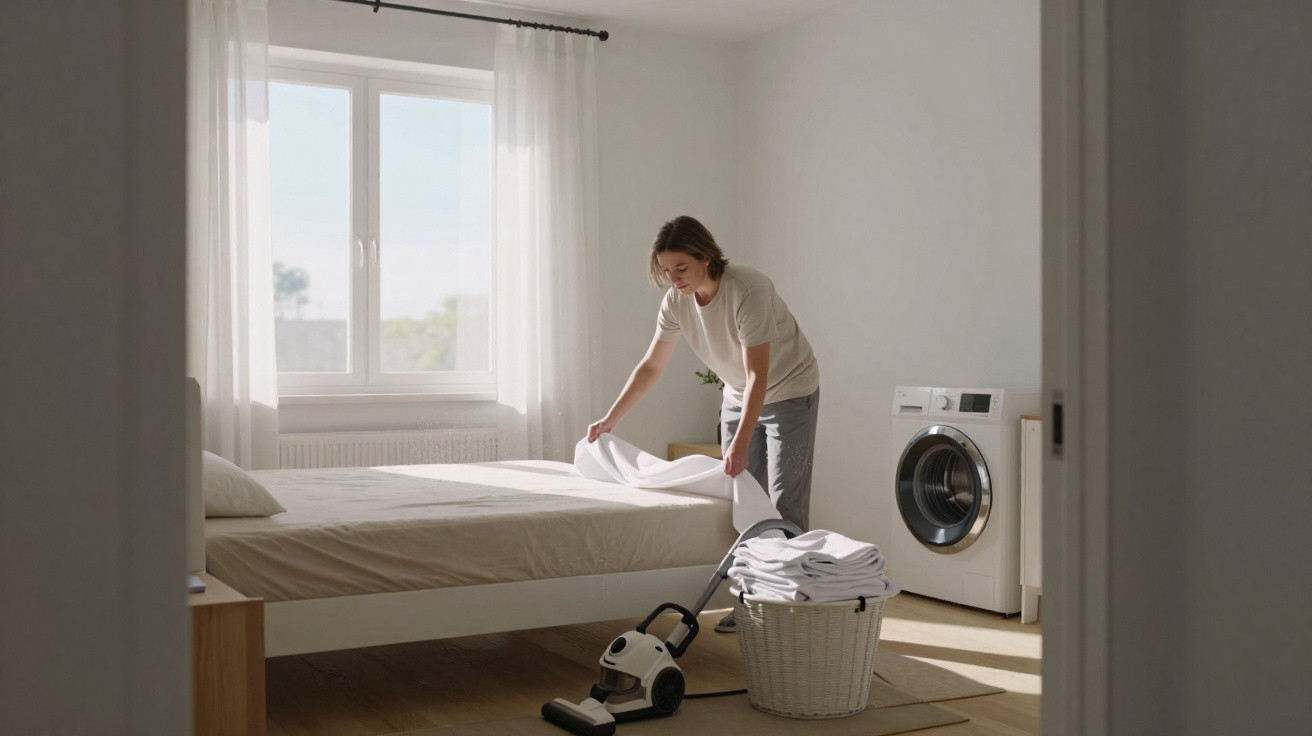
The bedroom looked immaculate, or so it seemed.
The bed had been freshly made, the pillows were plump, and a candle still carried a faint vanilla scent. But whenever light fell across the duvet, the lightest tap sent up a near-invisible haze, like dust glittering in a film scene. The homeowner beamed as she explained that she washed “all the bedding” every Sunday. The cleaning expert at the door did not return the smile. She knew the neatly made bed was teeming with tiny, flourishing dust mites – and that the weekly wash was, in fact, benefiting them.
Why “clean” bedding can secretly be a dust mite paradise
The first point that surprises cleaning experts is not what people wash, but how they wash it. Many assume sheets are sufficiently clean if they smell of fabric conditioner. Trouble begins when the water is too cold, the drum is overloaded, or the programme is too short to have any real effect. Mites do not merely survive these cosy spa-like washes. They emerge into a slightly refreshed setting that is warm and humid – ideal for reproduction.
Everything appears fresh on the outside. The bed is neatly crisp, the duvet has been fluffed up and the pillowcases feel smooth. Beneath that surface, however, dust mites hold on within the weave, alongside sweat, shed skin and microscopic food particles. You may not see them, but your nose and skin often recognise their presence. Night-time sneezing, waking with a blocked nose or a mild facial itch: cleaning experts link many of these “mystery” symptoms to how bedding is washed, dried and stored.
One UK cleaning specialist we spoke to believes that as many as 70% of households wash bedding in conditions that still allow dust mites to flourish. This is not an alarming laboratory figure; it comes from years spent visiting homes and seeing how people actually live. There are short, low-temperature eco programmes, beds made while mattresses remain warm and slightly damp, and duvets that are seldom washed because “they’re protected by covers”. On a hectic evening, putting everything into one crammed load can feel like an achievement. Let’s be honest: nobody really does all this every day.
At one family home, a mother proudly explained that she replaced everyone’s sheets fortnightly. Yet two of her children coughed constantly at night. The expert inspected the wash settings: 30°C, a quick programme, fragranced detergent and no high-heat tumble-drying. The duvets had not been washed for more than a year. The dust mite levels in that room were off the charts. After the washing routine changed – using higher temperatures, longer programmes and washing pillows and duvets regularly – the coughing subsided within weeks. There was no magic involved, only physics, water and heat.
The reasoning is straightforward, if slightly unsettling. Detergent matters little to dust mites; temperature and moisture are what concern them. Many will survive washes at 30°C and even 40°C, particularly when a packed drum prevents water from moving freely. If bedding comes out only partly dry and is hung in a cool room, the material becomes a damp, ideal environment for mites to multiply again. Washing bedding “incorrectly” does more than fail to kill them. It leaves them with a rearranged home and new moisture to drink.
Fabric conditioners and scented laundry boosters introduce another complication. They leave a coating on fibres to create a silky feel, but that layer may hold onto skin flakes and microscopic dust. Cleaning experts call it “gluing food to the fabric”. The outcome is sheets that are soft, scented like “spring meadow” and discreetly feeding a flourishing mite colony. The more regularly this is done, the more convinced you may be that everything is right, even as the real issue grows invisibly within the threads.
How cleaning experts really wash bedding to cut dust mites
The professionals’ first principle sounds almost overly simple: use more heat and allow more time. They advise washing sheets and pillowcases at 60°C where the care label permits, rather than relying on the standard 30°C or 40°C setting. A longer, more intensive wash gives heat time to reach deep into the fibres, where dust mites and their droppings are concealed. The drum should not be overfilled; leaving room allows water and detergent to circulate through the load properly.
Drying follows, and this is the stage at which many routines fall short. Bedding must be completely dry, rather than merely “nearly” dry. Tumble-drying at a medium temperature until every item is bone-dry is best. For those who line-dry, experts recommend selecting a sunny, breezy day, allowing sufficient time and turning the bedding once or twice. The purpose is to interrupt the moisture cycle that dust mites favour. A dry bed is not simply more comfortable; it is deliberately unfriendly to them.
Cleaning experts also place considerable emphasis on order. Before fitting clean sheets, they allow the mattress to air for a while, ideally with an open window. That brief interval lets moisture dissipate. Many lightly vacuum the mattress before making the bed again, particularly around the head area. This is not about turning a bedroom into a sterile hotel room. It is about making the bed slightly less welcoming to the tiny occupants nobody invited.
Experts understand that most people do not have time for a twelve-step bedroom routine. As one specialist put it: “Real cleaning advice has to survive real life.” For that reason, they recommend concentrating on the actions that offer the greatest benefit for the least effort. If you can only change one thing, they say, change the temperature. Even keeping the same approach but washing hotter when labels allow can shift the balance against dust mites. Once that becomes routine, the other adjustments tend to feel easier to manage.
One scenario appears frequently in their accounts. On a hurried Sunday evening, you take warm sheets straight from the dryer, put them on the bed and climb in. It feels wonderful. Yet it also holds residual heat and moisture beneath the covers, creating precisely the microclimate mites love. Experts are not there to criticise – many acknowledge doing exactly the same in their own homes. This is where the most useful advice comes in: modest, realistic adjustments rather than perfectionist expectations that fail during the first busy week.
One cleaning coach expressed it this way:
“You don’t need a sterile bed. You need a bed that’s just a little less comfortable for dust mites than it is for you.”
In their view, a dust-mite-conscious routine is closer to a checklist than a ritual:
- Wash sheets and pillowcases at 60°C when the fabric can safely tolerate it.
- Let the mattress air for 15–20 minutes before remaking the bed.
- Dry bedding fully, ideally allowing it some time in direct light.
- Wash pillows and duvets every 3–6 months, in line with their care labels.
- Avoid using large amounts of fabric conditioner on bedding, or use it only sparingly.
None of this makes you a laboratory technician. It simply moves everyday routines a few degrees nearer to what science – and years of home visits – genuinely support.
The quiet impact of changing how you wash your bed
When people adjust how they wash bedding, a subtle difference often emerges before any allergy test verifies it. Sleep feels more peaceful. Mornings bring slightly less congestion. The bedroom has a fresher smell of a different, less chemical kind. After a few weeks, many describe a feeling of “lightness” as they pull back the covers, as though the bed is no longer working against them. The difference is seldom dramatic. It is more like lowering the volume on a noise you had not realised was loud.
Dust mites will never be fully absent from a lived-in home. Cleaning experts are the first to point out that pursuing that ideal is tiring and futile. What can change is the divide between “overloaded” and “manageable”. Washing bedding in a way that truly disrupts mite habitats – rather than simply perfuming them – reduces the ongoing background exposure that leaves some people tired, inflamed or permanently sniffly. The bed becomes somewhere your body can unwind, rather than a subtle irritant night after night.
There is a quiet emotional element too. We spend a third of our lives in bed, often beside the people we love most. It is where we read, cry, scroll, recover after long days and get through long weeks. Discovering that our usual idea of “clean” is not genuinely clean can feel uncomfortable initially. Then it becomes something different: a small, practical act of self-care that needs neither a new gadget nor a complete renovation. Just hotter water, more thorough drying and a little awareness of what may be concealed in something that looks perfectly fine.
Once you understand that washing bedding the “wrong” way may actually support dust mites, it is difficult to forget. Some people will shrug and continue as before. Others will quietly alter the washing-machine settings tonight, remove duvet covers for a long-overdue wash, or leave the mattress uncovered for a few extra minutes before making the bed again. These minor changes do not create glamorous before-and-after photographs. They do not make noise on social media. They simply happen in the dark, while the house is still and your lungs are the only audience that counts.
| Key point | Detail | Benefit for the reader |
|---|---|---|
| Washing temperature | Choose 60°C for sheets and pillowcases where the care label permits it | Greatly reduces dust mite survival in bedding |
| Complete drying | Dry thoroughly in a tumble dryer or outdoors in dry, bright weather | Limits the moisture dust mites need to multiply |
| Frequency and routine | Wash bedding every 1–2 weeks, and duvets/pillows every 3–6 months | Reduces allergen build-up and improves night-time comfort |
FAQ:
- How often should I really wash my bed sheets? Most cleaning experts advise washing sheets and pillowcases every 1–2 weeks, or weekly if you have allergies, allow pets on the bed, or sleep hot and sweaty.
- Can dust mites actually survive a normal wash cycle? Yes, many survive 30°C and even 40°C washes, especially short programmes and loads in overfilled drums, which is why higher temperatures and longer cycles are important.
- Is fabric softener bad for bedding hygiene? It is not “bad”, but using a lot can coat fibres, retain skin flakes and dust, and make the fabric a little more welcoming to mites, so occasional or light use is preferable.
- How often should I wash pillows and duvets? Pillows and duvets generally need washing every 3–6 months, depending on how they are used, allergies and manufacturer guidance; many people leave them far too long.
- What if my bedding can’t be washed at 60°C? Use the highest temperature that is safe for the item, dry it thoroughly on a warm setting, and combine this with mattress covers, regular vacuuming and good bedroom ventilation.






Comments
No comments yet. Be the first to comment!
Leave a Comment