
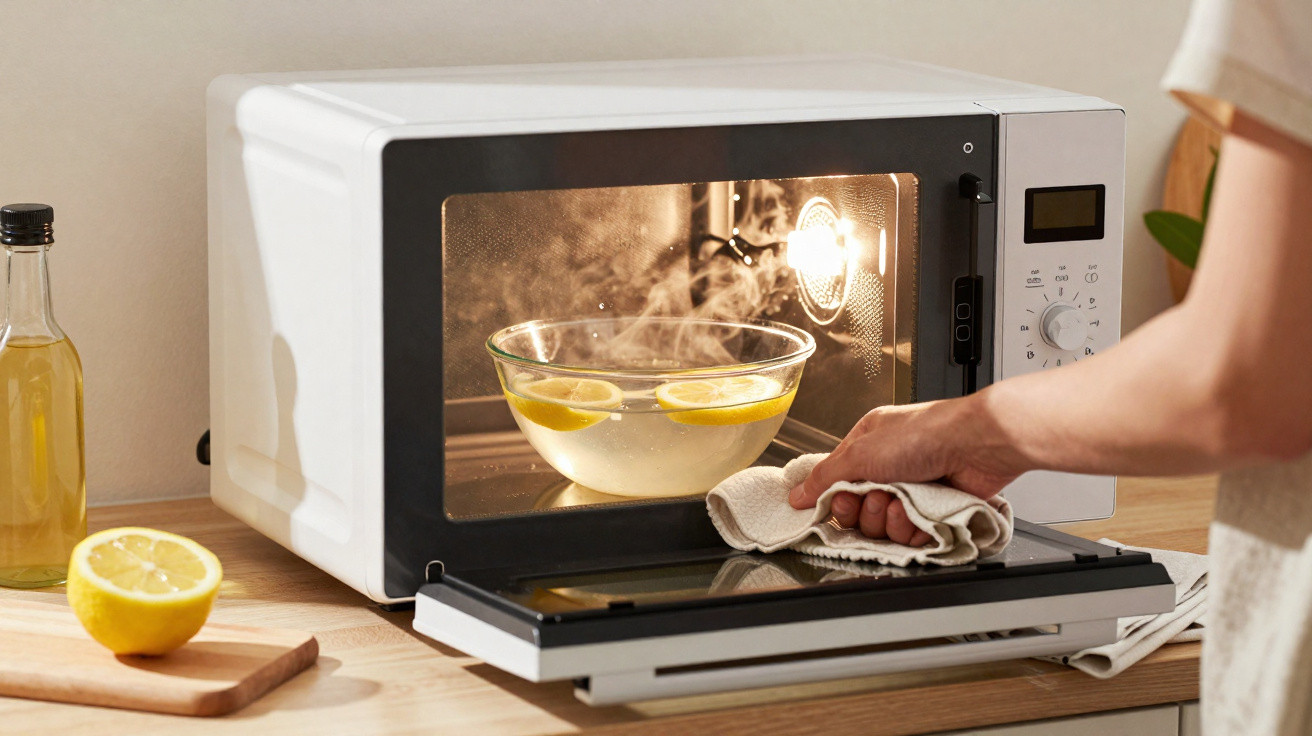
Of the many household cleaning methods that have become popular in recent years, boiling vinegar with lemon in the microwave has emerged as one of the most widely discussed tricks. First shared in social media groups and short videos, the practice is now used by whole families as a cleaning “shortcut”: it is straightforward, relies on everyday ingredients, helps lift grease, food splatters and lingering odours and, when carried out carefully, may even help extend the appliance’s working life.
How does boiling vinegar with lemon in the microwave work?
Heating vinegar with lemon in the microwave works through the acidic steam produced by the mixture. As the liquid heats up, it releases particles that circulate around the appliance’s interior, softening dried marks, grease and residue built up through daily use, much of which may not be immediately visible.
White vinegar offers degreasing and deodorising potential, while lemon adds citrus and fragrant qualities. Together, they create a humid, mildly acidic environment inside the microwave, making dirt that would withstand an ordinary damp cloth easier to remove and reducing the day-to-day need for harsher kitchen chemicals.
Watch a video from the Almanaque SOS YouTube channel explaining how to clean inside a microwave quickly by loosening grease with steam from acidic homemade mixtures:
https://www.youtube.com/watch?v=M9mF2c5R9U4
Does boiling vinegar with lemon in the microwave remove stubborn dirt?
For microwaves used every day, heated vinegar and lemon can often help tackle older layers of grime. Hot steam reaches the internal walls, ceiling and corners, loosening dried splashes of sauces, melted cheese and grease. This is especially helpful in homes where the appliance replaces the cooker for a large proportion of meals.
Once heating is complete, a soft cloth or non-abrasive sponge should meet less resistance when wiping away residue, while persistent smells from fish, strongly flavoured sauces or burnt popcorn usually become less noticeable. Very old crusts may require the process to be repeated or a little more gentle rubbing, always taking care not to damage the interior. Dark marks or rust, however, may signal that professional maintenance is needed.
What little-known detail makes a difference to the result?
The key is not simply boiling vinegar with lemon in the microwave, but also preparing and using the mixture correctly. How the lemon is cut, the water-to-vinegar ratio and the length of time the steam is left to work all directly affect the procedure’s effectiveness and safety, a point appliance technicians have highlighted as the method has grown in popularity.
To achieve a good result without harming the appliance, a few straightforward precautions are recommended when making the solution and placing the container. Use a microwave-safe glass or ceramic bowl with high sides, add water to dilute the vinegar, cut the lemon into slices or crosswise to release more essential oils, and leave room in the bowl for boiling. These measures help prevent overflow and lower the risk of internal damage.
Practical steps and precautions for using vinegar and lemon in the microwave
To use this method simply and safely, it is useful to follow a basic sequence. It makes the process more consistent, lowers the chance of accidents and improves cleaning results, including for those who rarely maintain their microwave and want a quick everyday option.
Make the solution using half a cup of water, a quarter of a cup of white vinegar and a few lemon slices, or half a squeezed lemon with its peel. Put it in a suitable container at the centre of the turntable, heat on high power for 3 to 5 minutes, leave it for a further 3 to 5 minutes with the door closed, then wipe the surfaces with a clean cloth or soft sponge. Avoid plastic containers that are not microwave-safe, excessively long heating times, and using this method on appliances with advanced rust, peeling paint or loose parts, as this could worsen existing damage.





Comments
No comments yet. Be the first to comment!
Leave a Comment