
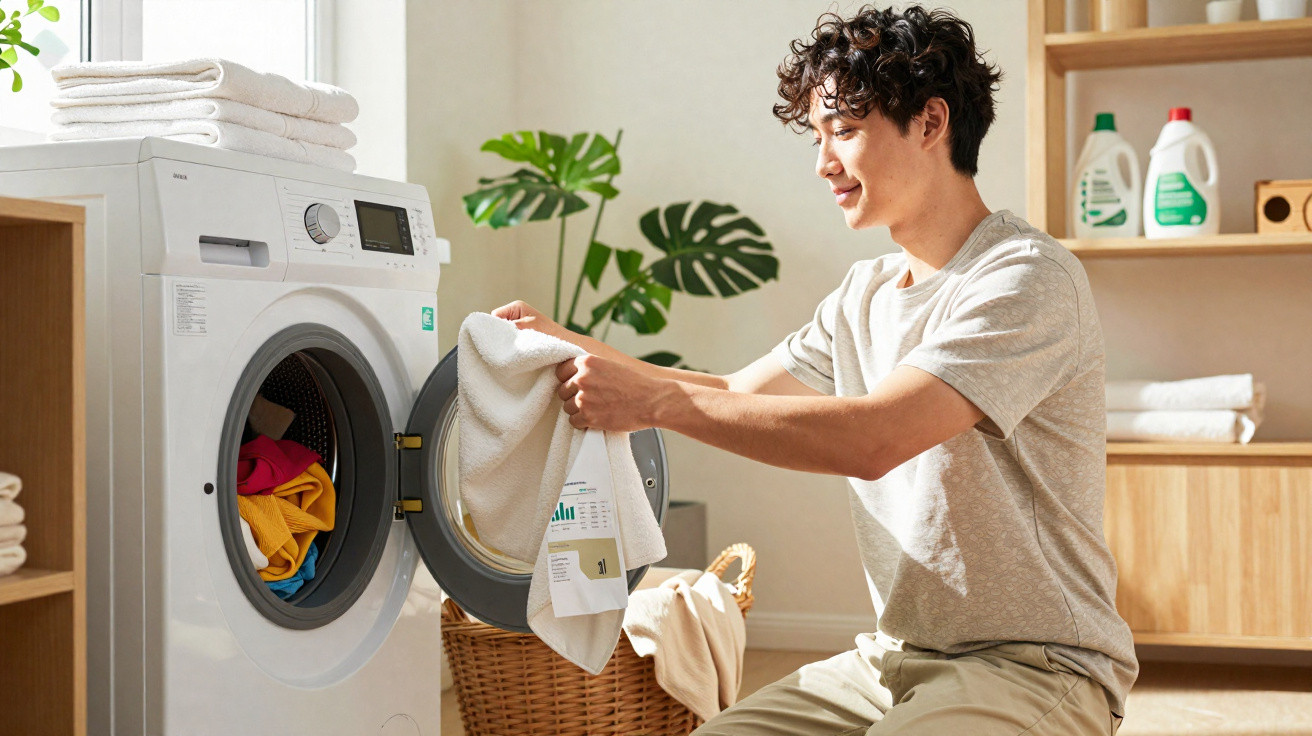
The buzzer sounds, you open the dryer door, and feel an immediate pang of disappointment. Your jeans are still weighty, the towels remain damp, and that familiar warm, musty smell is beginning to develop. You take out the partly dry clothes, vow to choose shorter cycles next time, and start working out what a second run will add to this month’s costs. With energy prices rising and work, children and everyday life to manage, even doing the laundry can feel like it needs careful planning.
Then somebody casually suggests: “Why don’t you throw a dry towel in with your wet clothes? It goes faster.”
It sounds like the sort of household tip that belongs alongside putting toothpaste on a mirror.
But, surprisingly, this one does work.
Why a simple dry towel can speed up your laundry day
Imagine a packed mixed load tumbling around the drum: a thick hoodie wrapped around a pillowcase, socks stuck to a bath towel. The dryer sends in hot air and keeps turning, yet the moisture appears to hold on to the fabric like an unwanted guest who will not leave. The appliance is doing what it should, but at a frustratingly slow pace.
Put a clean, dry towel into that load and the movement inside changes. During those important first minutes, the towel travels through the clothes and takes in surplus moisture. The load becomes lighter and heat can reach the fibres more quickly. What felt like an endless programme can suddenly become much shorter.
A young couple I spoke to tried this “grandma tip” because they were desperate. They had a small city flat, an ageing dryer and an energy bill that felt like a cruel joke. Before trying the towel method, a heavy mixed load took nearly 80 minutes to dry. Adding one large dry towel brought their average drying time down to around 55–60 minutes, without changing the temperature setting.
They were unconvinced after their first attempt, so they monitored the results for a month, noting the minutes and programme types on a notepad fixed to the wall. By the month’s end, they had cut several hours from their total drying time and saw a pleasing reduction on their electricity bill.
The explanation is quite straightforward. At the beginning of the programme, the dry towel behaves like a thirsty sponge. When the clothes are wettest, it absorbs part of the moisture, leaving less water for the dryer itself to evaporate. The appliance can get to its most effective temperature sooner, meaning it does not have to keep blowing hot air for as long.
Shorter drying, lower energy use and less strain on your fabrics: there is no magic involved, only physics working quietly in your favour. A minor adjustment to the way you load the dryer can alter the behaviour of the entire cycle.
How to use the dry towel trick without ruining your laundry
The method itself is simple. Put your wet laundry into the dryer as normal, taking care not to cram the drum too full. Air needs room to move around. Place one large, dry bath towel on top of the load, select your usual programme and start the machine.
After roughly 15–20 minutes, pause the dryer. Open the door and remove the towel, which should now be damp, then hang it to dry naturally or add it to your next wet load. Shut the door and restart the programme. The initial minutes are when the towel is most effective.
There are several understandable mistakes people make with this approach. Some add several dry towels, assuming that “more towels, more speed”, only to overcrowd the drum and reduce drying efficiency. Others choose a tiny hand towel that barely comes into contact with half the laundry, then conclude that the tip does not work. Some leave the towel in for the whole programme, until it is just as wet as everything else.
Realistically, no one is likely to follow this method every day. At times you will forget, or simply be too tired, and that is fine. Treat it as a useful option in your laundry toolkit, rather than another household rule you have to follow.
“Once we started using a dry towel in the dryer, we cut about 20 minutes off every cycle,” says Carla, a mother of three who runs two or three loads a day. “It doesn’t sound huge, but when you’re doing that many loads, it feels like buying back time you didn’t know you had.”
To make the routine easier, plenty of families keep a particular “drying helper towel” beside the machine. On days with heavy loads, they can pick it up without thinking.
- Choose one large, clean and absorbent bath towel for medium or heavy loads.
- Remove the towel after the first 15–20 minutes to achieve the best results.
- Do not pack the drum tightly, even when using this method.
- Keep the trick for heavy materials such as jeans, hoodies, towels and bedding.
- Do not use the towel with delicate or heat-sensitive garments.
Beyond the hack: what this tiny change says about our daily routines
Laundry is rarely near the top of anybody’s list of life priorities, but it still quietly influences evenings and weekends. The extra 20 or 30 minutes spent waiting for a stubborn load to dry is time not spent reading with your child, relaxing on the sofa or catching up with a friend. Adding a dry towel to the dryer is certainly an energy-saving tip, but it is also a small pushback against the idea that chores must always consume your day.
Once you alter this small part of your routine, you may begin spotting other modest efficiencies that require no extra effort, only a little awareness.
There can be a psychological change, too, when you no longer feel completely controlled by your appliances or energy costs. Your home starts to seem like something you can fine-tune instead of merely put up with. A dryer programme that finishes earlier brings less noise, less summer heat and fewer arguments about who is doing the laundry and when. You may mention it to a neighbour, sister or flatmate.
This slightly odd idea, shared in a comment section or over coffee, can then become part of a practical and distinctly modern question: how can we live well without continually using up money and resources?
Adding a dry towel to the dryer will not change the world. It may, however, change the feel of a Tuesday evening, the amount of a monthly bill or the sense that everything is slightly beyond your control. These small household actions may not look impressive to anyone else, but they gradually make a difference in the background.
Perhaps you will try it once and never stop. Perhaps you will adapt it around your own timetable and habits. Or perhaps you will simply pass it on: “Hey, there’s this weird thing that actually works,” and allow somebody else to decide how it fits into their daily routine.
| Key point | Detail | Value for the reader |
|---|---|---|
| A dry towel speeds up drying | During the first minutes of the programme, the towel takes in excess moisture | Less time in the dryer and reduced energy use for each load |
| Use it strategically | It works best with heavy loads, one large towel and removal after 15–20 minutes | Improves efficiency without harming clothes or overfilling the drum |
| Small habit, long-term impact | Regular use can save hours while reducing wear on both fabrics and the machine | Less laundry-related stress, possible bill savings and a longer appliance lifespan |
FAQ:
- Does the dry towel trick work with every type of fabric? It is most effective for mixed loads and heavier items such as jeans, sweatshirts and towels. The time saving is smaller for delicate, lightweight fabrics, and it is often kinder to air-dry them or use a low-heat programme without the towel.
- Can I use more than one dry towel to speed things up further? Adding two or three towels generally has the opposite result because it fills the drum and restricts airflow. For a standard household dryer, one large absorbent towel is normally sufficient and provides the best balance of moisture absorption and air circulation.
- Will this trick damage my dryer or clothes in the long term? When used properly, it usually does the reverse: shorter programmes mean less exposure to heat and less mechanical stress. Issues occur only when the dryer is overloaded or when the towel is mixed with very delicate items that should not be on a normal programme in the first place.
- Is this still useful if I already have a modern, energy-efficient dryer? Yes, particularly for bulky loads. Modern dryers are more effective at sensing moisture, and the towel helps them reach the “dry enough” point sooner. The appliance may finish the programme earlier, still saving time and a portion of energy.
- What kind of towel should I use for the best result? Select a clean, dry, medium-to-large cotton bath towel. Microfibre can be effective, but traditional cotton generally offers a more natural balance between absorption and airflow. Keep one dedicated towel close to the dryer so that you do not need to search for one each time.




Comments
No comments yet. Be the first to comment!
Leave a Comment