
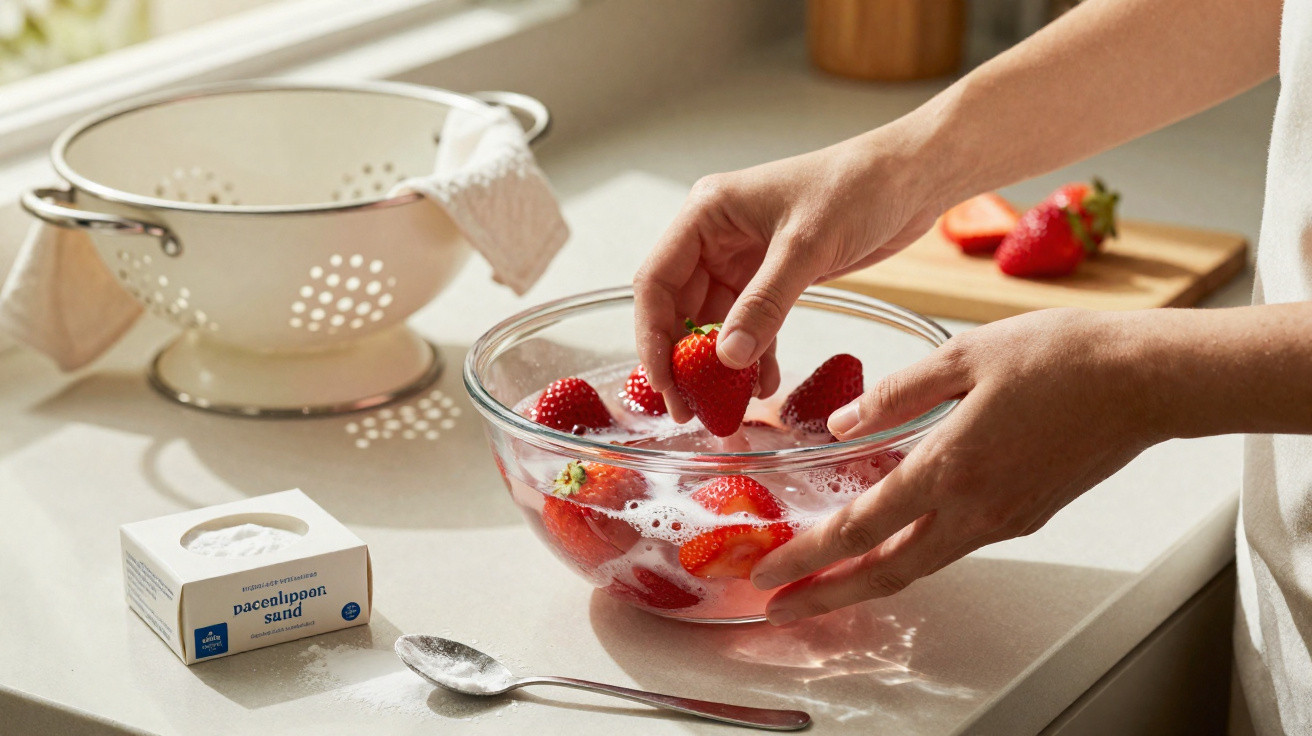
From market stalls to supermarket shelves, these vivid berries carry more than sweetness on their skins. An increasing number of food specialists say that the familiar brief rinse beneath the tap does little to address the issue.
Why strawberries need more than a quick rinse
Strawberries are unlike apples and pears. Their skins are thin and slightly porous, while their tiny seeds sit in shallow indentations. These grooves can hold dust, soil, pollen, microscopic insects and remnants of sprays applied in the field.
Farmers protect strawberries against mould, pests and decay; without doing so, much of the crop would not reach the shops. This protection commonly involves plant protection products, which may leave detectable residues on the fruit’s surface. A rinse under running water removes part of this material, yet laboratory testing in Europe and North America indicates that water alone often leaves a substantial amount behind.
Strawberries offer a large, uneven surface where residues, dust and spores can cling stubbornly, even after a quick rinse.
The reason is partly chemical. Tap water is neutral, but many residues are not. Some can adhere to the berry’s mildly waxy outer coating or dissolve more readily in fat than in water. Others act differently according to whether conditions are acidic or alkaline. As a result, a few seconds under the tap, however powerful the flow, usually removes only material that was loose already.
Parents may spot this when they rotate a washed strawberry in the light and notice a light dusty coating still present. Food scientists see the same issue when laboratory analysis of washed fruit identifies several residues: sometimes far beneath legal thresholds and sometimes nearer to them. The risk from one serving is generally low, but public awareness has increased markedly. Many shoppers now want to know whether they can improve the result simply, without making their kitchen feel like a laboratory.
The baking soda method experts now recommend
Why baking soda beats both vinegar and plain water
For years, food safety experts have assessed a range of washing approaches: water alone, vinegar soaks, shop-bought fruit washes, salt mixtures, soap-based products and household baking soda, which is also called bicarbonate of soda.
A number of peer-reviewed studies, including work funded by the US Department of Agriculture, have found that a gentle alkaline baking soda bath can lower certain pesticide residues more effectively than vinegar or plain water. Its higher pH appears to reduce the bond between residues and the surface of the fruit, making the particles easier to release.
Baking soda shifts the pH of the wash water, helping loosen residues that neutral water leaves behind, without damaging the delicate fruit.
Vinegar, on the other hand, makes the water acidic. It can work reasonably well against certain microbes on salad leaves, but may affect taste, leave a pungent odour and offer little added value for chemical residues on strawberries. More concentrated vinegar solutions may also soften berries more quickly. Many food scientists therefore reserve vinegar for limescale and salad dressings, choosing baking soda to wash berries instead.
Step-by-step: how to clean strawberries with baking soda
The process is almost surprisingly straightforward, perhaps explaining why it has spread quickly across home kitchens and food blogs:
- Fill a large bowl with cold tap water.
- Add about one teaspoon of baking soda for every litre of water.
- Mix gently until the powder dissolves.
- Put the strawberries into the bowl without hulling them, leaving the green tops attached.
- Carefully move them through the water using clean hands.
- Allow them to soak for 5–10 minutes, but no longer.
- Move the berries into a colander.
- Give them a short rinse with fresh cold water.
- Place them on kitchen paper and gently pat dry.
Leaving the green caps in place is important. If strawberries are hulled before washing, water can enter the flesh directly and carry any residue still suspended in the bowl further into the fruit. Washing them intact protects their delicate interior and helps them retain their texture.
What “clean” really means in everyday life
Food safety bodies in the UK, US and EU consistently point out that legal residue limits are set well below levels found to cause harm in testing. Nevertheless, children often consume more fruit in relation to their body weight than adults, and many households choose to minimise exposure whenever this is easy to do.
| Method | Main effect | Impact on flavour |
|---|---|---|
| Quick tap rinse | Removes loose dirt and some microbes | Neutral, but least effective on residues |
| Vinegar bath | Good against some bacteria and mould spores | Can leave sour smell and slightly sharp taste |
| Baking soda bath | Helps lift certain residues and grime | Neutral when rinsed, fruit flavour stays intact |
No approach reduces risk to zero, nor would most toxicologists suggest that this should be the aim. The much more practical objective is to clear away soil, lower surface residues as reasonably as possible, and reduce the microbes present on fruit by the time it is served.
Clean strawberries do not need to be sterile; they need to be rinsed with care, dried properly and eaten fresh.
This small routine also creates something that cannot be plotted on residue graphs: confidence. Parents can feel more comfortable giving their children a bowl of berries. Hosts may feel happier serving a pudding topped with red slices. Those buying organic produce, often assuming it arrives “clean by default”, start to handle those berries with equal care.
Common mistakes that ruin perfectly good berries
Letting them soak for too long
Strawberries act like miniature sponges. After half an hour in water, they begin absorbing liquid into their flesh. Their texture becomes soft, they lose their shape faster in the fridge and their flavour fades. Food scientists generally identify 5–10 minutes as the sensible maximum for a mild baking soda soak.
Using warm or hot water
Warm water can seem the obvious choice for washing, yet strawberries do not respond well to heat. Higher temperatures hasten the breakdown of cells and can encourage mould to develop more rapidly later. Cold water keeps the cells firm and juicy, giving you more time to enjoy the punnet.
Washing everything “just in case”
Batch washing creates another common problem. Some people clean an entire punnet on Sunday to last through the week. Water left on the surface provides ideal conditions for the small numbers of mould spores that are already there. As berries touch in the fridge, mould can then spread from one to another.
A safer approach is:
- Wash only the strawberries you intend to eat that day.
- Refrigerate the remainder without washing them.
- Store them in a shallow container lined with kitchen paper.
- Keep the lid slightly ajar to allow air to circulate.
Organic strawberries, pesticides and realistic expectations
Organic growers protect crops using different methods, including hardier varieties, physical barriers, biological pest control and a smaller, more tightly restricted range of approved sprays. Monitoring schemes show that organic fruit generally has fewer residues and lower levels of them. Even so, “organic” does not necessarily mean free from residues.
Sprays from conventional farms can be carried by wind onto adjacent land. Older contaminants may remain in soil for years. Handling after harvest introduces further factors, from transport crates to packing facilities. It still makes sense, therefore, to wash organic strawberries with baking soda. The technique costs pennies, takes virtually no extra effort and provides another measure of reassurance for those who pay more for what they regard as a safer choice.
Beyond strawberries: where the baking soda trick also helps
This same mild alkaline soak can be used for other thin-skinned fruit and vegetables that are commonly eaten whole:
- Grapes and cherries, where dust can collect between the stems.
- Soft plums and apricots, whose skins would be damaged by a scrubbing brush.
- Peppers and cucumbers with mildly waxy exteriors.
- Leafy herbs such as parsley or coriander, which can arrive carrying soil and sand.
Firmer produce, including apples, pears and potatoes, can cope with a soft brush under running water as an added step. Baking soda may still help remove waxes and film-like residue, although friction does much of the work for these foods. With berries, where brushing would tear the flesh, the chemistry has to play a greater role.
Home growers can use the method for their own strawberries too, even where the plants have never been sprayed. Garden beds sit near soil, traffic and pets. A baking soda bath removes soil particles, airborne pollutants and traces of urban dust that a simple rinse can miss.
Health, taste and a small everyday habit
Eating fruit regularly is associated with a lower risk of heart disease, stroke and some cancers, while berries perform strongly in research into diets rich in antioxidants. Concerns over residues can sometimes lead people, particularly where children are concerned, to restrict fruit intake, with its own longer-term downside.
The baking soda method provides a middle ground. It acknowledges the work growers put into producing the crop, recognises that modern farming depends on more than sunshine and rain, and gives home cooks a way to reduce exposure where possible. It also works well alongside another easy practice: eat strawberries soon after buying them, when their vitamin content, scent and texture remain close to their best.
For families who value useful routines, this can readily fit into the evening. One person fills a bowl with water and baking soda, the berries soak while dinner is finishing, and by dessert they have been rinsed, dried and are ready to serve. There is no specialist kit or costly product involved: only a teaspoon of powder from the back of the cupboard and a few peaceful minutes that make a plastic punnet feel more like a summer treat picked straight from the garden.




Comments
No comments yet. Be the first to comment!
Leave a Comment