
Often, it is not the bedding causing the problem, but the mattress.
Many people clean their kitchen, bathroom and floors regularly, yet the mattress is surprisingly often overlooked. We spend several hours every night lying directly on it. Caring for your mattress properly not only makes for a more hygienic night's sleep, but can also substantially extend the life of this costly sleep surface.
Why your mattress needs more attention
Over time, a mattress accumulates sweat, skin flakes, dust, mites and, occasionally, stains. Most of this is barely visible, but its effects can be noticeable: unpleasant odours, more frequent sneezing, restless sleep and back pain caused by indentations.
Anyone who gives their mattress a thorough clean a few times a year will save money in the long run, protect their back and demonstrably enjoy more restful sleep.
Professional cleaning services are booming, but with a little time and a few household essentials, you can carry out many of the steps yourself. Here is a practical step-by-step guide.
Step 1: Rotate and turn your mattress regularly
In time, visible dips and invisible pressure points develop in the areas where we always lie. At first this may feel soft, but it can quickly turn into a “worn-out” mattress.
- During the first year: rotate it once a month
- After that: rotate it every three months
- One-sided mattresses: rotate by 180 degrees so the head end becomes the foot end
- Two-sided mattresses: rotate and turn them over as well
This routine spreads weight more evenly, reduces dips and noticeably slows down wear. If you tend to forget, set a reminder in your phone calendar.
Step 2: Let your mattress breathe
Moisture is the ideal environment for odours, mould and mites. Every night, we release water through our skin and breathing, and some of it ends up in the mattress.
How to air it properly
Strip off all bedding, duvets and pillows. Put them aside while the mattress airs, perhaps over a chair or by an open window.
- Open the window wide, ideally creating a through-draught
- Leave the mattress uncovered for two to four hours
- Avoid intense direct sunlight, particularly with foam mattresses
A slatted bed base, rather than a solid platform, helps air circulate underneath. This is especially important in damp homes to help prevent mould growth.
Step 3: Deal with sagging and dips effectively
A slight “nest” is normal, but sinking deeply into the mattress is not. Take a closer look if you wake up with back pain or stiff shoulders.
What to check
- Bed base: Are any slats broken, bowed or loose?
- Mattress: Are there distinct dips that do not spring back after a short time?
- Weight distribution: Is the bed supported only in the middle by a small number of crossbars?
A high-quality mattress topper can provide an immediate solution by evening out the surface and adding support. At the same time, inspect the condition of the slatted base: a warped frame can ruin even a new mattress in a short period.
Acting early can often save a sagging mattress for several more years before replacement becomes necessary.
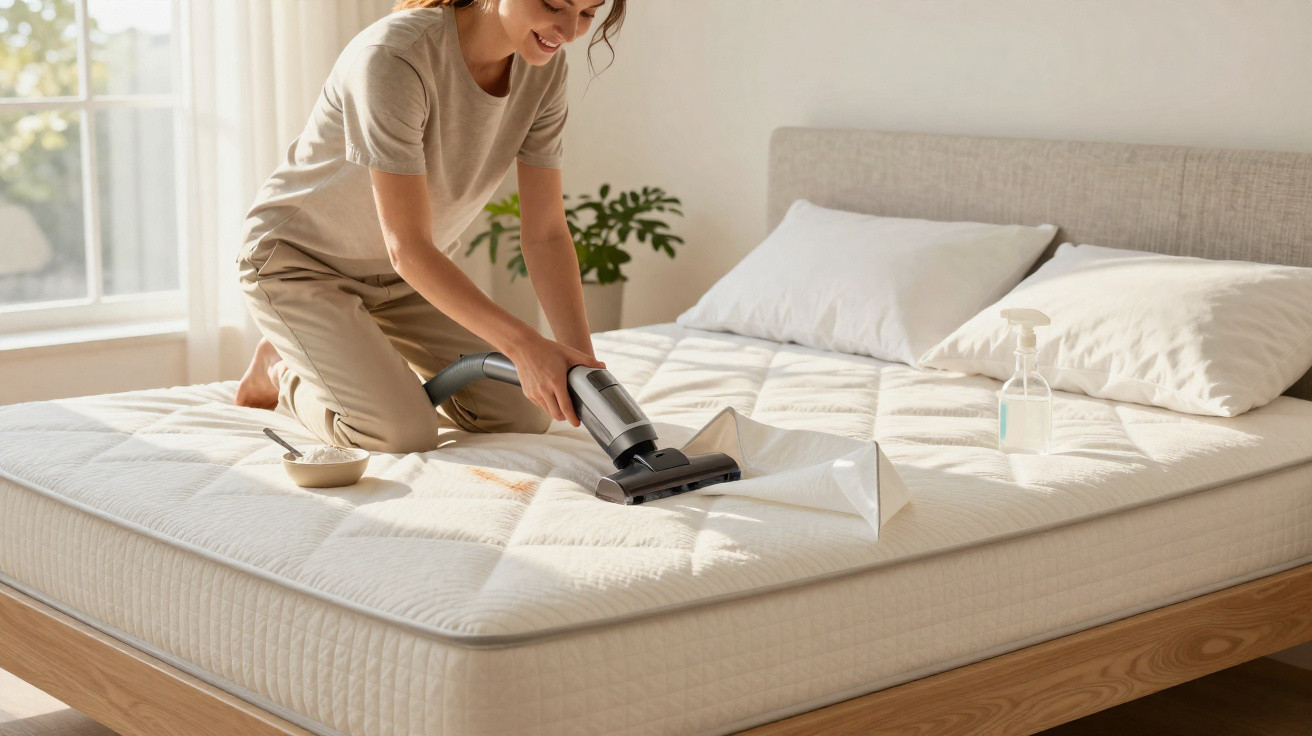
Step 4: Vacuum thoroughly for a hygienic mattress
Dust, mite droppings and skin flakes are found mainly in the upper centimetres. That is precisely where a vacuum cleaner with an upholstery attachment can reach effectively.
Vacuum correctly in just a few minutes
- Remove all bedding and expose the mattress
- Use a vacuum cleaner with an upholstery or furniture nozzle
- Move slowly in strips across the whole surface
- Do not overlook the edges and seams, where a great deal collects
If you have a house-dust allergy, schedule this task every four to six weeks. A vacuum with effective filtration, such as a HEPA filter, is ideal so fine dust is not released back into the air.
Step 5: Remove stains without soaking the mattress
Whether it is coffee in bed, spilled tea or sweat marks, there is no need to panic-but flooding the mattress with water is not the answer either. The aim is always to clean as locally as possible and get the mattress dry again quickly.
Gentle stain removal, step by step
- Absorb liquids immediately with kitchen roll or a clean cloth; do not rub, only blot.
- Mix a mild cleaning product, such as a small amount of delicate laundry detergent, with lukewarm water.
- Dab the stain with a lightly dampened cloth rather than soaking it.
- Use a second, dry cloth to absorb the moisture.
- Allow the mattress to dry thoroughly, preferably with the window open.
Vigorous scrubbing damages the surface and pushes dirt deeper into the material. Harsh cleaners or bleach can attack the structure and may even intensify odours.
Step 6: Wash the cover and mattress protector regularly
Many modern mattresses have a removable zip-up cover. It is easy to overlook in day-to-day life, although it is the first “filter layer” before the mattress core.
- Check the washing instructions on the label
- Most can be washed at 40 or 60 degrees
- Close the zip before washing, otherwise the cover may lose its shape
Ideally, there should always be a mattress protector over the mattress cover. It catches liquids, sweat and dust, and is much easier to clean.
A good mattress protector works like an airbag: you hope never to “need” it, but you are glad it is there when something happens.
What really matters in a mattress protector
The market is extensive, as is the price range. A few criteria can make choosing easier:
- Breathable: otherwise it can become sweaty and clammy
- Waterproof: protects against spilled drinks or minor accidents
- Washable at a minimum of 40 degrees: 60 degrees is better for allergy sufferers
- Secure fit: choose an elasticated skirt like a fitted sheet so it does not move around
If you change the protector along with the bedding, the mattress will remain almost stain-free over the long term. For people with allergies, a specialist encasement cover is also worthwhile, as it largely keeps mites out.
How often should you clean a mattress?
The following is a general guide for a household without particular allergies or medical conditions:
| Task | Frequency |
|---|---|
| Air without bedding | Once a week |
| Vacuum thoroughly | Every 4–6 weeks |
| Wash the cover, if removable | 2–4 times a year |
| Rotate / turn the mattress | Every 1–3 months |
| Wash the mattress protector | With the bedding or at least every 4 weeks |
If you sweat heavily, have pets in the bed or suffer from a house-dust allergy, shorten these intervals slightly.
When replacing your mattress makes sense
Even with the best care, there will eventually be a point when thorough cleaning no longer helps. Pronounced dips, noticeable springs, creaking noises or persistent back pain are clear warning signs. A strong odour that remains after several cleaning attempts is also more likely to indicate that replacement is needed.
As a general rule, most mattresses have passed their best after eight to ten years; budget models often reach this point sooner. Buying good quality and maintaining it regularly can noticeably extend this period.
Practical extra tips for better sleep
While giving your mattress some attention, you can also adjust a few factors that further improve sleep quality:
- Air the bedroom regularly with a short, wide-open ventilation period, especially in the evening before going to bed
- Use cotton or linen bedding, which absorbs moisture
- Do not store electrical devices that generate a lot of heat, such as laptops, on the bed for long periods
- If you have mould problems at home, use a hygrometer and check the humidity level
Your own physical response is also a useful indicator. If, after a few weeks of regular care, your back and nose feel calmer and the bed smells neutral or fresh, you are on the right track. That is ultimately the aim: quite literally, to sleep better.



Comments
No comments yet. Be the first to comment!
Leave a Comment