
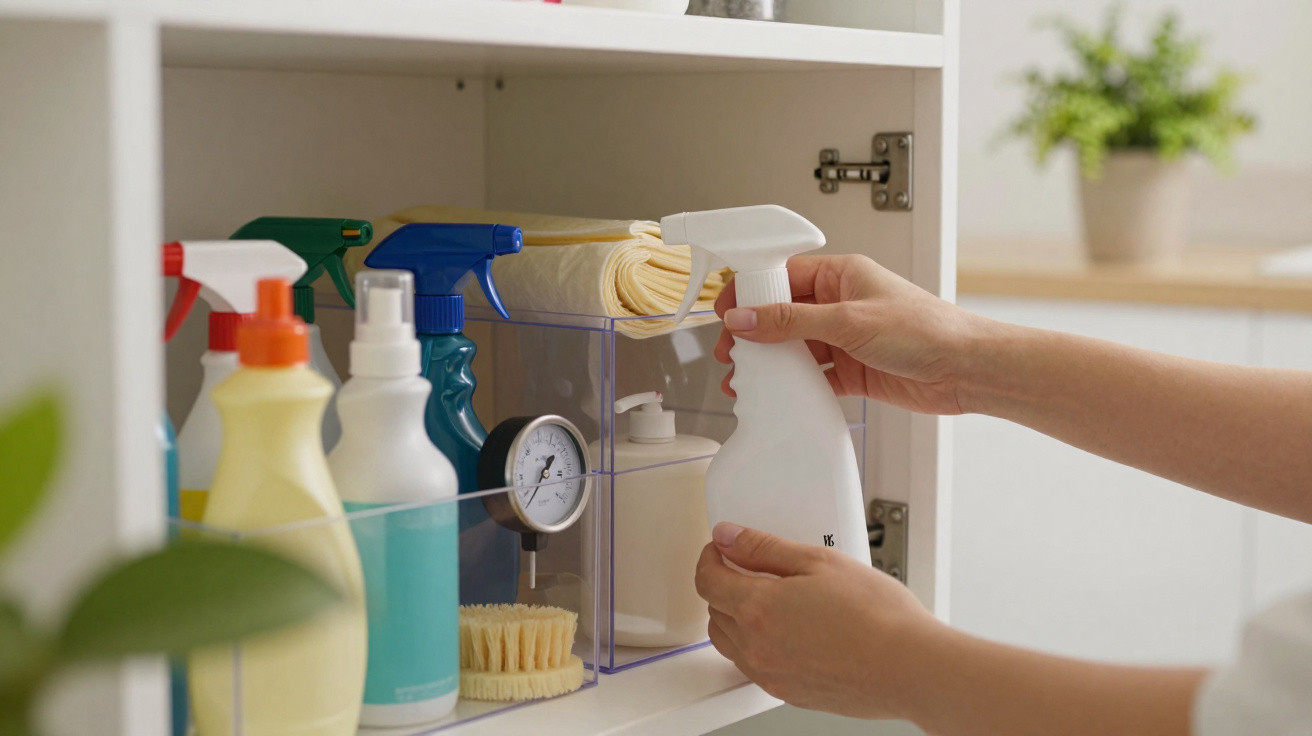
Beneath the sink, behind the bin, beside the sticky sponge you keep promising to throw away “one of these days” - that is where they end up. Labels are peeling away, several caps have not been shut properly, and one spray nozzle has developed an unexplained crust, as though it has survived a difficult time.
You pick up a multi-surface cleaner that claims to perform miracles in two minutes. You spray and scrub, only to be met with a disappointing finish: streaky mirrors, lacklustre marks on the worktop and a lingering chemical smell. The product is doing something, but it is clearly not delivering what the label promised.
Later, a professional cleaner opens the cupboard and arches an eyebrow. Without much comment, she shifts one bottle away from the radiator and stands another upright. That small action stays with you. The way we store these products may be quietly damaging them.
Most people do not realise it.
Why your “strong” cleaners are secretly getting weaker
Look inside almost any household cupboard and the scene is familiar: plastic bottles piled together at awkward angles, spray tops partly locked and lids coated in dried product. It may look untidy, yet it also feels entirely ordinary. That is where the cleaning products go, isn’t it?
Cleaning professionals, however, say that confined, warm and humid spaces are among the worst storage spots for many formulations. Some products react badly to heat, others to light, and others still should not be left partly open or sloshing about on their sides. Over time, this disorganised storage area can turn effective cleaners into tired liquids that no longer perform as they should.
During a home visit in Manchester, a professional cleaner I shadowed for a day took a cloudy bottle of bleach from a bathroom cupboard. Its label read “Kills 99.9% of germs”. Inside, the liquid resembled weak lemonade. “This has been in here for years,” she said. “Next to the radiator. It’s mostly water now.”
Every year, households purchase millions of litres of disinfectant and bleach, only to keep them in steamy bathrooms, bright laundry rooms and warm utility cupboards. A US laboratory study found that household bleach can lose a substantial amount of its strength within months when exposed to high temperatures. People believe they are disinfecting their surfaces, when they may simply be spreading dirt around with fragranced liquid.
The chemistry does not offer much room for error. Many disinfectants depend on unstable active ingredients, including sodium hypochlorite and hydrogen peroxide. Heat accelerates their deterioration, while light can have the same effect. Air entering through an inadequately closed cap can alter the formula. Even unsuitable products stored together in a cramped container may release vapours that gradually damage caps and seals. By the time you reach for that miracle spray, much of its “miracle” may have disappeared.
How to store cleaning products so they actually work
The first simple change is where you keep them. Rather than automatically putting everything beneath the kitchen sink, aim for somewhere cool, dry and protected from direct sunlight. A closed cupboard in the hallway, a shaded utility-room shelf or a ventilated pantry corner will provide a kinder setting for most cleaners.
Store bottles upright rather than on their sides. This single adjustment helps prevent gradual leaks and reduces the air trapped in the bottle. Secure caps fully and return spray nozzles to the “off” setting, preventing the product from constant exposure to tiny air currents and evaporation. It can seem overly particular during the first week, but it soon becomes automatic.
Let’s be honest: hardly anyone does this every day. Most of us throw things back into the cupboard, shut the door and get on with our lives. The answer is to arrange the area so that even “lazy” habits work to your advantage. A mother I interviewed in London bought a basic opaque plastic caddy for each area of her home: bathroom, kitchen and floors. Each caddy sits on a cool shelf rather than on a warm floor beside pipework. She told me that she simply returns each product to its allocated space without giving it a thought. The arrangement, rather than her self-discipline, keeps the formulas protected.
There is an emotional element too. On a rainy Tuesday in a small Dublin flat, a young couple showed me their under-sink “cleaning graveyard”: partly used sprays, unidentified bottles with faded labels and duplicate products hidden behind bulk packs of kitchen roll. They kept purchasing replacements because “nothing seemed to work anymore”, not realising that years of steam and hot pipes had heated and weakened their old products.
We have all uncovered a bottle that we “don’t remember buying”. That is more than mere clutter. It represents wasted money and time, as well as a quiet erosion of trust in the idea that cleaning can be straightforward and effective. After clearing the space, moving their everyday products into a higher, cooler cupboard and writing the purchase date on the base of every bottle, their shopping list became shorter. At last, their bathroom smelled clean rather than like an ageing swimming pool.
There is something unexpectedly personal about examining how people store the chemicals they use to make their private spaces feel safe. One experienced hotel housekeeper I spoke with put it plainly:
“Most people think the magic is in the product. In reality, half of the magic is in how you store it and the other half is in how long you let it sit on the surface.”
So, what does that “magic” storage look like in daily life?
- Keep bleach and disinfectants away from radiators, other heat sources and direct sunlight.
- Place light-sensitive products, such as hydrogen peroxide cleaners, in opaque or closed cupboards.
- Avoid piling heavy objects on spray bottles, as this can gradually loosen their caps and nozzles.
- Keep acids, including toilet descalers, separate from chlorine bleach to prevent dangerous fumes.
- Review expiry dates twice yearly and discard anything past its best without feeling guilty.
A tidier cupboard, and cleaners that genuinely clean
Once you understand how much storage can affect performance, it is difficult not to notice it everywhere. The glass cleaner left on a sunny windowsill may always leave streaks, whereas the identical brand stored in a shaded cupboard works brilliantly. The bathroom spray that “never really did much” may have been slowly heated by the hot-water pipe directly behind the unit.
Small changes have wider effects. You purchase fewer products but use the ones you have correctly. Instead of pursuing the newest “ultra-powerful” claim, you pay closer attention to where your current bottles rest between cleaning sessions. The cupboard below the sink becomes less like a junk drawer and more like a calm, practical laboratory. Not flawless, simply more deliberate.
At a deeper level, this concerns more than marks and streaks. It means avoiding sleepwalking through the unseen parts of household life. We spend money on formulas that promise safety, hygiene and care for our families, then store them in ways that weaken those promises. Correcting this can feel surprisingly grounding, much like straightening a crooked picture frame that you had ignored for years.
Your home will not turn into a hotel overnight. Nobody is asking you to create colour-coded shelves or label everything with military precision. Still, showing a little regard for temperature, light and time changes how those ordinary plastic bottles behave. It reduces the gap between what the label claims and what happens when you wipe the kitchen down after dinner.
That may be the most overlooked cleaning upgrade of all.
| Key point | Detail | Why it matters to the reader |
|---|---|---|
| Heat and light break down active ingredients | Disinfectants and bleach kept in hot, bright locations lose strength more quickly | Explains why “strong” products can suddenly appear weak or ineffective |
| Storage position matters | Upright bottles with firmly closed caps and nozzles reduce evaporation and exposure to air | An easy habit that helps products perform properly for longer |
| Cool, dry, shaded spaces are best | Hallway cupboards, shaded shelves and ventilated pantries protect formulas | Offers practical alternatives to the usual under-sink disorder |
FAQ:
- How long do typical cleaning products actually last? Most unopened products perform best for 1–2 years. Once opened, many disinfectants and bleach lose noticeable strength after 6–12 months, particularly when stored in warm conditions.
- Is it safe to store all cleaners together in one box? It is safer to keep harsh acids, such as toilet descalers, away from chlorine bleach and strong ammonia products. Fumes and minor leaks can combine in a confined space, damaging caps and producing risky vapours.
- Can I keep cleaning sprays in the bathroom? You can, but select the coolest and driest location available. Do not use cupboards directly beside hot-water pipes or radiators, and avoid leaving bottles on steamy window ledges.
- Why does my bleach look weaker or less white over time? Bleach naturally degrades into salt and water, especially when exposed to warmth or sunlight. If it appears yellowish or pale and has a less sharp smell, much of its disinfecting power has already been lost.
- Do eco or “natural” cleaners need special storage? Many plant-based formulas use gentler, more delicate ingredients and fewer preservatives. They generally benefit even more from cool, dark storage and from being used by the date shown on the bottle.

Comments
No comments yet. Be the first to comment!
Leave a Comment