
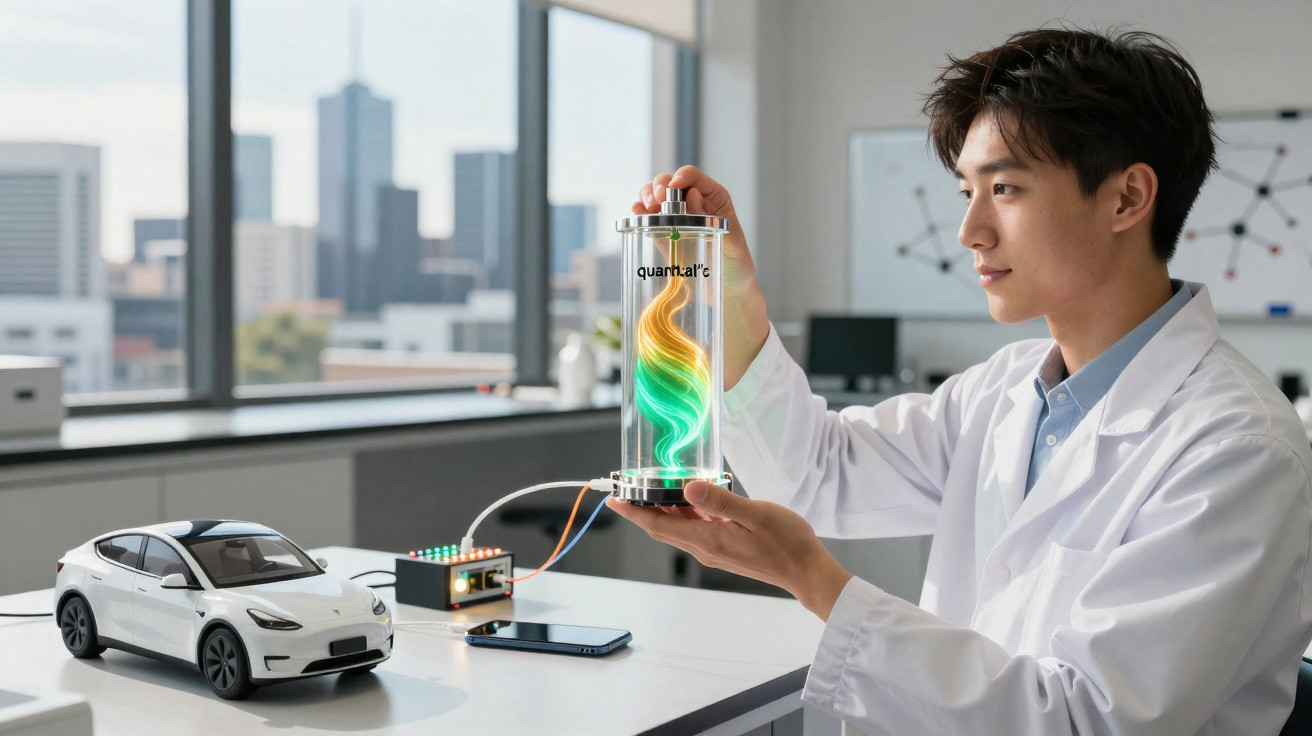
In laboratories in Melbourne, researchers have achieved something that sounds like science fiction: a tiny quantum battery absorbs energy from light in a fraction of a second. It remains an experimental system for now, but the technology could fundamentally reshape charging times and energy use, from smartphones to electric cars.
What powers the new quantum battery
The prototype was developed by a research team from Australia’s CSIRO agency, the University of Melbourne and RMIT. Its approach is radically different from conventional lithium-ion batteries, which depend on comparatively slow chemical reactions.
Instead, the quantum battery exploits the unusual rules of quantum physics. Put simply, numerous energy states are arranged within one jointly coupled system, allowing them to absorb light not bit by bit but through a single collective process.
“The battery does not charge continuously; it absorbs the laser’s energy in a single event – rather like taking a huge energetic gulp from a bottle.”
The scientific journal Nature, Light: Science & Applications describes the system as highly experimental but operational. The researchers say it provides clear evidence that a quantum-based storage system can be charged extremely rapidly and without physical contact.
Super-absorption: when light energy disappears in one go
The key effect underpinning the technology is known as “super-absorption”. Rather than individual particles independently taking in quanta of light, or photons, the entire system is entangled so that it absorbs energy through a collective process.
In practical terms, the battery does not need to be gradually “filled” with energy, as is the case with today’s fast-charging functions. Instead, almost all of the energy reaches the storage device within an exceptionally short time window.
- The battery is exposed to a laser.
- The quantum-physical system enters a shared excited state.
- Light energy is absorbed in a “super-event”.
- The charging process takes significantly less than one second.
For the tests, the team used ultra-fast lasers from the University of Melbourne’s chemistry faculty. These instruments make measurements in femtoseconds possible – intervals in which light travels only a few nanometres. At that scale, it became clear that energy is not absorbed in portions, but in one brief and concentrated event.
The larger the battery, the faster it charges
One of the most surprising observations appears almost counterintuitive: the quantum battery charges more quickly as it becomes larger. This runs contrary to everyday experience with conventional batteries, where greater capacity almost always means longer charging times.
“In quantum batteries, charging speed increases with the size of the system – an effect that arises directly from quantum physics and cannot be explained classically.”
This is due to the collective coupling of the many particles involved. The more particles that operate in a shared quantum state, the more pronounced the super-absorption effect becomes. The researchers regard this as a fundamental quantum advantage that classical technologies cannot replicate.
What this could eventually mean for electric cars and gadgets
The group’s vision extends well beyond a laboratory experiment. Potential uses range from wirelessly charged smartphones that need only rest briefly on a desk to electric cars that could be “filled up” in a few seconds.
Project leader James Quach has set an ambitious target: one day, electric vehicles should charge faster than combustion-engine cars can refuel. At the same time, the team envisages everyday devices that simply remain within the range of a transmitter and recharge automatically – with no plug, no induction pad and no tangle of cables.
How realistic is everyday use?
Despite the impressive results, the quantum battery is still at a very early stage. The current prototype has only a tiny capacity. Above all, it demonstrates that the storage principle works; it does not mean a mass-market electronics product will arrive tomorrow.
The researchers identify three central challenges:
- Scaling capacity: The energy store must be made substantially larger without destroying the quantum effect.
- Charge stability: Energy must not dissipate again after seconds or minutes, but remain stored in a usable form.
- Operation under ordinary conditions: The system must work reliably at room temperature, without relying on extremes such as a vacuum or very low temperatures.
At least the newly presented prototype already operates at room temperature, representing an important move towards practical use. Many other quantum experiments require complex cooling systems or specialised environments.
How quantum energy storage differs from ordinary batteries
A direct comparison with today’s lithium-ion cells helps put its significance into perspective.
| Feature | Today’s batteries | Quantum battery (prototype) |
|---|---|---|
| Charging principle | Slow chemical reactions | Quantum-physical super-absorption of light energy |
| Charging time | Minutes to hours | Less than one second in a laboratory experiment |
| Charging cable | Essential | Contactless charging by laser possible |
| Scaling | More capacity = longer charging time | More capacity = potentially faster charging |
The quantum version therefore does not replace electricity or the conservation of energy. It merely changes how quickly and efficiently energy can flow from light into storage.
Opportunities, risks and unanswered questions
The new technology inevitably raises questions. How safe would continuous laser operation be in homes or alongside motorways? How could misuse or health risks be prevented? So far, the researchers are discussing laboratory performance involving precisely controlled beams and power levels, rather than uncontrolled high-energy lasers in everyday settings.
At the same time, the technology could create new opportunities for electricity grids and renewable energy. Extremely fast-charging storage systems might better absorb short-term output peaks from solar and wind installations. Energy that is currently lost because storage options are lacking could then be used more purposefully.
Consumers could notice the difference: less wear caused by repeated fast charging, shorter waiting times and more flexible use of electric vehicles. Combined with smart electricity grids, quantum storage could smooth demand peaks and stabilise electricity prices.
What quantum terms mean in this context
Terms such as “super-absorption” and “entanglement” often sound abstract. At their core, they describe how particles behave differently as a collective than they do individually. In a quantum battery, the complete system responds to light as one large receiver, rather than as many separate miniature aerials.
For everyday purposes, the distinction can be pictured this way: while a current battery is more like a bucket that is filled with water gradually, a quantum battery is more like a sponge that absorbs the water all at once. The challenge is to build that sponge so it reliably holds the water afterwards.
Whether, and when, such storage systems reach the mass market remains uncertain. However, the Australian breakthrough shows that quantum physics is useful not only for exotic computers: it could also transform the charging of electric cars, laptops and household appliances.






Comments
No comments yet. Be the first to comment!
Leave a Comment