
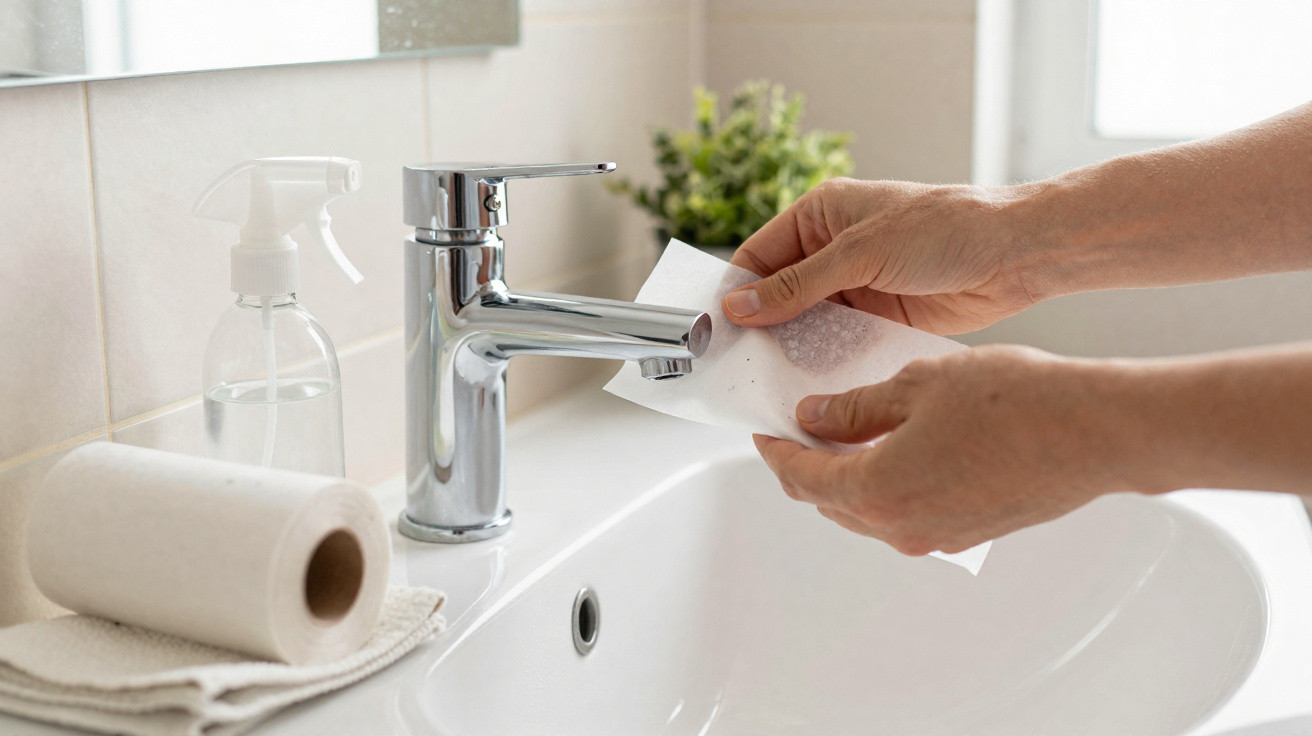
Anyone living in an area with hard water will recognise the issue: limescale quickly builds up on taps, makes chrome look dull and undoes the results of a thorough clean in no time. Chemical descalers may work, but they often smell harsh, can damage surfaces and cost money. A surprisingly easy kitchen trick offers a solution, using something most people already have at home.
Why limescale damages taps so quickly
Limescale, usually calcium carbonate in technical terms, occurs wherever water contains high levels of calcium and magnesium ions. The more of these minerals are present in the mains water, the “harder” it is. When the water is heated or evaporates in the air, the minerals remain behind as whitish marks, deposits or a cloudy film.
Taps are particularly prone to this problem. Typical signs include:
- white spots around the base of the tap
- a dull finish on chrome or stainless steel
- an altered water flow that splashes or runs only as a thin stream
Inside the aerator, also known as a perlator, limescale collects on the fine filters and nozzles. This reduces the flow rate, makes the stream uneven and causes water to spread across the edge of the basin – creating ideal conditions for even more limescale marks.
Conventional supermarket descalers reliably dissolve these layers, but they must be used carefully. They need time to work, require thorough rinsing and often contain acids that can gradually dull tap finishes, particularly if a harsh scouring pad is used at the same time.
“Anyone who wants not only to remove limescale but also to slow down its return needs a gentle, preventative method.”
Baking paper as a secret weapon against limescale marks
This is where an unassuming product comes in: baking paper, also called parchment paper. Although it was designed to stop dough and food sticking to a baking tray, it has a thin non-stick coating. Surprisingly, that coating also works well on metal surfaces in bathrooms and kitchens.
On a dry tap, baking paper works in two ways:
- Gentle abrasion: Rubbing with the slightly smooth paper loosens fine limescale residue and water marks without scratching the surface.
- An invisible protective film: Its coating leaves behind an extremely thin water-repellent layer. Drops bead up more readily and are less likely to remain as standing pools of water.
Many users report that taps treated this way stay visibly clean for five to seven days. They retain a polished appearance for longer, even without a conventional cleaning product.
How to use baking paper correctly
The technique is straightforward and takes barely more than a minute:
- First, dry the tap thoroughly with a microfibre cloth.
- Tear off a piece of baking paper and loosely scrunch it into a ball.
- Rub the ball over every shiny area: the spout, handle, base and, if applicable, the hand shower.
- Use only light pressure, treating it as polishing rather than scrubbing.
- Finish by briefly buffing the surface with a clean microfibre cloth.
Important: baking paper is mainly suitable for smooth, shiny finishes, such as chrome-plated or stainless-steel taps. On matt or black surfaces, test it first in an inconspicuous area to check whether it changes the look of the finish. It is also best to avoid nearby natural stone, such as marble or travertine, to prevent staining.
Why this baking paper trick reduces cleaning frequency
Its greatest benefit is prevention. Rather than waiting until thick limescale rings have formed, the film left by baking paper offers protection from the outset. Water droplets cling less readily, run off faster and leave fewer deposits as they dry.
Anyone who makes this short ritual part of their weekly routine will notice several everyday benefits:
- Taps continue to look freshly cleaned for much longer.
- Strong descalers are needed far less often, saving money.
- Surfaces are protected because fewer aggressive products are required.
“Baking paper does not replace a thorough descaler, but it takes away much of its work.”
What to do with heavily limescaled taps
If a tap already has visible deposits, the kitchen trick alone will not be enough. In that case, a thorough treatment with established products is necessary. The following approach has proved effective:
- Unscrew the aerator from the spout and soak it in lukewarm household vinegar.
- Leave it to work for several hours, or overnight if the limescale is stubborn.
- Apply vinegar or lemon juice around the spout and base of the tap, wait a few minutes, then wipe it away with a soft cloth.
- For thick crusts, mix bicarbonate of soda with a little water to form a paste, apply it, leave it briefly, then rub gently.
- Finally, rinse everything thoroughly with clean water and dry it off.
Only once the original shine has returned can baking paper deliver its full benefit. After that, a brief weekly treatment is enough to maintain the condition for as long as possible.
A simple everyday routine against bathroom limescale
A few small habits can significantly reduce limescale problems. A combination of three steps is especially effective:
- Daily: After washing your hands or brushing your teeth, quickly wipe the tap with a microfibre cloth.
- Weekly: Polish the tap with baking paper to renew the water-repellent effect.
- Every few weeks: Unscrew the aerator and clean it in vinegar to keep the water flow even.
People living in areas with especially hard water may also want to consider technical solutions, such as aerators with a special coating that makes limescale deposits harder to form, or water-treatment systems fitted directly to the household water supply. Such systems involve an initial cost, but in the long term they reduce the strain not only on taps, but also on washing machines, boilers and dishwashers.
Background: what “hard water” does in the home
The term “water hardness” describes the level of calcium and magnesium salts in mains water. Once it reaches a certain level, the water is classed as hard. In many parts of Germany, Austria and Switzerland, levels fall within the medium-to-high range.
The effects are visible in more places than just the tap:
- scaled-up heating elements in kettles and washing machines
- white rings in showers and baths
- a higher need for laundry detergent and dishwasher detergent
Once you understand that minerals are always left behind as water dries, it becomes clear why drying surfaces and making them water-repellent matter so much. This is precisely where baking paper has an effect: it makes metal slightly smoother and reduces the contact area between water and the tap.
When the trick is less suitable
Useful as it is, this tip is not right for every circumstance. In homes where children regularly cover taps with soap residue, polishing alone will not be sufficient. In these cases, regular use of a conventional bathroom cleaner remains necessary before applying baking paper.
It is also worth checking the manufacturer’s care instructions for expensive designer taps with special coatings. Some finishes tolerate only very mild care products. In these situations, always test the method on a small, concealed area first.
Practical additions for even less cleaning
To reinforce the effect of baking paper further, a few extra measures can help:
- Choose an aerator with a lower flow rate – less water means less splashing.
- Wipe away soap residue from the edge of the basin immediately, so that it cannot combine with limescale.
- Before leaving the shower, quickly dry the shower tap and rail with your towel.
After a few weeks, many people notice that their taps look better cared for despite being scrubbed far less often. The same pattern appears in the cleaning cupboard: bottles of aggressive descalers remain full for longer, so replacements are needed less frequently.
“A piece of baking paper from the drawer does not replace a deep clean, but it can make one surprisingly unnecessary for a long time.”
Comments
No comments yet. Be the first to comment!
Leave a Comment