
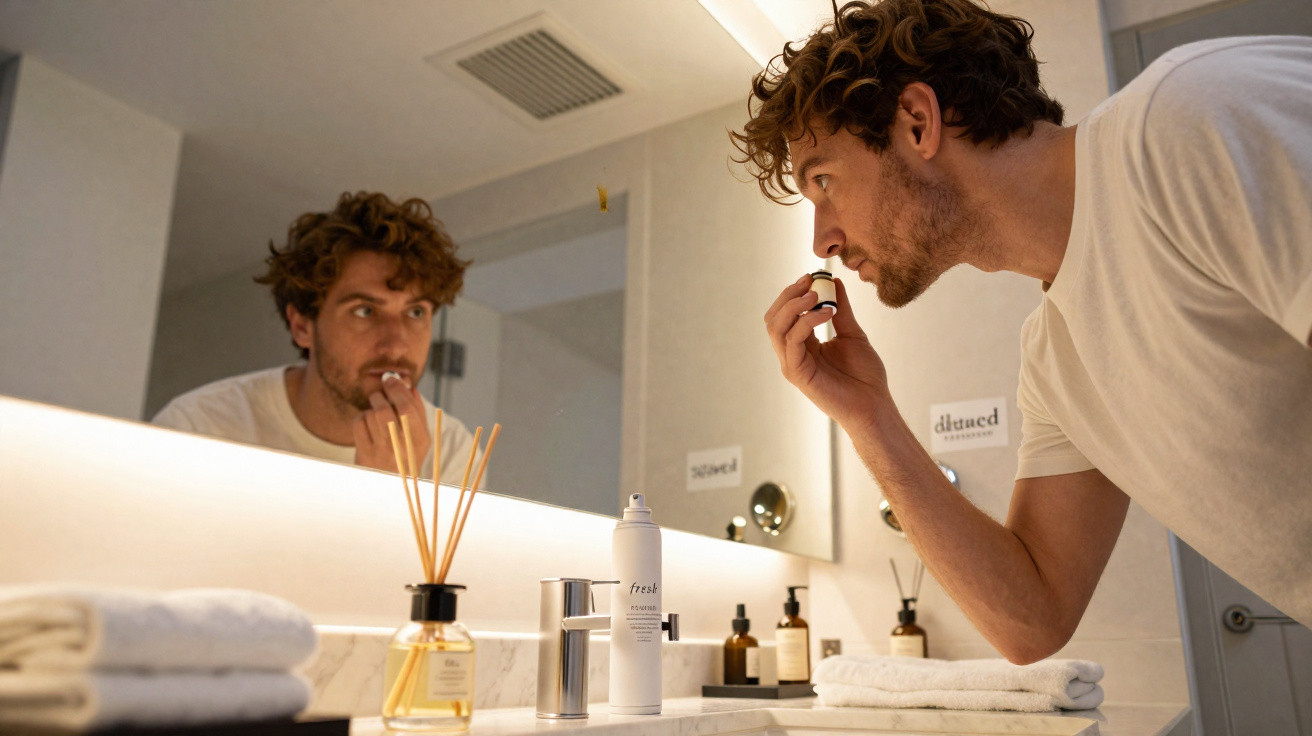
The bathroom door shuts with the muted quiet of a hotel, and for a moment it feels as though you have walked into an advert. There are soft white towels, chrome taps and a mirror that makes you appear less exhausted than you feel. Then there is the fragrance: clean, “fresh”, almost sea-like, with a floral note you cannot quite identify. You unwind. If it smells this pleasant, surely it must be spotless?
You put down your bag and take another breath. The fragrance lingers in the room, on the shower curtain and even on your clothing. Between the tiles and the miniature soaps, your mind makes a silent connection between “perfume” and “hygiene”. There seems little reason to inspect anything more closely or consider what may be concealed beneath the gleam.
That is precisely where the illusion starts.
The reassuring myth of the “fresh” hotel bathroom
Step into almost any mid-range or upmarket hotel, and its bathroom can seem like a refuge. The atmosphere is sharp and clean, reminiscent of washing dried in a mountain breeze, perhaps with citrus or something described as “marine”. Your shoulders loosen before your suitcase has even touched the floor. None of this happens by chance. It is carefully designed.
Marketers refer to this as scent branding. Hotel groups invest huge sums in developing a distinctive fragrance that communicates calm and cleanliness as soon as guests arrive. Your nose receives the signal before your eyes can assess the room, and your brain supplies the missing details. You are not simply detecting lemon; you are detecting “this place is safe”.
That is the perception on which hotels quietly rely.
A receptionist in Lisbon once said to me, only half in jest, that her hotel’s “biggest cleaning tool is an aerosol can”. She meant the bathroom spray used between guests. The room where I stayed certainly smelled pristine, but the grout lines told a different story.
Everything looked glossy at first glance. However, a hardened ring of limescale sat around the basin tap, while a faint trace of old mould appeared behind the bottom edge of the shower curtain. Even so, the air held that comforting “just cleaned” haze. My immediate reaction was to believe the smell rather than examine the evidence.
Most of us know that moment: the nose overrules the eyes, and we choose not to investigate further.
A straightforward psychological bias is involved. We associate a pleasant fragrance with cleanliness, even where the two have no real connection. Hotels understand this and may use powerful fragrances to disguise what hurried cleaning has failed to tackle thoroughly. Fast room turnarounds, poorly paid housekeeping teams and pressure to maintain high occupancy all encourage this shortcut.
The result can be a bathroom that seems disinfected when it has merely been deodorised. The drain may be partly blocked and the showerhead may contain biofilm, but an ocean-breeze spray can remove your hesitation. A fresh scent is cheaper than an extra fifteen minutes of detailed cleaning.
That is the understated financial logic behind the moment when you think, “wow, it smells so clean”.
How hotels shape the air in your bathroom
Watch housekeeping during a busy morning of departures and you will see just how fast the work must happen. Bedding is stripped, bins are emptied and surfaces are wiped at Formula 1 pace. Bathrooms receive their own rapid routine: chemical cleaner is sprayed onto obvious areas, followed by a brief scrub, a wipe or two across the mirror and then the key step-spray. Plenty of spray.
Air freshener is not merely the final flourish; it is part of the process. A long hiss goes into the shower, another near the toilet and a final mist by the door. The fragrant cloud remains suspended, ready to greet the next guest with “reassuring cleanliness” the instant they enter.
You are not detecting hygiene. You are detecting a strategy.
Luxury hotels seldom feature this in Instagram posts, yet former housekeeping workers often describe the same approach. On anonymous online forums, cleaners say they were told to “focus on what guests see and smell first”. In practice, that means the mirror, basin, toilet seat and then a liberal application of the hotel’s signature fragrance.
One former housekeeper at a four-star London hotel said that, on days when the hotel was full, staff had under 15 minutes for each room, including its bathroom. Properly cleaning shower tiles in depth or taking apart a drain was simply impossible within that timeframe. What was possible? A powerful fragrance diffuser in the corridor and a concentrated spray bottle in each bathroom.
The outcome is a finish made for Instagram, a sense of olfactory reassurance and neglected corners quietly deteriorating out of sight.
There has also been a gradual move away from neutral cleanliness and towards forceful fragrance. Rather than a subtle scent of soap, many hotel bathrooms now resemble a perfume counter. That abundance is deliberate, not accidental. Strong smells stay with people and become part of the brand experience: the detail you remember later on the train home, “Their rooms smelled so fresh.”
The uncomplicated reality is that a bathroom may smell like a spa while bacteria remain unseen on the shower curtain or hair sits in the drain. Your nose cannot identify hygiene; it only detects molecules. Those molecules may be from bleach, or they may come from a synthetic “ocean rain” blend released by a concealed diffuser.
Cleanliness is about what’s removed; scent is about what’s added. Hotels may sometimes neglect the first while placing considerable emphasis on the second.
How to look beyond perfume and protect yourself
The next time you enter a hotel bathroom and encounter that familiar surge of “freshness”, wait ten seconds before settling in. Pause, allow the scent to disperse, then inspect the room properly-not with the distracted glance common after a tiring journey.
Examine the grout between the tiles. Check the silicone sealant around the bath or shower. Wipe beneath the basin tap with a tissue to see whether it comes away grey or clean. Look at the lower edge of the shower curtain, the floor corners behind the toilet and the air-vent grille.
This is not paranoia; it is simply distinguishing fragrance from hygiene.
Many people feel uncomfortable doing this, as though they are personally accusing a member of staff. Nobody wants to be “that” guest-the demanding one. So we smell the citrus mist, assure ourselves that all is well and place a toothbrush beside a tap that may not have had its built-up grime properly removed for months.
Realistically, nobody disinfects every hotel surface they touch every day. Still, you can take a few uncomplicated precautions. Avoid placing your toothbrush directly on the basin; keep it in a travel case or stand it in a glass. If you have tissues or sanitising wipes with you, quickly wipe the toilet flush button and the door handle.
If the fragrance is intensely strong or nearly suffocating, do not interpret it as evidence of additional care. Treat it as a reason to look more carefully.
A veteran hotel cleaner once told me, “If you want to know how serious a place is about hygiene, ignore the smell and check the places we don’t have time for-the corners, the hinges, the underside of things.”
- Inspect the shower-curtain hem: yellowing and mould marks reveal more than any “fresh linen” fragrance.
- Check the drains: visible residue or hair suggests that the less obvious areas are being missed.
- Look at the air vent: a heavy layer of dust indicates that deeper cleaning is not a priority.
- Choose your own small toiletries rather than opened hotel bottles that may have been refilled.
- Listen to your body: if a fragrance causes a headache, open the window or request a room without scent diffusers.
Behind the pleasant smell: what sort of “clean” do you want?
Once you become aware of how heavily hotels use scent to communicate cleanliness, it is difficult to stop noticing it. There is the bathroom spray, the unobtrusive diffuser in the corridor and the same “signature aroma” appearing again in the lobby and, strangely, the lift. Together, they deliver one message: this hotel is fresh, safe and hygienic.
Actual hygiene, however, is largely invisible and does not always resemble a Pinterest board. A truly clean bathroom may have a slight chlorine smell, or virtually no scent at all. It does not require a dense layer of perfume to persuade you; its details provide the proof. The grout is clear, the corners are dry and free of mould, and the shower curtain appears freshly washed rather than merely freshly sprayed.
When you next catch yourself assuming that “smells great” means “must be clean”, stop for a moment and mention it to the person travelling with you. Discuss the tactics you have observed and the small checks you have begun to make. That brief awareness can alter the way you assess every hotel room you enter afterwards.
Maybe the real luxury isn’t a bathroom that smells like a spa, but one that doesn’t need perfume to prove it’s truly clean.
| Key point | Detail | Value for the reader |
|---|---|---|
| Smell ≠ hygiene | Hotels use powerful fragrances and scent branding to create a “clean” impression even when deep cleaning is rushed | Helps you avoid treating perfume as evidence of sanitation |
| Check hidden zones | Grout, shower-curtain hems, drains and vents show whether cleaning is superficial or thorough | Offers fast ways to judge genuine cleanliness in seconds |
| Simple protective habits | Keep your toothbrush raised, wipe important touch points and be wary of overpowering fragrances | Lowers health risks without making your trip feel like a military operation |
FAQ:
- Do hotel air fresheners kill germs or just mask smells? Most hotel air fresheners simply conceal odours; they do not disinfect surfaces or kill bacteria in any meaningful way.
- Is a strong perfume smell in the bathroom a red flag? It can be: an overpowering scent may indicate that a hotel is masking odours rather than addressing their underlying causes through deep cleaning.
- What should I quickly check first in a hotel bathroom? Examine the shower-curtain hem, grout lines, drain area and corners behind the toilet-these areas reveal the true cleaning effort.
- Are hotel toiletries safe to use? Sealed, single-use products are usually safer; refillable or open bottles may sometimes be topped up without proper sanitising.
- Can these fragrances be bad for my health? Yes, certain synthetic scents can trigger headaches, allergies or asthma; if you feel unwell, ask reception for a room with less fragrance or none at all.

Comments
No comments yet. Be the first to comment!
Leave a Comment