
Many homes are crowded with bottles, sprays and cloths for virtually every surface. Yet, despite all their promises, fine scratches, dusty films and hazardous fragments of glass are often left behind. An old-fashioned household tip now shows that an ordinary kitchen item can clean delicate surfaces remarkably thoroughly – without a chemistry set, overpowering fragrances or risks to children and pets.
The unexpected cleaning helper from the bread bin
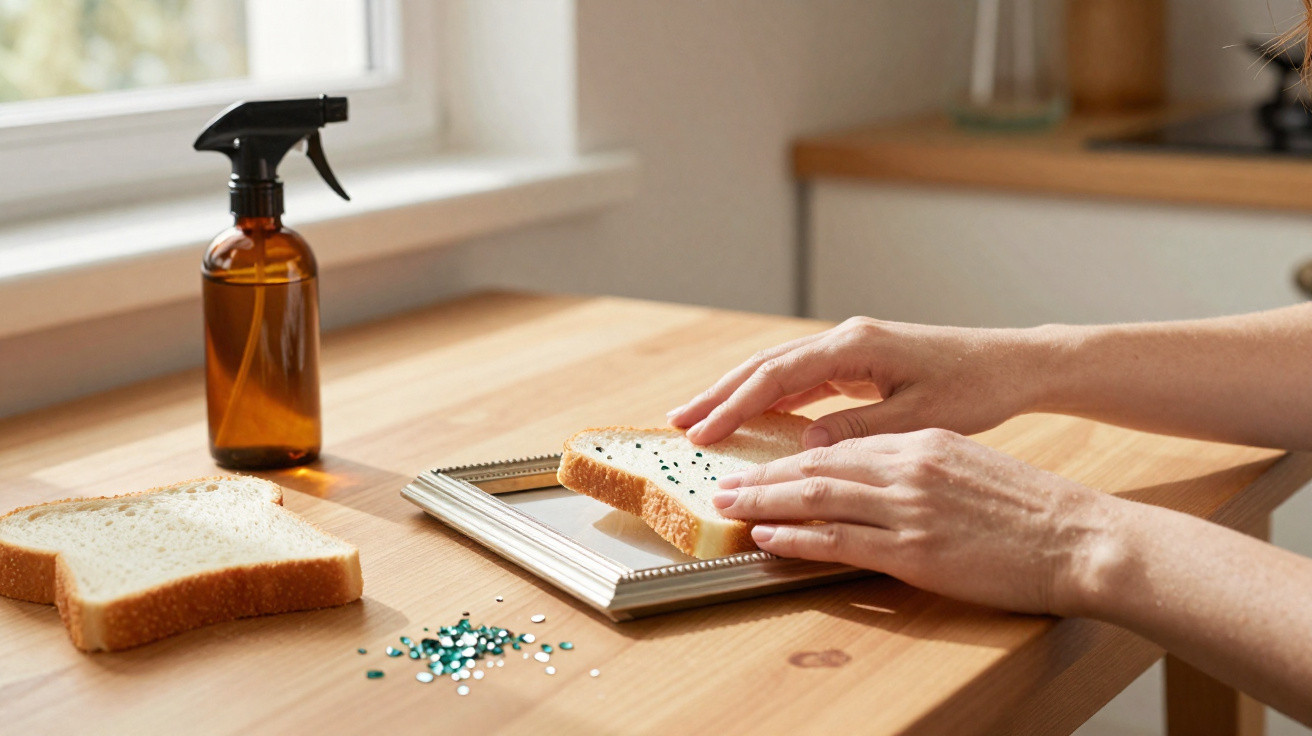
The secret star is neither a high-tech sponge nor a newly launched miracle cleaner, but plain bread crumb – specifically fresh, soft white bread crumb without the crust. What many grandmothers once used as a matter of course was forgotten with the rise of spray bottles and mops.
A simple piece of soft bread crumb becomes a gentle cleaning aid that cleans sensitive surfaces without damaging them.
The key is that the crumb absorbs dirt and even tiny glass shards rather than spreading them across the surface. It contains no harsh chemicals or abrasive particles. This makes it particularly useful in places people might otherwise hesitate to clean, including old paintings, delicate walls and fine glass objects.
How bread crumb works as a natural cleaner
Why the crumb structure captures glass shards
Fresh bread crumb is made up of countless small cavities – air bubbles formed during baking. Its sponge-like structure acts like a fine net.
- Tiny fragments and dust particles become trapped in the pores.
- The soft material encloses foreign particles and holds them inside.
- The particles can no longer travel across the floor or through the air.
When a glass breaks, invisible miniature shards often remain after sweeping or vacuuming. An ordinary broom merely moves them around, while the airflow from a vacuum cleaner may even scatter them. If a piece of bread crumb is gently pressed onto the affected area, these remnants stick to its elastic mass. The crumb can then simply be disposed of in the general waste.
This lowers the risk of stepping on unseen shards while barefoot. It is an obvious safety benefit, especially in kitchens and children’s bedrooms.
Elasticity rather than friction: dirt is lifted, not smeared
A second important benefit is the natural elasticity of fresh bread crumb. Unlike a dry cloth, it does not push dust aside but encloses it. When pressed lightly, the material adapts to the surface, enters small indentations and grooves, and lifts out particles lodged there.
It can work on delicate materials that people would normally avoid cleaning for fear of scratches or water marks:
- old paintings and oil-paint surfaces
- sensitive wallpaper and matt wall paint
- fine mirrors and thin glass
As bread crumb is soft, it does not leave abrasive marks. Provided it is still fresh, it will not break down into hard crumbs that could themselves cause scratches.
Where bread crumb is unbeatable: common uses around the home
Delicate paintings and old picture frames
Dust on an oil painting is a persistent problem. Damp cloths may loosen the paint surface, while aggressive cleaners can ruin the patina and sheen. Used with careful dabbing, bread crumb works surprisingly gently:
- Tear off a small piece of fresh crumb.
- Shape it lightly into a soft “puck” using your fingertips.
- Dab it vertically onto the painted surface without applying pressure; do not rub.
- Replace the crumb with a new piece as soon as it looks grey or dirty.
Gradually, the dust adheres to the crumb and the colours appear clearer and more vivid. Conservators have long used techniques like this when dealing only with light surface dirt.
Smudged pencil marks on pale walls
Anyone with children will recognise the issue: creative walls in the hallway or bedroom. Conventional erasers often leave pale streaks, while cleaning products can create marks in the paintwork. Soft bread crumb can provide targeted help here.
Press the crumb repeatedly onto the affected spot using very little pressure. The graphite gradually transfers into the material without rubbing away the wall paint. Patience pays off: several small steps usually achieve more than one forceful wipe.
Glass, mirrors and delicate decorative objects
Thin glass and old mirrors can react badly to rough cloths and kitchen roll. Tiny abrasive grains or dust trapped beneath a cloth can leave scratches that only become visible in backlight. A soft piece of bread absorbs dust and small particles without scouring the surface.
Treating glass and mirrors with bread crumb greatly reduces the risk of micro-scratches – particularly on older pieces.
For display cabinets, glass lamps or glass decorations, it is worth trying the method first in an inconspicuous area. If the trick works, entire surfaces can be cleaned before being polished with a soft, slightly damp cloth.
Which bread is suitable – and which is not?
Why white sliced bread is often the best choice
Not every type of bread crumb performs equally well. Soft white bread that is not overly moist and has no hard crust is ideal. The crumb should:
- have an even, fine-pored texture
- compress when pressed without falling apart
- contain no grains, seeds or hard pieces
Wholemeal bread and very crusty loaves often contain husk residues and outer layers that may scratch surfaces. Extremely moist doughs are also more likely to stick than to clean effectively.
| Bread type | Suitability for cleaning |
|---|---|
| White bread without crust | very suitable |
| Fresh toast bread | suitable |
| Wholemeal bread | only partly suitable, generally unsuitable |
| Baguette with a hard crust | unsuitable, as the crust may scratch |
| Stale, hard bread | unsuitable, too crumbly and abrasive |
The best option is a piece that is no longer appealing enough to eat but remains soft. This means less bread is thrown away, while it gains a second use around the home.
The correct technique: dab rather than rub
Success depends entirely on the movement used. Rubbing simply shifts dirt around or damages the surface. A calm, repeated downward press is more effective.
- work on small areas only
- change the piece of bread once visible dirt appears
- test stubborn marks first in an inconspicuous spot
If an object is highly sensitive, such as a valuable painting or antique, it is best to consult a specialist when in doubt. Bread crumb is not a substitute for professional restoration; it is mainly useful for light dust and everyday marks.
Environmental benefits and possible limitations
Using bread crumb can eliminate the need for several specialist cleaners. This reduces packaging waste, chemical residues in wastewater and household costs. Bread is made from natural ingredients and biodegrades completely. Only the collected dirt ends up in the general waste.
Even so, this trick is not suitable for everything. Greasy kitchen surfaces, bathroom limescale and stubborn discolouration require other methods. Bread crumb is better suited to dry dirt, dust, pigments, light scuff marks and, importantly, hazardous tiny glass shards.
The psychological effect is also interesting: once someone has seen how well such a simple remedy works, they are more likely to question reaching for the next colourful bottle. Many household problems can be solved with straightforward, time-tested tips if you know them – from vinegar cleaner to a slice of potato for water marks. Bread crumb takes its place on this list quietly but effectively.
The next time you hear a glass shatter or spot another pencil line on a child’s bedroom wall, there is no need to reach immediately for a box of chemicals. A quick reach into the bread bin is often enough to deal with the delicate area safely and gently. That is the quietest strength of this almost forgotten household trick.
Comments
No comments yet. Be the first to comment!
Leave a Comment