
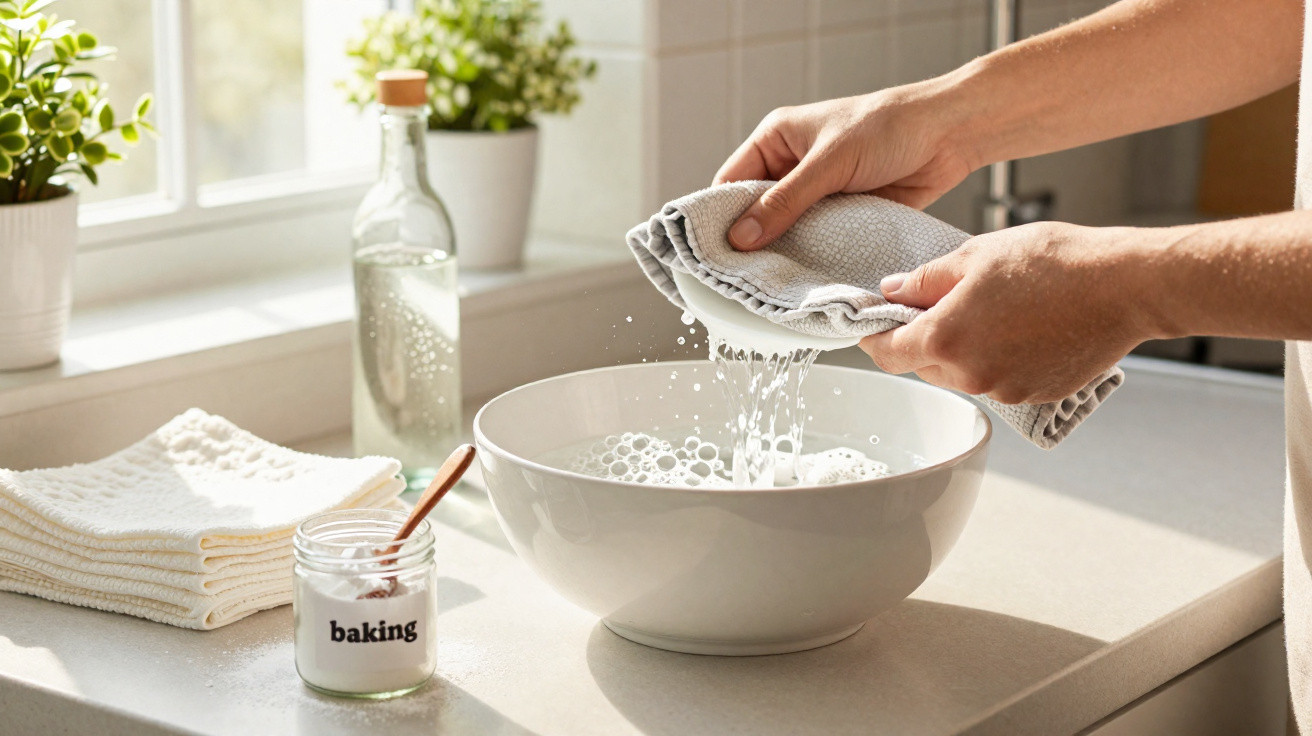
Anyone who cooks regularly will know the problem: newly bought tea towels soon start to look dull, stained and stiff. The washing machine is running, the detergent is right – yet a grey film remains. A straightforward combination of two household staples can help, without using chlorine cleaner.
Why tea towels quickly turn grey and smell musty
Tea towels are constantly in use: frying fat, tomato sauce, coffee, tea and red wine all end up on them. Much of this does not wash out completely, particularly at lower temperatures.
A few common everyday habits also contribute:
- washing at 30 or 40°C, even though the towel can withstand considerably more;
- using too much detergent, which becomes trapped in the fibres;
- choosing short cycles with a weak rinse;
- hard tap water, which leaves limescale in the fabric;
- leaving damp, crumpled towels to dry slowly.
Over time, this creates a build-up of grease, limescale and detergent residue. The fibres look grey and feel board-stiff, and the towel may even smell of old frying oil despite being “freshly washed”.
Why chlorine cleaner is rarely the best answer
Reaching for strong chemicals can seem obvious: a splash of chlorine-based cleaner may make the fabric appear whiter at first glance. Over the longer term, however, it brings numerous drawbacks.
- Fibres become brittle and tear more easily.
- White cotton may gradually take on a yellowish tint.
- Prints, stripes and patterns can fade or discolour.
- The fumes can irritate hands and airways.
- Toxic gases may form if it comes into contact with acids.
“For everyday kitchen laundry, a gentler method is worthwhile: one that does not damage the fabric while still cleaning it thoroughly.”
The powerful kitchen-and-cleaning-cupboard duo
The basis of this trick is surprisingly ordinary: bicarbonate of soda – commonly sold as “bicarbonate” or “baking soda” – and standard white wine vinegar or clear household vinegar.
What bicarbonate of soda does to the fabric
Bicarbonate of soda works as a gentle dirt remover and odour neutraliser. It penetrates the fibres, loosens grease and pigments, and softens hardened fabric. At the same time, it neutralises acids responsible for rancid smells. Unlike many bleaching agents, it barely attacks the material.
Why vinegar is the ideal partner here
Vinegar mainly tackles limescale and detergent residues. It dissolves the mineral deposits that make a towel stiff and helps reduce the grey film. As an added benefit, it lessens unpleasant odours and can make colours look a little fresher again.
When bicarbonate of soda and vinegar meet in water, they create a gentle fizzing reaction. This small effervescence helps lift dirt mechanically from the fibres – rather like a tiny bubbling bath for tired kitchen towels.
Step by step: the “white bath” for grey tea towels
This intensive soak requires only a few items that many people already have at home.
Ingredients needed
- 3 tablespoons bicarbonate of soda (around 30–40 g)
- 250 ml clear household vinegar
- 2–3 litres hot, but not boiling, water
- several cotton or linen tea towels, preferably light-coloured
Instructions for the deep-cleaning soak
- Set out a sufficiently large bowl or tub.
- Place the dry or only slightly damp tea towels inside.
- Scatter the bicarbonate of soda evenly over the towels.
- Slowly pour the vinegar over them – the foaming is intentional.
- Add hot water until every towel is fully submerged.
- Leave to soak for at least six hours, or overnight for heavily soiled towels.
- Then wash them in the machine as usual with your normal detergent, without chlorine-containing additives.
- Hang them up to dry, ideally in sunlight – UV light acts as a natural bleach.
“Many people report that the towels come out of the machine visibly brighter and noticeably softer after the very first bath.”
A quick treatment for hopeless cases
If a towel is almost ready for the bin, a “shock treatment” may help:
- heat 2–3 litres of water in a pan until it is gently boiling;
- stir in 1–2 tablespoons of bicarbonate of soda;
- simmer the badly greyed towels for 15–20 minutes (under supervision!).
Rinse well afterwards, then machine-wash as normal. This method is not suitable for delicate fabrics; it is better reserved for sturdy cotton or linen tea towels.
How to prevent a new grey film
Anyone who has put significant effort into a cleaning bath will not want to start again from scratch. A few simple routines will keep kitchen towels fresher for much longer:
- replace tea towels every one to two days rather than using them “forever”;
- do not throw wet towels into a corner in a crumpled heap; spread them out to dry instead;
- wash at 60°C when the material permits it, as grease and bacteria lift more effectively;
- use detergent sparingly and avoid fabric conditioner, which can build up in the fibres;
- with hard water, occasionally add a little vinegar to the fabric-conditioner drawer.
What really causes odour, stiffness and stains
Many kitchen-laundry problems have little to do with washing that is “too weak” and much more to do with residues. When grease remains in the fabric, bacteria can multiply very effectively, resulting in a musty or rancid smell. Limescale deposits make towels feel scratchy and stiff once dry. Colour pigments from tea or tomatoes, for example, settle on the fabric like a veil.
The interaction between temperature, cleaning product and water quality matters more here than dramatic specialist products advertised on television. A simple bicarbonate of soda and vinegar bath tackles all three issues at once: grease, limescale and colour residues.
Where else this trick can be used
This mixture is not only useful for tea towels. Many households also use it successfully for:
- white cotton tablecloths with red wine and coffee stains;
- cloth napkins after a substantial evening meal;
- older kitchen aprons with grease marks around the stomach area;
- light-coloured cotton oven gloves and pot holders.
It remains important to test an inconspicuous area first when prints, patches or delicate blended fabrics are involved.
Risks, limits and sensible combinations
Useful as this trick is, it does not replace sensible basic hygiene. Kitchen towels should not serve as an “all-purpose cloth” for floors, worktops and hands. When handling raw meat, kitchen paper or a separate towel is ideally used, with the latter then washed at a high temperature.
For strongly coloured textiles, check the care label. Some prints react sensitively when left in very hot water for a long time. In such cases, a lukewarm bath with slightly less bicarbonate of soda and a shorter soaking time is often enough.
Anyone dealing with hard water regularly can add small amounts of bicarbonate of soda directly to the wash cycle. This supports the detergent’s cleaning performance and prevents limescale from settling as quickly. Vinegar in the fabric-conditioner drawer can replace conventional fabric conditioner – leaving laundry feeling softer without creating an extra cloud of fragrance in the bathroom.


Comments
No comments yet. Be the first to comment!
Leave a Comment