
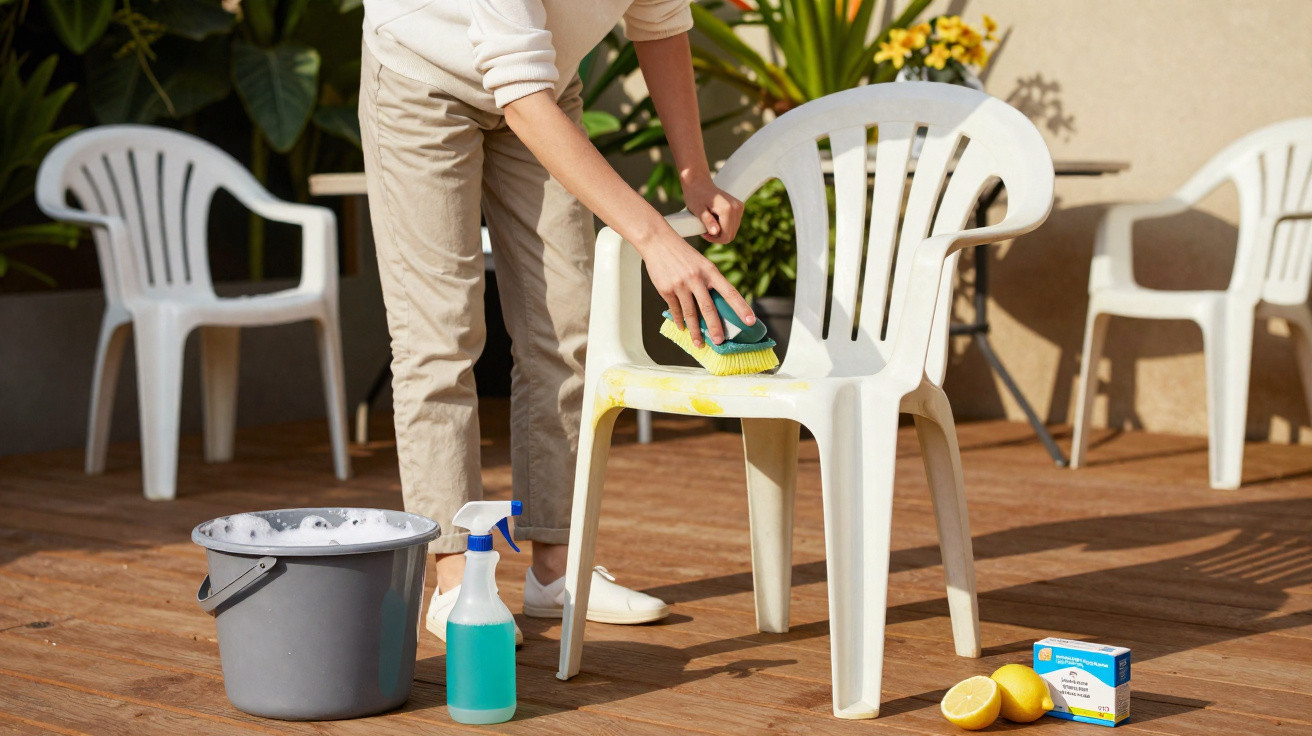
Many people immediately think of the tip or a replacement set from the DIY store. Yet yellowed or greyed plastic can surprisingly often be revived with a simple kitchen household remedy – without specialist cleaners or expensive miracle products from adverts.
Why plastic garden furniture turns yellow and grey so quickly
Plastic garden furniture is exposed to the elements more than most: UV radiation, rain, pollen, dust and changing temperatures. All of these affect its surface. Over time, the plastic becomes more porous and rougher, making it more prone to collecting dirt.
Light-coloured and white furniture in particular soon takes on a yellowish tint. After a few summers, coloured chairs and tables can look faded and patchy. This is often because the material has insufficient UV protection, or because the colour has been applied only to the surface rather than being integrated throughout the plastic.
Other materials age too, but in different ways: metal may rust, wood turns grey and needs oil and care, while polyrattan suffers in persistent rain. Plain plastic, however, has one clear advantage: provided that nothing is broken or deeply cracked, it can usually be restored remarkably well.
Many greyed plastic chairs look ready for the bin – but in reality, the issue is often simply a dirty, weathered surface.
The two-step method: clean thoroughly first, then let the household mix work
Before applying any special mixture, the garden set needs a proper initial clean. Remove cobwebs, leaves and loose dust first; otherwise, the brush merely moves dirt from one place to another.
Step 1: Basic cleaning with warm soapy water
For the first stage, all you need is a bucket, some washing-up liquid and a soft cloth or sponge:
- Use a hand brush or a clean broom to clear away cobwebs and loose dust.
- Fill a bucket with warm water and add a squirt of washing-up liquid.
- Wipe down the chairs and table generously, remembering the undersides and the backs of the backrests.
- Rinse with clean water so that no soapy film remains.
After this stage, the set will usually already look better – although the grey film often remains. That is where the second part comes in.
Step 2: A kitchen mix for yellowing and grey film
The main result comes from a mixture of lukewarm water, clear household vinegar and bicarbonate of soda or baking powder. This combination loosens organic residues, neutralises mild discolouration and removes the dull film from the plastic.
For a standard spray bottle, use the following mixture:
- about 500 ml lukewarm water
- 1 tablespoon clear household vinegar
- 2 tablespoons bicarbonate of soda or classic bicarbonate of soda powder
- a small squirt of washing-up liquid for better coverage
Apply the mixture as follows:
- Pour the mix into a spray bottle and shake it thoroughly.
- Spray generously over the dry, pre-cleaned surfaces.
- Work it in using a soft sponge or microfibre cloth in circular motions.
- Leave it for a few minutes, but do not allow it to dry completely.
- Rinse thoroughly with plenty of clean water.
Even after the first application, the plastic often looks noticeably fresher and more even. For heavily yellowed furniture, a second treatment may be worthwhile.
What to do about particularly stubborn stains?
Some marks are difficult to remove: dark scuff marks, old flower stains or baked-on barbecue grease. More robust but targeted products can help here.
Cleaning white plastic furniture
White chairs and tables are often cleaned with a mineral-based cleaning paste, commonly sold as a “cleaning stone” or “cleaning disc”. These pastes usually contain finely ground minerals, a little soap and glycerine.
How to use it:
- Pick up a little paste with a slightly damp sponge.
- Rub it gently over the stain without pressing too hard.
- Rinse with water and check whether the surface looks even.
The benefit is that the micro-particles provide a light polish without immediately leaving deep scratches. On purely decorative surfaces, this can create an almost “like new” effect.
Take care with coloured furniture
With coloured plastic, caution is essential. Abrasive cleaners or rough sponges can damage the surface or wash out the colour. Anyone using a paste should always test it first in an inconspicuous spot – for example, underneath the seat.
Repair or rubbish? When restoring plastic garden furniture is still worthwhile
Before spending hours cleaning, take a critical look at the furniture’s condition:
- Hairline cracks in load-bearing parts: Fine cracks in the seat or backrest are a safety risk. It is better to dispose of these items.
- Clearly warped chair legs: If a chair wobbles or bends significantly, cleaning will no longer solve the problem.
- Purely cosmetic issues: Scratches, stains and dull surfaces – restoration is usually worthwhile in these cases.
For furniture that looks worn but remains stable, light sanding can help. Fine sandpaper (120 grit or higher) can smooth rough areas. Afterwards, a specialist plastic paint suitable for outdoor use can be applied.
Spray paints designed to adhere directly to plastic create a new, even finish. A dust-free area with little wind is important, as is applying several thin coats rather than one thick layer. This reduces runs and makes the new surface last longer.
As long as nothing is broken, many “ugly” plastic chairs are really only a good clean and perhaps a coat of paint away from a second life.
How to keep your refreshed garden set looking good for longer
Once the restoration is complete, the question is: how can the set stay attractive for longer without requiring a major job every spring?
- Look for UV protection when buying: Many manufacturers state whether the material has been stabilised against intense sunlight.
- Store it away in winter: Ideally, keep the set in a cellar, garage or garden shed.
- Use a protective cover: If storage space is unavailable, protect the table and chairs with breathable covers.
- Avoid cooking oil: Although it may create a short-lived shine, oil makes plastic patchy and more likely to attract dirt over time.
- Carry out regular quick cleans: Wiping the furniture once a month with warm soapy water prevents stubborn layers from building up.
What really causes yellowing and grey film
The unattractive film on plastic is rarely just “dirt”. Chemistry is often involved too: sunlight breaks molecular chains apart, plasticisers migrate to the surface, and fine dust and soot settle on it. Together, these create the typical layer that is difficult to remove.
The kitchen mix of vinegar and bicarbonate of soda mainly helps grease residues, mineral deposits and organic matter to swell and release more easily. Mild discolouration then appears less pronounced because the surface becomes smoother again and reflects light differently.
Practical tip: how to plan the restoration efficiently
If you do not want to spend an entire Saturday cleaning, take a structured approach. One possible routine is:
- Morning: Dust the chairs and table with a brush, then complete the basic clean with warm water.
- Straight afterwards: Spray on the household mix, leave it to work, then rinse it away.
- Once dry: Treat stubborn stains specifically with cleaning paste.
- If needed: Apply a thin coat of plastic paint the following day.
Doing this thoroughly once significantly reduces the work required in later years. After that, a quick spring wash is often enough before the barbecue season begins.
Many households replace plastic furniture automatically as soon as the first yellowing appears. But a look at the chemistry behind it, along with a bucket of kitchen ingredients, shows that in a great many cases a garden set that seems destined for the tip is still perfectly usable and can be made to look tidy again with little money and a bit of time.
Comments
No comments yet. Be the first to comment!
Leave a Comment