
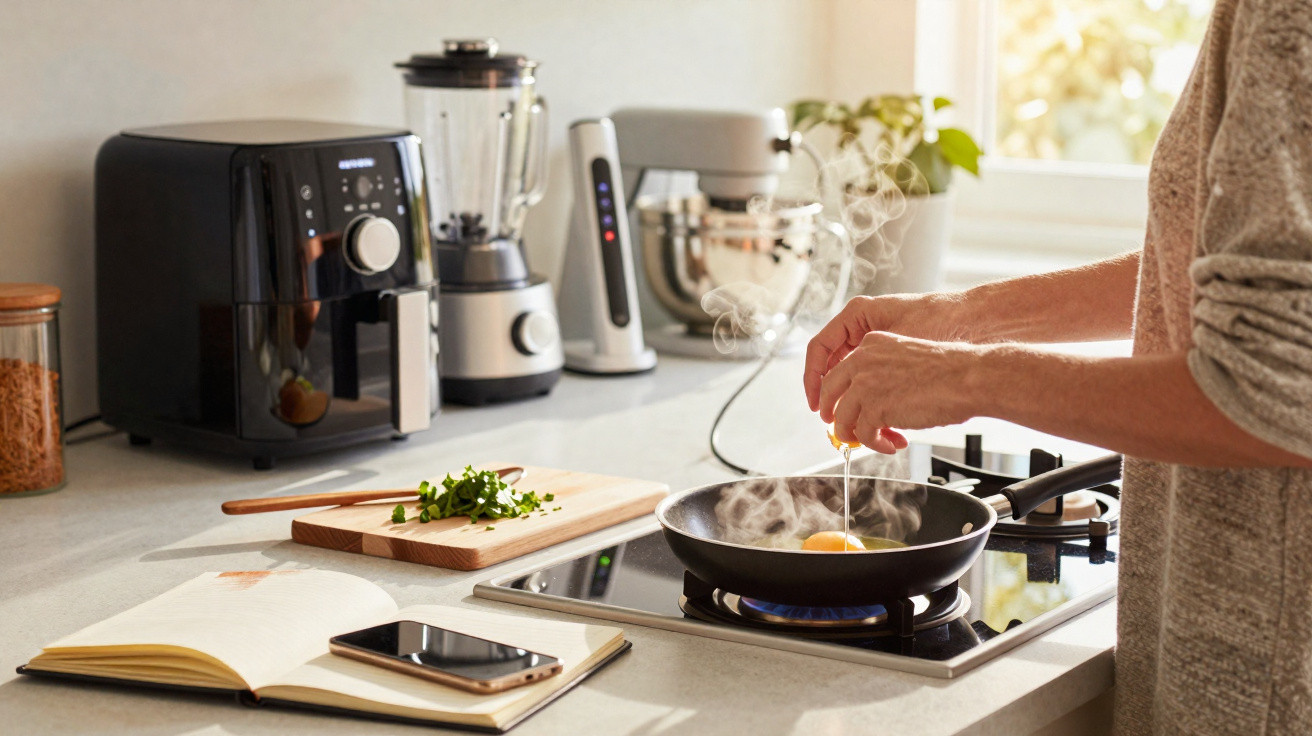
The blender roars, the food processor lights up like a cockpit, yet the same frying pan ends up on the hob again. Fried eggs, pasta with pesto, a quick sandwich. The expensive appliances in the background suddenly seem like guests who do not quite belong at the party. They are there and look good, but nobody speaks to them. You know the look: someone opens the box of a high-tech steam oven, pauses in brief fascination, then pushes it beside the coffee machine, where it slowly gathers dust. Not because it is broken, but because the person in front of it would rather cook as they always have.
In many kitchens, it is not technology that fails. It is routines.
When high-tech meets the fried-egg routine
Anyone arriving home tired in the evening does not want to think about cooking times. You reach for what is familiar: that one frying pan, the same old saucepan, two movements, hob on, done. Even if a gleaming multicooker sitting right beside it can do three times as much. It is kitchen psychology on a small scale, visible on every worktop. New appliances promise a different, better version of everyday cooking. Our bodies, meanwhile, follow old routes through the kitchen, much like a car always taking the same exit.
The dishwasher gets used, as does the kettle. But the slow cooker? It stays put. A bread maker might run every day for three weeks, then suddenly fall silent. According to a representative survey in Germany, people regularly use an average of only four to five kitchen appliances, although many households own more than a dozen. You could call kitchens small museums of technology, curated by convenience. Big boxes end up on top of cupboards, cables are rolled up, the shopping excitement fades. Meanwhile, pasta water continues to boil in the old enamel saucepan.
Technology is not the problem; the friction between promise and everyday life is. Many appliances require planning ahead, unfamiliar steps and sometimes even different shopping habits. Anyone who cooks spontaneously is unlikely to take to a sous-vide stick. And if you have only two hob rings, the air fryer gets stored in the cupboard behind the baking tins. The appliance clashes with habits that have been stable for years. Technology can speed up or simplify many things, but it often runs into deeply ingrained routines that are almost never consciously questioned.
Why most kitchen appliances bounce off everyday life
A familiar scenario: someone buys a smart food processor, an all-in-one marvel with a display, app and recipe library. The first month is full of enthusiasm: risotto without stirring, exotic curries, steamed vegetables that suddenly taste restaurant-quality. Then comes a stressful week at work, a child being ill, social plans. Before long, frozen pizza is the quick answer again. The appliance has done nothing wrong. Everyday life simply picks up speed, and the more involved way of using it slips out of the bend.
A friend of mine had a steam oven fitted, costing several thousand euros and with every detail expertly advised. He proudly showed me the programmes, temperature curves and gentle meat-cooking setting. Six months later, the steam oven had become a bread basket. Baking trays, aluminium foil and cookbooks all disappeared into what was actually an impressive appliance. When it was used, it was for one thing only: potatoes. “They’re just quick to put in,” he said with a tired grin. That is the point: an appliance that does not fit effortlessly into the smallest everyday actions soon becomes a luxury compartment for bits and pieces.
Technology has long reached a level at which almost anything seems possible: sous-vide cooking, fermenting, air frying, slow cooking and precision steaming. What is usually missing is not a feature but integration with the shape of our typical days. People cook in patterns: pasta on Mondays, soup on Wednesdays, something “special” at the weekend. If an appliance does not directly support these patterns but instead forces new processes, it becomes a mental obstacle. Let us be honest: nobody really does that every day. High-tech loses out to spontaneous rhythms of life, hunger in 20 minutes and the famous one frying pan in which “you can just make everything”.
Bringing kitchen appliances into everyday routines instead of shutting them away
The first step in preventing an appliance from failing starts before purchase, with an unassuming question: which two, or at most three, very specific dishes do I genuinely want to use it for? Not “healthy cooking in general”, but rather “porridge in the morning”, “vegetables in the evening” or “Sunday pizza”. Suddenly, the appliance is no longer an abstract promise but a tool for three recurring moments. The routine around it can then be adjusted easily.
One useful trick is to deliberately leave the appliance on the worktop for a month, at the expense of another utensil that goes into the cupboard for that period.
Many people do not struggle with operation but with a quiet perfectionism. They believe they need to get the absolute most from the appliance, learn every programme and test each mode at least once. That expectation holds them back. It is better to begin with a single function that feels intuitive, such as “steam” or “sear”. The mental dividing line between hob and machine then begins to blur. Anyone always waiting for “the right occasion” unconsciously banishes the appliance to the realm of special occasions - and continues cooking the same pan of spaghetti Bolognese every Tuesday.
“Appliances do not fail in the kitchen; they fail on our to-do lists,” said a friend who enjoys cooking when I asked her about her never-used juicer.
- Set yourself a mini-task: use a new appliance for just one recipe a week - always the same dish until it becomes second nature.
- Remove its event status: not “I’ll try that at the weekend”, but Tuesday evening, when you are cooking anyway.
- Cut the barrier: leave the appliance set up, keep favourite ingredients within reach and do not have to search for accessories.
- Start with five-minute uses, not three-course meals from the accompanying book.
- Measure success not by functions, but by recurring, relaxed moments at the hob.
What remains once the excitement has gone
At some point, an appliance no longer feels new. The protective film has been removed, the buttons are no longer mysterious and the display has its first grease marks. This is precisely where it is decided whether a technical fling becomes a genuine kitchen relationship. You could sit down and ask yourself with complete honesty: does this thing actually suit the way I cook? Or am I trying to convince myself, through technology, that I have a cooking life which does not really suit me? Anyone who prefers a quick fry after work to lengthy preparation will not be happy with even the finest slow cooker.
Appliances are good when they suit your laziness, not your ideals.
It becomes interesting when you stop thinking in functions and start thinking in scenes. Breakfast at 7 am, half asleep and with no patience. Evening at 7 pm, hungry and not keen on washing up. Sunday, with a little more time and a desire to experiment. If an appliance effortlessly improves at least one of these scenes, it has a genuine chance. If not, it is worth passing it on rather than feeling guilty. Many kitchens contain silent reproaches made of plastic and stainless steel. They can become grateful helpers - or freedom on the worktop.
Appliances rarely fail because of the technology. They fail because of our myth that we will “soon cook differently”. Those who instead see them as practical allies for very specific everyday situations sometimes discover surprising partnerships: the rice cooker that saves every stressful day; the small air fryer that replaces the oven and greasy roasting tin late at night; the old blender that quietly ensures there is at least something fresh in the glass every morning. Perhaps it is worth taking an honest look at your own kitchen: which machines live only in your imagination, and which could genuinely make your daily cooking easier if you gave them a different place in your habits?
| Key message | Detail | Value for the reader |
|---|---|---|
| Appliances fail because of routines, not functions | Everyday patterns such as “quick, uncomplicated, familiar” displace more complex appliances | The reader understands why expensive technology remains unused and feels less “guilty” |
| Focus on a few, specific use scenarios | Define two to three standard dishes for each appliance and build them into the weekly pattern | A directly applicable strategy for genuinely integrating appliances into everyday life |
| Radically reduce barriers to use | Place appliances where they can be seen, begin with mini-tasks and reduce pressure to be perfect | Practical steps for moving from a technology museum to a kitchen that works every day |
FAQ:
- How many kitchen appliances are “normal”? There is no ideal number, but many households regularly use only four to five appliances. Anything beyond that is worthwhile only if it clearly fits your daily life.
- How can I tell that an appliance does not suit me? If, despite good intentions, you repeatedly return to old solutions after one or two months and see the appliance only as something for “special occasions”, that is a clear sign.
- Should I get rid of old appliances? It can be liberating to decide honestly: either an appliance gets a clear place in your week, or it moves on to someone who will use it.
- How do I overcome my reluctance to use complex appliances? Choose just one function, establish one standard dish with it and ignore the accompanying booklet for the time being. Let complexity grow slowly.
- Is it still worth buying specialist appliances at all? Yes, if you buy them for very specific moments of use rather than from a vague wish to cook “differently” or “better”.



Comments
No comments yet. Be the first to comment!
Leave a Comment