
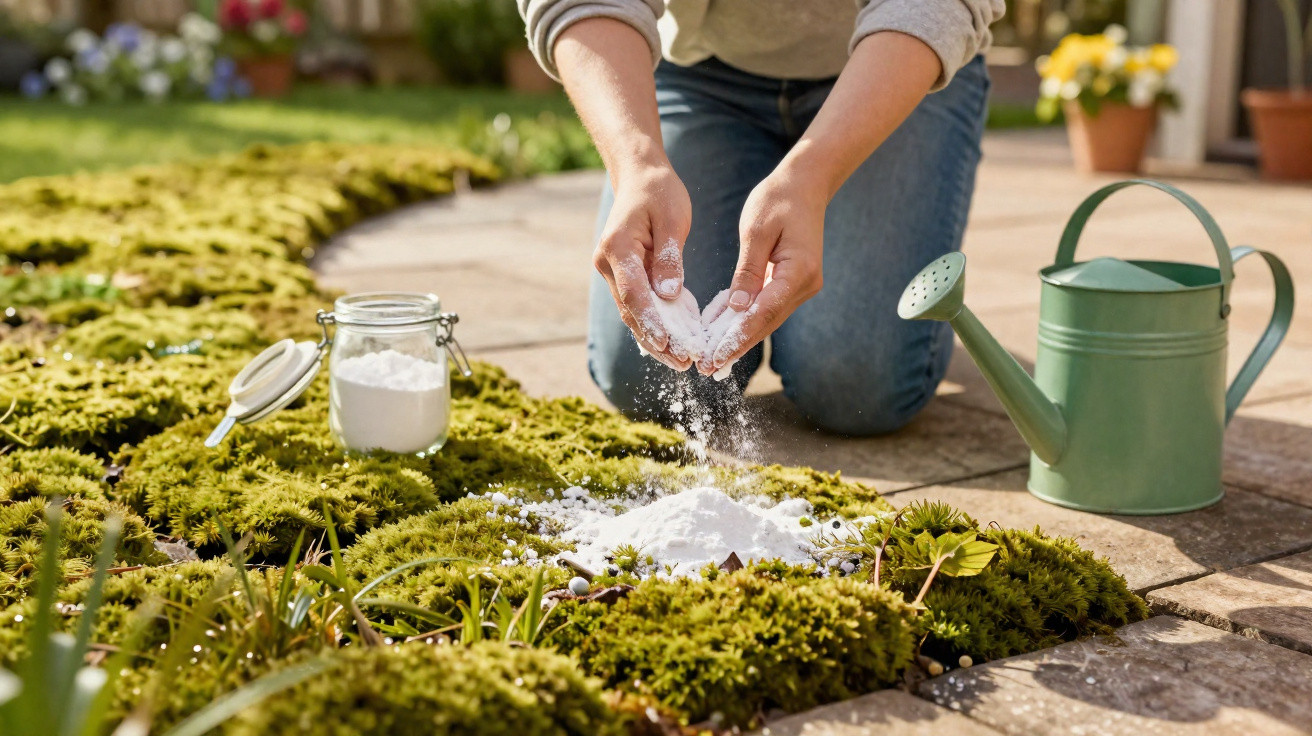
Anyone with a garden knows the pattern: as soon as the weather turns wet, cool and dark, moss appears everywhere. It spreads across lawns, through paving joints and over patios. Many products once used for the job have disappeared from sale or gained a questionable reputation. As a result, people are looking beyond the garden centre and into the kitchen cupboard, where an inexpensive powder can stop moss surprisingly effectively.
Why moss takes over your lawn so quickly
Moss does not indicate laziness; it points to underlying soil issues. It thrives in conditions that make life difficult for grass. Common causes include:
- acidic soil with a pH below 6
- compacted ground where water cannot drain properly
- shaded areas with little sunlight
- permanently damp ground
- thin, patchy turf after drought or incorrect mowing
As the grass thins out, moss takes its opportunity. It forms a carpet over the surface, intercepting light and moisture while depriving the grass of its remaining strength. Simply scraping away the green layer with a rake will not address the cause. The soil remains compacted, wet and acidic – an ideal invitation for the next layer of moss.
Moss on paths and patios: a dangerous slip hazard
On paths, steps and patios, moss is more than unsightly: it is a genuine safety risk. Between paving blocks, in joints and on slightly rough surfaces, it creates a slippery film. When wet, a driveway can turn into a green ice rink overnight.
Strong chemical treatments are largely off limits in private gardens. Legal requirements severely restrict synthetic pesticides in gardens, on balconies and on patios. This is why many older “moss killers” have vanished from shop shelves. At the same time, more people prefer not to use aggressive products in their own gardens, due to concerns about soil, groundwater, pets and children.
This is where a product that almost everyone has at home comes in: sodium bicarbonate, better known as bicarbonate of soda or household baking soda.
The kitchen powder that dries out moss
Bicarbonate of soda is the fine white powder often used for baking, cleaning and removing odours. In the garden, it works against moss in two ways:
- It raises the pH locally on the plant’s surface.
- It draws moisture from the moss cushions.
As a result, the moss’s delicate cells dry out and die. In the days after treatment, the area changes from rich green to yellowish brown. That is the point at which you should reach for the rake.
How to use bicarbonate of soda on a lawn
You need to be more careful on lawns than on stone, because grass reacts much more sensitively. A tried-and-tested mixture for many gardens is:
- 2 to 3 tablespoons of bicarbonate of soda
- to about 1 litre of water
Follow these steps:
- Target only visible patches of moss rather than soaking the entire lawn.
- Pour the solution into a spray bottle or pressure sprayer.
- Apply it on a dry day, with no rain forecast for the following 24 to 48 hours.
- Spray the moss cushions lightly and evenly.
Discolouration usually begins after two to three days. Then it is time to use the rake. Thoroughly remove the dead material. The resulting bare patches are ideal for light overseeding with lawn seed. This enables grass to fill the open areas more quickly before fresh moss establishes itself.
Create a small test area: Grass can react more sensitively in strongly acidic soil. If you are unsure, first try the mixture on a patch roughly the size of an A4 sheet.
Paths and patios: apply bicarbonate of soda directly to joints
You can be slightly more generous on paving, concrete slabs or stone steps, as there are no lawn roots to damage. Two common methods are available.
Option 1: Scatter it dry
This approach is particularly suitable for joints and cracks in paved paths.
- Sweep the surface thoroughly, removing leaves and loose moss.
- Scatter a thin layer of bicarbonate of soda along the joints – around 20 grams per linear metre of joint is a rough guide.
- Work it into the gaps using a stiff brush or scrubbing brush.
- Dew and light rainfall do the rest: the bicarbonate of soda gradually dissolves and acts directly within the moss cushions.
After several days or weeks, the growth discolours and becomes easier to remove. Vigorous brushing is often enough, although a joint scraper can help with thicker cushions.
Option 2: A wet treatment for heavy growth
If a path is already extremely slippery, applying it as a liquid is a suitable alternative, much like on a lawn:
- Mix 2 to 3 tablespoons of bicarbonate of soda per litre of water.
- Apply it directly to affected areas with a watering can without a rose or with a pressure sprayer.
Depending on the temperature, leave the surfaces untouched for one to two days. Afterwards, rinse with a little water and brush away the dead material. If you have pets, keep them away from the wet areas where possible during this period, so they do not unnecessarily lick the alkaline solution.
How often can you treat moss – and what are the limits?
Sodium bicarbonate is comparatively gentle, but it is not a harmless “apply it and forget it” product. Specialists advise treating the same area no more than once or twice a year. If it is spread or sprayed substantially more often, joints may gradually become depleted and lawn areas can turn yellow.
Too much bicarbonate of soda can make joints almost sterile – moss may disappear, but small soil animals and other plants can suffer too.
It is also important to consider the rest of the garden: water containing dissolved bicarbonate of soda should not run unchecked into vegetable beds, herbaceous borders or a pond. A day without strong winds or heavy rain is best. When working on slopes, boards or small earth banks can prevent the solution from running away uncontrollably.
Reduce moss long term: soil care beats repeated spraying
Bicarbonate of soda is a practical immediate measure, but it does not replace basic maintenance. To achieve permanently less moss, you need to change the conditions in which it thrives. Effective measures for lawns include:
- Scarifying regularly in spring and autumn to remove thatch and old plant debris.
- Aerating the soil, for example with a spiked lawn roller or specialist aerating shoes.
- Improving drainage if water remains on the area for a long time.
- Applying lime if the pH is clearly below 6, but only after a soil test.
- Using the correct cutting height: do not mow too short, so the lawn can develop strong roots.
Paths call for a different approach: lay joints so that there is little fine material available for moss to grow in. This can be achieved, for example, with bound jointing mortar or a very tight interlock between paving blocks. Anyone wishing to avoid deliberately “green joints” should consider whether the jointing material can be changed after removing the moss.
When bicarbonate of soda is not a good idea
Despite its many benefits, there are situations in which it is better not to use it:
- directly beside a garden pond or stream
- very close to sensitive ornamental plants
- on surfaces regularly used barefoot by young children
- on stones or metals in the joints that are highly sensitive to salts
If you are uncertain, test a small, inconspicuous corner and observe the reaction over several days. This can prevent unpleasant surprises.
Why bicarbonate of soda outperforms many “miracle products”
This kitchen powder has one clear advantage: you know reasonably well what you are using. Unlike dubious “organic miracle products” sold online, sodium bicarbonate is a familiar product that has been used for decades. Under the influence of water and carbon dioxide, it breaks down into less harmful components and degrades comparatively quickly.
With a little research, you can adapt the dosage to your own conditions instead of blindly following a marketing claim. Combined with good soil care, more air and light for the lawn, and a few practical adjustments around the driveway, it can substantially reduce moss pressure – without harsh chemicals, high costs or anything more than a product already in the kitchen cupboard.
Comments
No comments yet. Be the first to comment!
Leave a Comment