
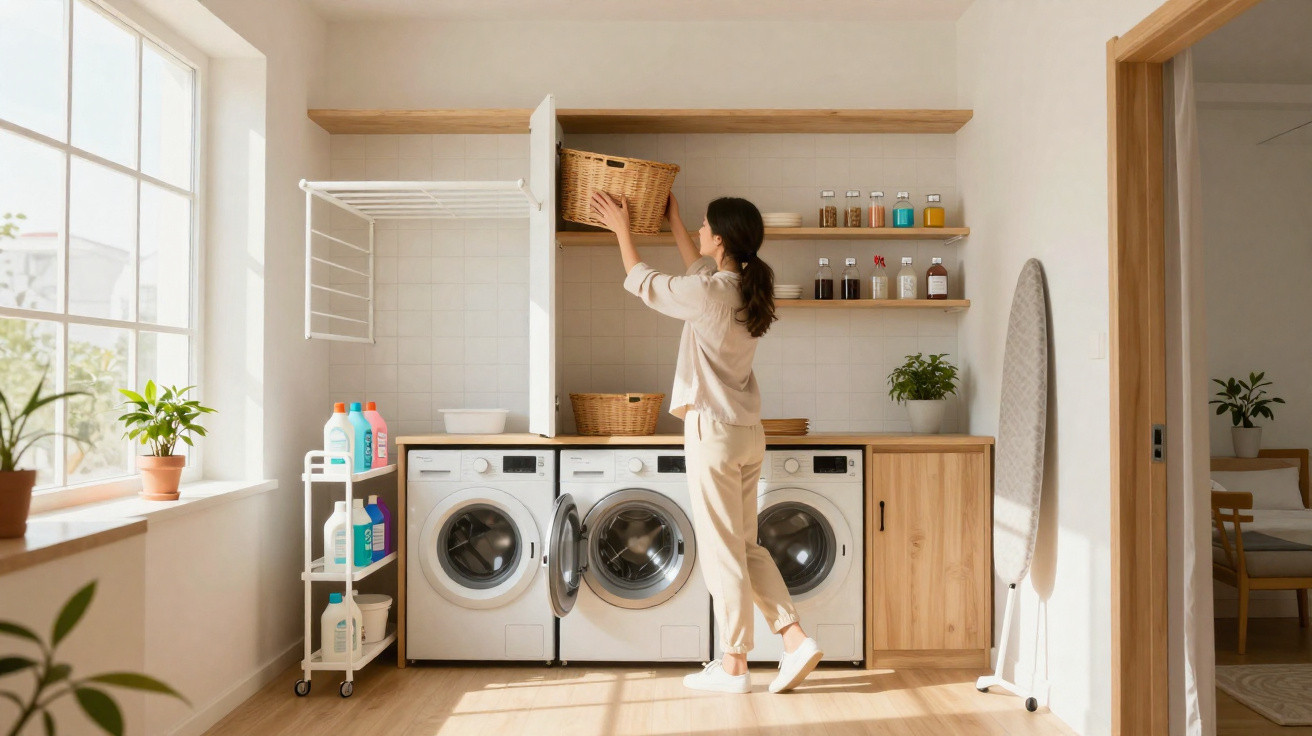
The scene is familiar in many flats: the washing machine takes up half the room, buckets are stacked in a corner, brooms fall over whenever someone opens the door, and the clothes airer looks like a tangle of garments and pegs.
The utility room often becomes the home’s unofficial storage area, where anything without a designated place ends up. Then, when it is time to do the washing or quickly mop the floor, it can feel as though the room itself is working against you. Looking at it is enough to sap your energy. Yet one detail stands out: changing just two or three key points can suddenly make that neglected corner feel several square metres larger. A utility room may be small, but it does not have to be chaotic.
Why your utility room feels smaller than it really is
Anyone with the utility room of an older flat will know the issue: it may be a reasonable size, yet it always feels overcrowded. In newer developments, the challenge is even greater. The room has shrunk, the number of belongings has grown, and combining a laundry area, pantry and mini storage room has become standard. That cramped feeling is not caused by floor area alone. It comes from how items are arranged, what is left on the floor and what catches your eye as soon as you walk in. A bucket left out of place takes up more visual space than you might expect.
In São Paulo, a resident of a 45 m² flat said she had almost given up on her utility room. “I would close the door and pretend it did not exist,” she laughed, slightly embarrassed. There was a ladder, a suitcase and a toolbox, all piled in with the washing machine. One weekend, she chose to tackle it: she removed what did not need to stay there, fitted two simple shelves and added a £6 broom holder. The result was surprising. Not only was there room to move around, but the utility room became her favourite spot for leaving plants in the sun. The floor area remained exactly the same. The feeling did not.
The key is recognising that space is not only about clear floor space. It also includes available wall space, forgotten corners, the area above the washing machine and the inside of the door. When everything is scattered across the floor, the room feels smaller, heavier and harder to clean. Raising objects up, grouping belongings by category and creating clear routes through the room changes how your mind interprets the space. Suddenly, the utility room stops being the “back of the house” and becomes a tool that works for you. In this case, organisation is almost an optical illusion.
Simple changes that multiply space in the utility room
The first change that transforms everything requires no expensive product: remove anything that does not need to be there. A suitcase, a broken chair “to repair one day”, old toys or a box of cables all take up physical and mental room. Once that clutter is cleared, it becomes easier to see what genuinely needs storing in the utility room: cleaning products, laundry essentials and perhaps basic tools. From there, strategy comes into play. Measure the room with a tape measure, try different layouts and, if possible, sketch out where shelves, a ceiling-mounted clothes airer or a narrow cupboard could fit.
Let us be honest: nobody does this every day. Usually, the utility room gets emergency fixes, the supposedly temporary solutions that remain for five years. But one well-considered investment can create extra space for a long time. A ceiling-mounted clothes airer replaces the floor-standing rack that blocks half the walkway. A tall, shallow cupboard takes the place of products piled around the sink. A wall-mounted broom holder frees up an entire corner. Once every item has a fixed home, the room no longer feels like a battlefield and becomes a functional circuit. Doing the laundry does not become effortless by magic, but it does become less tiring.
Making use of height is crucial. Utility rooms commonly have enough ceiling height for one or two levels of shelving above the washing machine or sink. This is the right place for storage baskets, less frequently used products and even spare bed linen kept in vacuum bags. For everyday use, create three visible zones: one for laundry products, such as detergent and fabric conditioner; another for household cleaning supplies, including washing-up liquid and disinfectant; and a third support area for pegs, cloths and small repairs. This division cuts down on the “where is that thing?” moments that drain time and patience. It also establishes a quiet logic that everyone in the household can follow.
Practical ways to double functionality without extending the room
One straightforward way to organise a utility room is to think in terms of “active walls”. Every surface can serve a purpose. Behind the door, fit a hook for an upright vacuum cleaner or ironing board. On the side of the washing machine, add a magnetic holder for bottles or a peg basket. Above the sink, install a narrow shelf for the products used most often every day. Higher shelves can hold surplus items and stock. Anything light and frequently used can go higher up. Heavy items, or those that could fall, should stay at lower levels. Functional does not have to look unattractive; it simply needs to suit your routine.
Many mistakes begin with good intentions. There is the impulse purchase of a huge organiser that does not fit in the utility room, or the classic error of filling the room with unlabelled opaque boxes that conceal more than they help. The fault does not lie with the person trying to improve the space, but with a lack of basic planning. Always measure before buying any item, and begin with small solutions: a hook, a basket or a shelf. Another trap is turning the utility room into storage for everything that did not fit in the kitchen cupboard. When a room takes on too many functions, it performs poorly at all of them. It is possible to have an efficient laundry space without making it the home’s official dumping ground.
“When the utility room is treated as a workspace rather than a domestic punishment, organisation emerges naturally,” commented a professional organiser who works in small flats.
- Use wall hooks and holders to lift brooms, mops and dustpans off the floor.
- Use baskets by category: one for laundry, one for cleaning and one for tools.
- Invest in a ceiling-mounted or retractable clothes airer to keep the walkway clear.
- Choose a tall, narrow cupboard instead of deep furniture that swallows up the room.
- Label boxes and containers: one clear word is more useful than rummaging through everything every week.
When the utility room stops being a problem and becomes an ally
Once the utility room has been reorganised, something interesting happens: the sense of heaviness at home decreases. You walk in and find what you need without any drama. You do not trip over buckets, struggle with the clothes airer or waste time searching for pegs or disinfectant. Your mind starts to view the room as support rather than a constant reminder of an overdue task. In a country where so many people live in compact homes, that small relief changes how the day feels. The routine remains, and dirty laundry does not vanish, but the process becomes less hostile. Your body appreciates it, and so does your mood.
| Key point | Detail | Value for the reader |
|---|---|---|
| Use walls and height | Shelves, hooks, ceiling-mounted clothes airer, holders | Clears the floor and improves circulation without building work |
| Reduce items and set categories | Separate by use: laundry, cleaning, support | Makes everything easier to find and speeds up tasks |
| Treat the room as a workspace | Plan routes, access and frequency of use | Makes the space more functional and less tiring |
FAQ:
Question 1 How can I organise a very small utility room?
Start by removing everything that is not used directly in the room. Use a ceiling-mounted clothes airer, wall hooks and a tall, narrow cupboard. Give priority to items used every week and keep everything else outside this room.Question 2 Is it worth having a fitted cupboard made?
If your budget allows and the space is particularly challenging, yes. However, a good arrangement of shelves, baskets and simple holders can solve a large part of the problem without major expense.Question 3 What should not be kept in the utility room?
Items with no clear use, broken things “to fix one day”, excessive stock and belongings that can be damaged by damp, such as books and documents. These take up room and create a cluttered appearance.Question 4 How can cleaning products be stored safely?
Keep them at a height that children and pets cannot reach, preferably in a closed cupboard or high baskets. Avoid mixing different products in the same bottle, and keep everything labelled.Question 5 How can I maintain organisation day to day?
Set aside five minutes twice a week to return every item to its place. Small, consistent adjustments prevent clutter from building up and make tidying almost automatic.




Comments
No comments yet. Be the first to comment!
Leave a Comment