
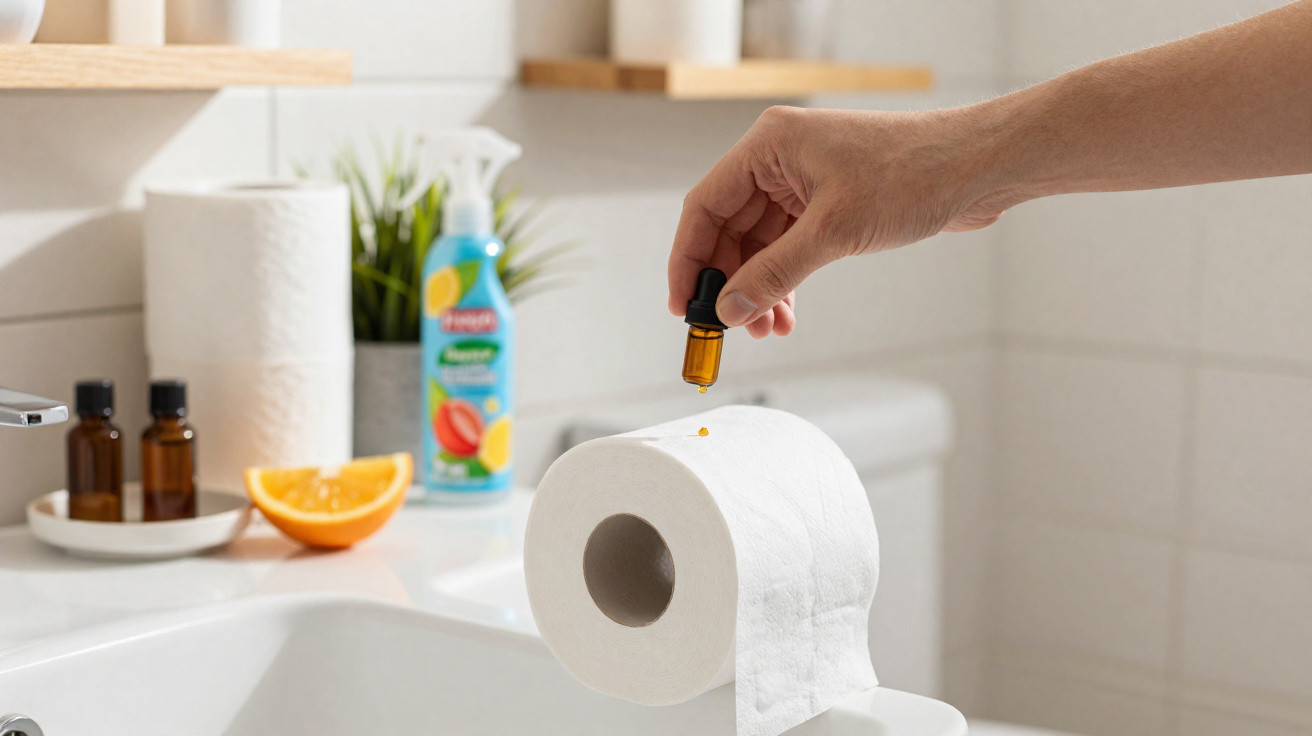
The first time I came across the “toilet paper hack” on TikTok, I rolled my eyes so dramatically that I nearly overlooked what it was actually doing. A woman stood in her cramped bathroom with no candle, spray or expensive diffuser in sight. There was only an ordinary white toilet roll on its holder. She picked up a bottle from beside the sink, did something that took all of three seconds, and the comments went wild: “Wait… why does this work better than my $20 air freshener?”
I tested it in my own bathroom two days later, shortly before visitors arrived. Within ten minutes, one guest asked what perfume I had used in the room. I had not burned a single candle.
That was the point when I understood that this was more than a charming little tip. It also highlights just how ineffective many conventional air fresheners can be.
The ordinary bathroom item that outperforms your spray can
The main attraction is your unassuming toilet roll: the item you barely notice until it has run out and you are caught short. Its cardboard centre is essentially a large fragrance sponge, positioned exactly where bathroom odours tend to be strongest. Yet for years, we have regarded it as nothing beyond a basic essential.
The toilet paper hack itself is remarkably straightforward. It turns the roll into a discreet, ongoing diffuser that works whenever somebody uses the bathroom, often without them noticing why the space smells pleasant. There is no plug-in device, aerosol, or noisy fan involved - only paper, gravity and one small bottle that you probably already have.
The clip that made this trick go viral amassed millions of views over a single weekend. In it, the creator enters an entirely typical rented bathroom: no window, no extractor fan, and a rather sad plastic air freshener stuck to the wall that seems better at squeaking than freshening the room. She takes a small bottle of essential oil from the sink, lifts the toilet roll, and places four drops inside its cardboard tube.
Then she simply… walks away.
Commenters experimented with laundry fragrance boosters diluted in water, cologne samples and even vanilla extract from the kitchen. The products varied, but the responses were much the same: “My bathroom finally smells like something other than ‘tried to hide the smell’.”
There is a simple explanation for why it can work so effectively. A toilet roll sits in an area of constant airflow. Whenever someone unrolls paper, sits down, gets up, flushes, or opens the door, air passes over the fragranced cardboard tube. Rather than arriving as one intense chemical burst, as it often does with an aerosol, the scent is released softly on those small air currents throughout the day.
Standard air fresheners frequently cover odours with a powerful top note that disappears quickly. By contrast, the toilet paper hack is subtly refreshed whenever the roll is handled. That gentle, continuous release makes a room seem naturally clean rather than heavily perfumed.
The contentious part is that, once you understand the principle, many shop-bought products begin to seem more like decorative accessories than genuine solutions.
How to use the toilet paper hack without making a mess
The basic method is simple. Leave your usual toilet roll on its holder, then carefully lift it off the bar so that you can reach the brown cardboard tube in the centre. Take a small bottle of essential oil, or another lightly fragranced liquid you enjoy, tilt it over the tube and add 3–6 drops directly inside. Allow the drops to absorb into the cardboard walls.
Return the roll to the holder. That is all there is to it: no rubbing, no saturating the paper itself, and no elaborate DIY construction. Each time somebody pulls off some paper, air moves through the tube and releases a mild, reliable fragrance that appears to come from nowhere.
Because it is such an easy step, it can be tempting to use too much. This is where it may go wrong. Excess liquid can leak from the tube and mark the paper, or, worse still, run onto the wall or floor. If the fragrance is overly strong or synthetic, the bathroom can end up smelling like a perfume department in a state of panic.
Take it slowly. Begin with fewer drops and choose a fresh, light fragrance, such as citrus, eucalyptus, lavender or even diluted fabric-softener water. Your nose needs a day or two to decide whether a scent is comforting or just exhausting. Realistically, few people will do this every day. Reapplying it weekly already puts you ahead of most people.
There is also the unspoken question: is it genuinely safe, or is it another social-media craze that is flirting with trouble? This is where specialists are beginning to offer their views, sometimes with unexpected nuance.
“From a hygiene standpoint, adding a few drops of essential oil to the inner tube is less risky than spraying fragrances on the seat or in the air,” notes one home hygiene consultant. “You’re not coating surfaces people touch with their skin or inhale at close range.”
- Opt for pure essential oils or gently fragranced water rather than oily synthetic room sprays.
- Apply the drops inside the cardboard tube only, never to the outer paper or any plastic components.
- Try one fragrance for at least 48 hours before deciding that it “doesn’t work.”
- Air the room whenever possible; this hack should complement fresh air, not take its place.
- If anyone at home is sensitive to fragrance, begin with only one or two drops, or avoid strong oils altogether.
Why the toilet paper hack unsettles the air-freshener industry
After trying the toilet paper hack, it is difficult to see the packed supermarket aisle of sprays and gel beads in quite the same way. Those bright aerosol cans start to look like noise: bold claims, bold scents and bold labels, all built around the same approach - blast the air and hope that nobody notices when the fragrance becomes flat and chemical after 20 minutes.
This cardboard-tube trick takes the opposite approach. It is almost unnoticeable, costs pennies a month, and relies on something already in your bathroom. The room still smells like a bathroom, only cleaner and lived-in, rather than as though it has been panic-sprayed moments before someone entered.
There is a wider change in attitude, too. Increasing numbers of people are cautious about intense synthetic fragrances in confined spaces, particularly where children, pets or allergies are involved. The toilet paper hack offers a feeling of control: you decide on the fragrance, its strength and when to use it. There are no automatic bursts while the house is empty and no mysterious green gel gradually drying out behind the toilet.
It also encourages a more realistic routine. Instead of battling odours with increasingly powerful perfumes, the emphasis is on cleaning, ventilating where possible, and treating fragrance as a subtle finishing touch. It is like seasoning a dish with salt at the end, rather than emptying half the shaker over it.
The debate around this hack reveals more about us than it does about cardboard tubes and oils. Some people enjoy it because it seems clever and slightly rebellious: why purchase another product when a small trick does the job? Others dislike it, calling it “pointless” or “gross”, or arguing that it is simply another way to avoid cleaning the toilet. Both viewpoints have some merit.
Here is the straightforward truth that you probably recognise too: no hack in the world replaces actual cleaning or ventilation. This toilet roll trick will not undo poor habits; it only makes everyday life a little more pleasant. In compact bathrooms, shared flats, or hectic family mornings when ten things are happening at once, it is one of those imperfect but useful habits that can quietly reduce the stress of the day.
That is precisely why aerosols and expensive diffusers can begin to seem less like answers… and more like costly ornaments.
| Key point | Detail | Value for the reader |
|---|---|---|
| Simple toilet paper hack | 3–6 drops of fragrance inside the cardboard tube | Low-cost, discreet scent that lasts throughout the day |
| Better than sprays | Gentle diffusion rather than chemical bursts | The bathroom smells naturally fresh instead of aggressively perfumed |
| Mindful use | Use a moderate amount, light scents and continue cleaning | A comfortable atmosphere without health concerns or excess |
FAQ:
- Question 1 Does the toilet paper hack really replace air fresheners?
- Answer 1 In many bathrooms, it can. It will not remove severe odours or replace cleaning and ventilation, but in day-to-day use it provides a steady, gentle fragrance that often feels more pleasant and less “fake” than sprays.
- Question 2 Can the oil stain or damage the toilet paper?
- Answer 2 When only a few drops are added inside the cardboard tube, the liquid generally remains in the inner layer. Soaking the tube or pouring oil directly onto the paper can stain or weaken it, so a light touch prevents that issue.
- Question 3 What kind of scent works best for this hack?
- Answer 3 Fresh, light fragrances such as lemon, orange, eucalyptus, lavender or a very diluted fabric-softener mixture work well. Heavy, sweet perfumes can soon become suffocating in a small room, particularly one without a window.
- Question 4 Is it safe for children and pets?
- Answer 4 Provided the fragranced tube is out of reach and the paper is not soaked, exposure remains minimal. If anyone at home is sensitive or has asthma, test one or two drops first and watch for any reaction before making it a regular habit.
- Question 5 How often should I refresh the scent?
- Answer 5 Most people find that once a week is sufficient in a lightly used bathroom, with more frequent application in a busy family household. Simply add a couple of fresh drops when the fragrance fades or when you replace the roll.
Comments
No comments yet. Be the first to comment!
Leave a Comment