
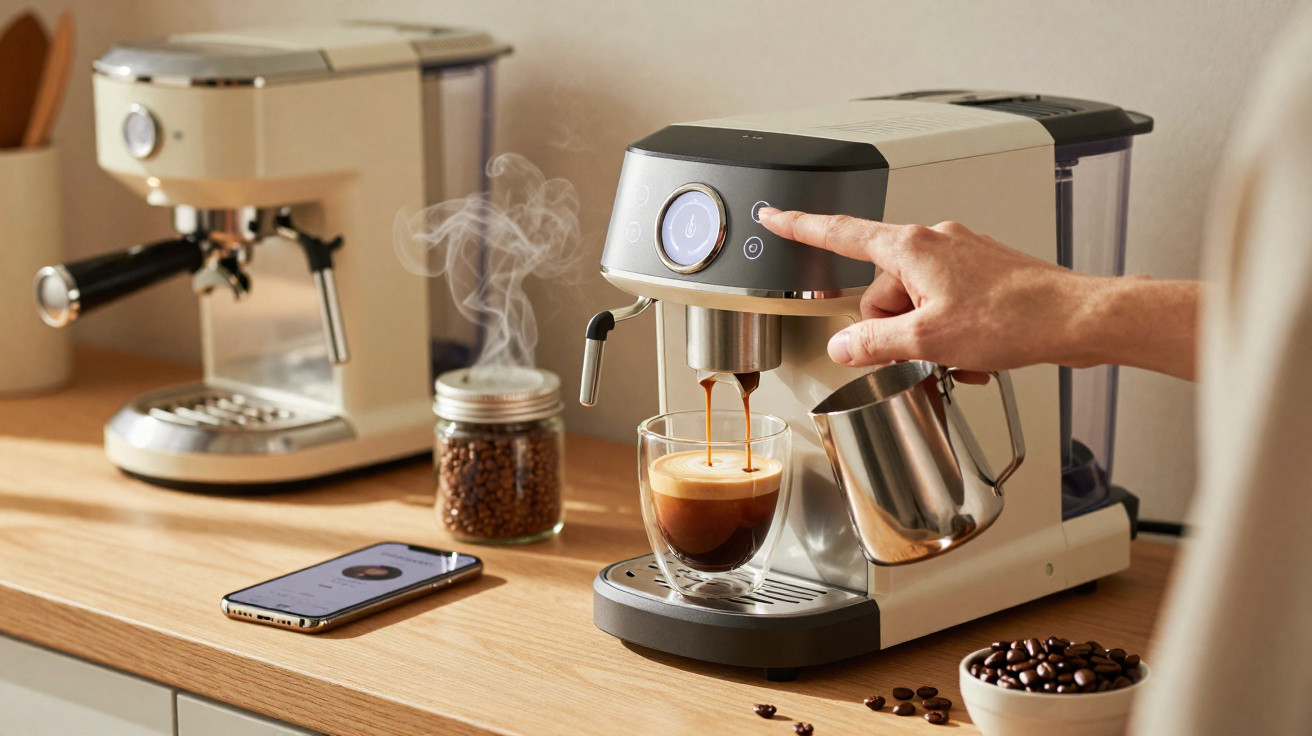
The ageing drip coffee maker is beginning to resemble a fax machine left on the kitchen worktop.
People still hold on to it “just in case”, yet it sits unplugged, shunted aside and covered in a faint layer of dust. Its spot has been claimed by a streamlined, quietly buzzing appliance that casts a soft glow across the worktop, rather like a miniature barista that never takes a break. There are no paper filters, glass jugs to wash or uncertain measurements of ground coffee. Simply insert a capsule, pod or puck… and a café-style drink is ready in less than a minute.
The same moment plays out from Brooklyn to Berlin: somebody takes a sip from their mug, lifts their eyebrows and says, “How is this from a machine at home?” The divide between coffee made in the kitchen and coffee bought in town is closing quickly.
Meanwhile, the modest coffee maker is falling behind.
From bulky coffee pots to smart countertop baristas
The traditional coffee maker performed a single task: it dripped hot water through ground coffee and left the rest to chance. For years, it fulfilled that role in offices, student flats and family kitchens, producing the familiar jug of coffee that was a little scorched and a little bitter. Yet everyday life has become faster, and expectations have accelerated alongside it. We swipe past anything ordinary. We look for experiences.
When an appliance promises barista-standard lattes, iced coffees and espresso-style shots with virtually no work, people pay attention. Caffeine alone is no longer enough. They want the café moment – the froth, the scent and the small ritual of pressing a button that makes it feel as though someone has prepared the drink especially for them.
Smart brewers are designed around precisely that experience.
In a London flatshare, three friends staged a quiet coffee uprising. Their old filter machine was perpetually half-filled with stale coffee that nobody particularly enjoyed. One flatmate arrived home with a compact smart brewer, controlled through an app and offering presets such as “Flat White – Strong” and “Iced Oat Latte”. They set it beside the old machine without saying anything.
After a week, the drip coffee maker was untouched. The smart device recorded more than 80 drinks over seven days. The first person leaving each morning no longer lost time at the café downstairs. The person working remotely began arranging video calls around “brew slots”. The final sleeper of the day made a frothy cappuccino into a modest daily ritual.
Scale that flatshare up by millions. In 2024, sales figures from several kitchen-appliance retailers recorded double-digit growth for smart brewers and “all-in-one” capsule systems, while conventional coffee makers either levelled off or declined. Consumers were not merely replacing appliances. They were changing the sort of mornings they wanted to have.
The shift involves more than the appliance itself. It has changed the entire routine of making coffee at home. Traditional coffee makers require preparation: measure the grounds, add water, wait and clean afterwards. They produce one large pot with the same flavour every time, whether that is what you want or not. New smart brewers reverse the arrangement. One person may want a long, mild Americano, while another prefers a short, powerful espresso-style shot with oat milk. With a tap, the machine adopts a different character.
Inside, sensors monitor water temperature, pressure and flow rate. Algorithms determine how flavour should be extracted from each capsule or grind profile. Certain devices even scan a code on the pod and adjust themselves accordingly. Rather than adapting yourself to the machine, the machine adjusts to your mood. That is the understated kitchen revolution: personalisation, cup by cup.
How people really use these “instant café” smart brewers at home
For many users, the easiest routine is the winning one: put in a capsule, press one button and walk away. Nothing more is required. There is no tamping, manual steaming or concern about grind size. A smart brewer can move from cold to ready within seconds, remember your previous drink and recommend it again at approximately the same time the following day. The appliance becomes a gentle prompt: “Morning. Same as yesterday?”
Other users take the customisation further. Through the app, they alter the strength, milk texture and even the drink temperature. One tap creates a “Sunday slow brew” profile, while another stores a quick weekday shot. You do not need to know about extraction curves to enjoy the result. The technical complexity stays out of sight, leaving one obvious outcome: a drink that looks and feels as though it came from a genuine café, without stepping outside your kitchen.
On a grey Tuesday, when the to-do list already seems overwhelming, that degree of simplicity can matter enormously.
Many first-time users are surprised by the way these appliances become the focus of small social rituals. In a compact Paris flat, a young couple made their smart brewer into a shared menu of drinks. They each stored a preferred recipe under a silly name: “Pre-Meeting Armor”, “Sunday Sofa Latte”. When friends visited, they scrolled through the choices, laughed and selected one to taste. The little illuminated appliance became the room’s centrepiece.
Workplaces are changing as well. Some businesses are discreetly replacing the large industrial coffee pot with a row of smarter machines. Rather than sharing one enormous jug of mediocre coffee, every employee can have a made-to-order drink. A medium-sized technology company in Berlin found that use of its smart brewers tripled compared with its previous drip setup, despite employee numbers remaining unchanged.
A clear pattern emerges: after people have had café-style drinks at home or at work, returning to bland, lukewarm coffee from a glass jug becomes very difficult.
This transition has a quiet psychological dimension too. Conventional coffee makers were background appliances, humming away in a corner. Smart brewers seem more like miniature service providers. They “welcome” you with a light or sound, “remember” your preferences and give an immediate reward after a late night or a sluggish afternoon. Flavour is only part of the appeal; it is also about feeling cared for, even when the care comes from a gadget.
That emotional aspect explains why users discuss these devices in the same way they discuss a favourite café. They recommend them, debate them and exchange recipes. The morning coffee ceases to be a compromise and becomes a small, individual luxury.
Getting the best from a smart brewer without losing the human touch
The most sensible approach to these devices is remarkably straightforward: begin with one or two “anchor” drinks, then develop from there. Pick the coffee that genuinely suits your life, rather than the coffee you think ought to suit it. If your actual morning allowance is seven hectic minutes, create a drink that the machine can make in under 60 seconds with very little cleaning. Set that as your standard preset.
Next, establish a slower second drink for weekends or late afternoons, perhaps with a fuller profile or extra foam. Two dependable recipes are more useful than ten experimental versions you never choose. Allow the appliance to handle the smart work in the background, while keeping your own decisions simple and rooted in your actual routine.
Let’s be honest: nobody really does that every day.
A frequent pitfall is pursuing perfection until it becomes frustrating. People purchase a smart brewer, browse an endless range of capsules and expect each cup to match their favourite-ever café in Rome or Melbourne. If it falls short, they blame either the device or themselves. A more useful method is to view the first few weeks as a tasting period. Sample several pods or grind profiles, make a note of what appeals to you, then narrow the selection down ruthlessly.
Another common error is to neglect maintenance until the coffee begins to taste “off”. Limescale accumulates, sensors become less accurate and extraction changes. Most appliances now issue alerts or app reminders for cleaning cycles. Pay attention to them. Clean water, fresh beans or pods, plus a quick clean of milk systems, prolong both the machine’s lifespan and the quality of every drink.
If you share your home with others, leave room for everyone’s tastes as well. A smart brewer that caters only to one person’s preferences will gradually annoy everybody else in the household.
“The smart part isn’t just the tech,” says Jonas, a 34-year-old designer who replaced his old drip machine last year. “It’s how the device fits into your actual life. It gives you better coffee, but it also gives you back those ten minutes you used to spend fiddling with filters and guessing grind size.”
That perspective helps separate useful features from marketing noise. An attractive appliance has little value if it creates extra stress. Choose functions that truly suit your habits: an integrated milk frother or a separate jug, app controls or one dependable physical button, a pod system or freshly ground beans. Then place a brief checklist somewhere visible at home so nobody needs to ask, “Why does this taste weird today?”
- Rinse removable components each week to prevent deposits and unpleasant flavours.
- Start the descaling programme as soon as the machine requests it.
- Keep capsules or beans away from light and moisture.
- Store your two favourite drink presets and give them clear names.
- Agree in advance who is responsible for topping up water and pods.
The coffee maker is not “dead” – but our tolerance for bad coffee is
There is something distinctly nostalgic about an old coffee maker dripping slowly on a peaceful Sunday. Some people will never abandon one completely, just as others still keep vinyl records alongside streaming subscriptions. The smart brewer does not wipe out that past. It simply sets a higher standard for how “normal” coffee at home can taste.
As energy costs, commuting habits and working-from-home routines continue to change, the role of that morning cup is changing as well. Coffee was once simply fuel. Today, it can also lift a mood, offer a brief escape and tell your brain that the day has begun. An appliance that can provide that feeling whenever required, in whichever style you prefer, will always earn space on a busy worktop.
The central question is not whether we will bid farewell to the old coffee maker. It is how far we are prepared to go in transforming our kitchens into tiny personal cafés – and what that changes about how we begin, share and even measure our days.
| Key point | Detail | Why it matters to the reader |
|---|---|---|
| Shift to smart brewing | People are moving away from classic coffee makers towards connected, customisable appliances | Understand why your old machine suddenly feels outdated |
| Barista-level coffee at home | Sensors, capsules and pre-programmed recipes recreate café drinks | Learn how to make better coffee without training as a barista |
| Rituals and real-world use | Smart machines fit into fast routines and social moments | Picture how a new appliance could practically change your mornings |
FAQ:
- Are smart coffee brewers really better than a regular drip machine? They provide greater control, consistency and variety, particularly for espresso-style and milk-based drinks, although some people still favour the straightforward nature and flavour of classic drip coffee.
- Do I need an app to use a smart coffee device? Most will operate without an app, but the app generally provides additional functions including fine-tuned settings, scheduling and maintenance reminders.
- Are capsule systems bad for the environment? They do generate waste, although many brands now provide recyclable or compostable pods; bean-to-cup machines use less packaging but need more cleaning.
- Can a smart brewer replace my favorite café completely? It can come remarkably close for everyday drinks and may save money over time, but the social experience and skill of an excellent café remain distinctive.
- How much should I spend on a smart coffee machine? Solid entry-level models begin at a fairly low price, but spending a little more often brings better construction, more reliable extraction and fewer day-to-day frustrations.

Comments
No comments yet. Be the first to comment!
Leave a Comment