
You open the microwave to warm up your coffee and stop in your tracks.
The mug is spotless, but the walls around it resemble a crime scene.
There are tomato splatters, cheese fused to the ceiling, and an unexplained orange streak that nobody in the household will own up to.
You try a paper towel, but the mark may as well be laughing at you.
You reach for a sponge, pause at the hardened corner, then gently shut the door and promise yourself you will sort it out “later”.
We have all experienced it: a routine reheating job exposes a month’s worth of minor kitchen offences.
Between dried sauce and the lingering scent of yesterday’s curry, one question begins to emerge.
Why your microwave gets so gross so fast
The microwave is the appliance equivalent of a junk drawer: everyone relies on it, but hardly anyone properly looks after it.
Food bubbles over, spits and bursts, then quickly bakes onto its warm interior walls.
Steam rising from bowls deposits tiny droplets of grease and sugar everywhere.
Every reheated meal adds another barely visible coating, until eventually the whole thing smells… faintly of last week’s fish.
Let’s face it: almost nobody cleans it thoroughly every day.
You might wipe it when something spills over, but usually that is the extent of it.
Before long, it becomes a box where smells and germs settle unnoticed while you scroll through your phone and wait for your pasta to beep.
Remember the last “microwave disaster” in your own kitchen.
Perhaps a bowl of tomato soup erupted like a volcano while you were on a Zoom call.
You probably told yourself you would clean it “right after this meeting”.
Then the meeting overran, the soup dried, the evening began, and the job was forgotten.
A week later, you open the door and that red splatter is still waiting for you on the back wall.
By then, the stain can feel almost personal.
You are not lazy; you are tired and busy, and the prospect of soaking and scrubbing with harsh products feels like one more task than you can manage.
Those baked-on splashes seem impossible to remove because of the way a microwave operates.
Its waves heat the water and fat in your food rather than the air surrounding it.
When food bursts, it lands on the comparatively cool walls and rapidly cools down.
The residue dries almost straight away, combining fat, sugar and protein into a form of culinary glue.
Trying to remove that with a dry sponge is much like polishing a stone.
Instead, recreate the conditions that formed the stain: heat and moisture.
Once that makes sense, the need for chemical cleaners and vigorous scrubbing starts to disappear as well.
The no-chemical, no-scrub microwave method that actually works
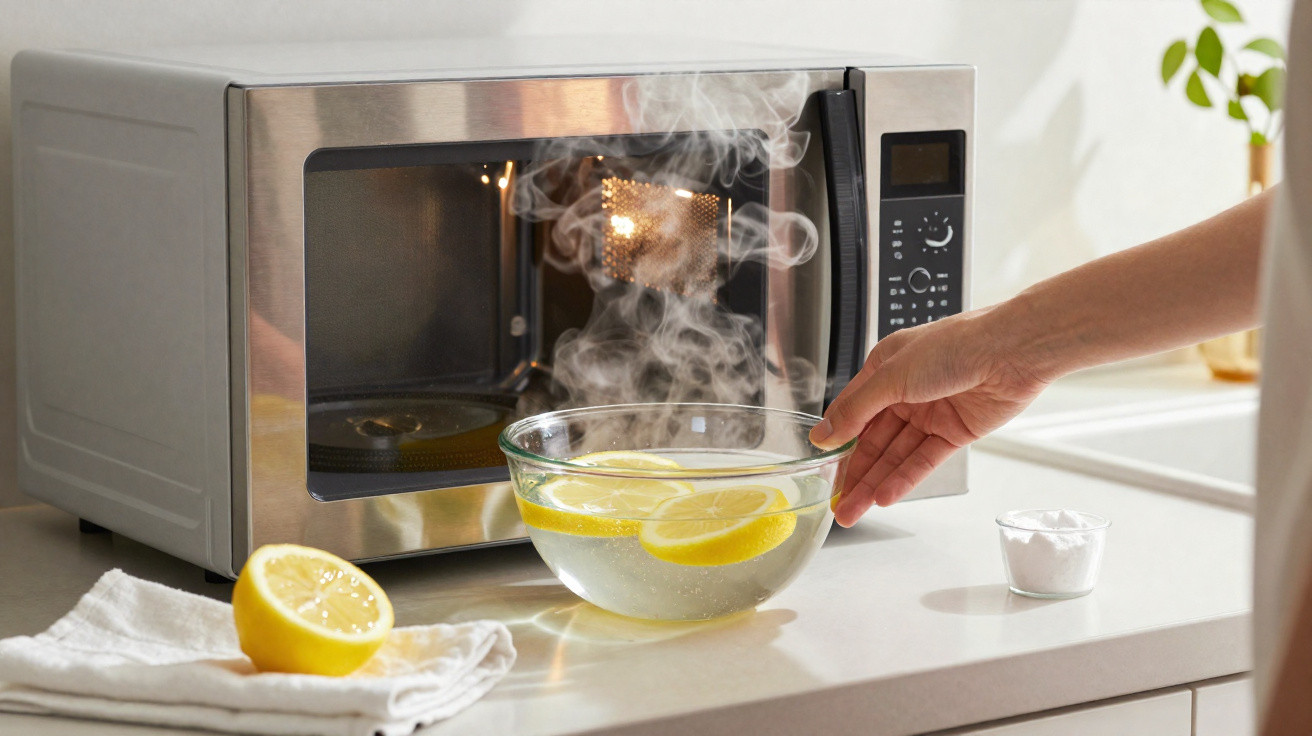
Begin with the most basic item in your kitchen: a bowl of water.
Half-fill a microwave-safe bowl with water, then add several lemon slices or a spoonful of white vinegar.
Set the bowl in the middle, shut the door and microwave it on high for 3 to 5 minutes.
The aim is to bring the water close to boiling, filling every corner with steam.
Next comes the essential part: do not open the door immediately.
Leave the bowl inside for a further 5 minutes.
The steam will soften dried residue, release grease and transform your “crusty bunker” into a small, steamy spa.
This is the stage at which people often make a mistake: they rush it.
They stop the microwave, pull open the door and scrub walls that have softened only halfway.
Allow the steam to do the work on your behalf.
Those five calm minutes replace the elbow grease you would rather avoid.
Once you do open the door, remove the turntable and wipe down the interior using a soft cloth or sponge.
There is no need to press hard; use broad, gentle strokes from the back towards the front.
Most marks will slide away with a quietly satisfying effect, rather like lifting off an old sticker in one piece.
Sometimes, when I ask people how they clean their microwave, they look guilty, laugh, and say, “I just close the door faster and hope nobody looks inside.”
- Bowl of hot water + lemon or vinegar
Works as a natural steam cleaner, loosening dried-on food and neutralising odours. - Wait 5 minutes with the door closed
Allows steam to penetrate grime, so aggressive scrubbing is unnecessary. - Remove the turntable and wipe separately
Lets you access concealed corners and stops that gritty grinding sound when it rotates. - Use a soft cloth, not a rough pad
Safeguards the internal finish and helps your microwave stay newer-looking for longer. - Quick 30-second steam once a week
Keeps mess under control, so you never have to face the “microwave of doom” again.
Living with a microwave you are not ashamed to open
There is a modest but satisfying pleasure in opening your microwave and seeing… nothing.
No splashes, no unexplained dots and no suspicious pools beneath the plate.
You heat leftovers and smell only your meal, rather than the combined aroma of ten previous dishes.
You no longer feel the need to apologise when a guest opens the door to warm their coffee.
This easy routine produces an unexpected benefit.
It can make you feel slightly more in charge of everyday disorder.
It is one kitchen box that no longer displays the evidence of rushed evenings and partly eaten dinners.
| Key point | Detail | Value for the reader |
|---|---|---|
| Steam, don’t scrub | Bowl of water with lemon or vinegar, heated 3–5 minutes, left to sit | Removes stuck-on grime without chemicals or tiring scrubbing |
| Gentle wiping | Soft cloth, turntable removed and cleaned separately | Protects surfaces, keeps microwave looking newer |
| Small weekly habit | Quick 30–60 second steam session once a week | Prevents heavy build-up and smelly interiors |
FAQ:
- Question 1 Can I clean my microwave with just water if I don’t have lemon or vinegar?
Yes. Water alone will still create steam and loosen grime. Lemon or vinegar simply assist with odours and provide a little extra degreasing.- Question 2 Is it safe to microwave vinegar?
Yes, it is safe in small household amounts. Add one or two tablespoons to a bowl of water, and do not inhale the steam too closely when you first open the door.- Question 3 How do I clean the microwave door and glass?
Wipe both the inside and outside with a damp cloth containing a few drops of vinegar or lemon juice. Finish with a soft towel to prevent streaks.- Question 4 What if the stains are still there after steaming?
Do another steam cycle, then carefully rub persistent marks with a paste made from baking soda and water, using gentle circular movements.- Question 5 How often should I do this steam clean?
Once a week is best for a busy household. If your microwave is seldom used, a quick clean every couple of weeks will generally be sufficient.


Comments
No comments yet. Be the first to comment!
Leave a Comment