
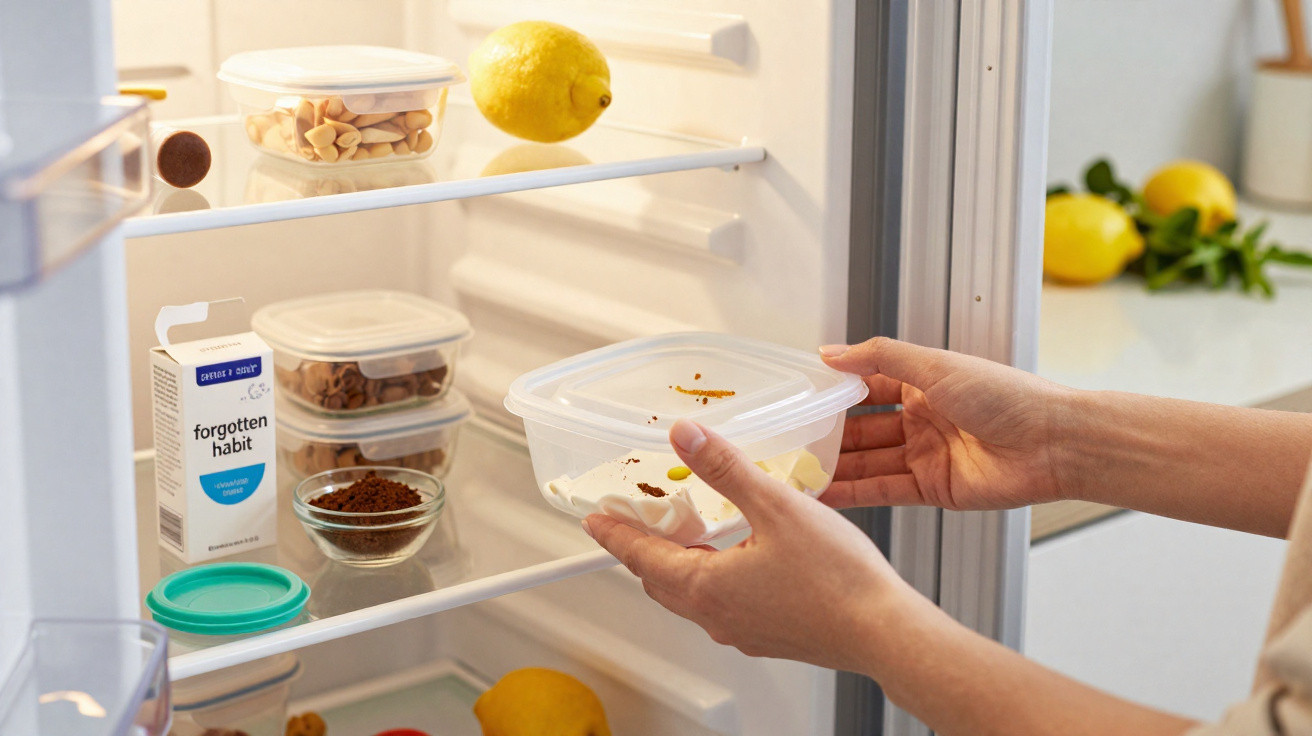
The fridge door opens and a wave of odour hits you straight away.
You instinctively take a small step back before leaning inside like a detective. Everything appears clean: the shelves are reasonably shiny, nothing is leaking and no food container has burst. Yet there is still that smell of shy old cheese mixed with an unidentifiable leftover sauce.
You check the dates, vaguely sniff a yoghurt pot and move a tub of vegetables. Then you close the door, unconvinced, hoping the smell will somehow fade by itself. It never does. It settles in like a flatmate who has not signed the tenancy agreement. Worse still, the real source of this stubborn smell is hardly ever the one you suspect.
The seemingly clean habit that traps fridge odours
Most people assume fridge odours come from mouldy food forgotten at the back. Very often, that is merely the visible part of the problem. The real culprit is somewhere you consider clean: opened packaging that has been badly resealed, piling up and mingling like a junction full of trapped aromas.
A packet of cheese folded over halfway, a meat tray covered only by its partly torn plastic film, or a jar of sauce left open because “I’ll finish it tomorrow”: each one releases a little of its smell continuously into an enclosed space. Over time, those vapours cling to the walls, seals and plastic. Even after you throw away the supposed culprit, the smell lingers.
We have all had the moment when a yoghurt cake tastes of “curry”, or cooking chocolate seems to taste of “onion”. It is not your imagination. It comes from this constant mix, an invisible haze of odours that permeates everything. Leaving packets half open turns your fridge into a permanent aroma diffuser. Not the pleasant lavender kind, but one scented with last week’s leftovers.
A study by the Institute of Food Technologists found that the fats and proteins in some foods are particularly good at taking on and retaining odours. Butter, cheese, eggs and homemade cakes behave almost like sponges. If you store a poorly covered fish dish beside a cake, volatile molecules do not hesitate before moving across.
Professional kitchens already understand this effect. Chefs separate strongly scented foods, not out of fussiness but to prevent flavour contamination. At home, we tend to think, “it is only the family fridge”. We stack, slide and put things down “for now”. The result is a library of cross-contaminated odours, where blue cheese shares its story with the salad leaves and the morning milk.
This habit of leaving packaging partly closed causes trouble on several fronts. Food loses freshness, some products deteriorate faster, and you create those familiar smells that never entirely disappear. The original plastic or cardboard packaging is not designed to stay open for several days in a humid, ventilated environment. It is like leaving a window ajar in winter and then complaining about the cold.
The airtight container rule that transforms your fridge
The answer is the task everyone puts off until “later”: swiftly transferring strong-smelling food into genuinely airtight containers. Not a bowl with cling film loosely stretched over it. Use proper containers with lids that close firmly, even if they are not Instagram-worthy. The appearance can come later.
Spend five minutes after the food shop on what might be called “boxing up”. Put cheese bought from the deli counter into its own container. Do the same with sliced meats. Place leftover chopped onion in a small sealed pot. Move last night’s meal from the saucepan into a properly closed food container rather than putting the pan in the fridge. This small routine can cut odours tenfold, sometimes by more. As an unexpected bonus, food will often keep for an extra two days.
The problem is that we always promise ourselves we will do it “after dinner” or “tomorrow morning”. Let us be honest: nobody really does that every day. The only way it works is if the habit becomes automatic. Once you open a particularly pungent packet, it should never return to the fridge half open. It needs an airtight “home”, full stop.
The same scene plays out in many kitchens. On Sunday evening, the fridge is full of leftovers and transparent containers, and everything looks under control. By Thursday, the lids have vanished, replaced by wobbly plates and crumpled cling film. The initial effort unravels. That is when the odours return with greater force, more sneakily, because you feel that you have already “organised” the fridge.
A study by the National Sanitation Foundation in the United States found that vegetable drawers and fridge seals are among the most contaminated areas in a domestic kitchen. When pungent foods release odours constantly, their molecules settle everywhere. You can clean, disinfect and put in half a lemon, but if you continue putting back cheese or fish that is only half protected, the smell will always return.
A fridge is not simply a cold space: it is a microclimate. With humidity, air circulation and condensation, it provides ideal conditions for odours. This is not just a matter of comfort either. Poorly wrapped food dries out more quickly, loses its texture and becomes less safe to eat. Over time, this minor neglect leads to waste.
“Persistent odours in a clean fridge rarely come from one forgotten food item. They are almost always the result of several open packages and poorly protected leftovers that release smells continuously,” explains a food safety hygienist I interviewed. “When people adopt genuinely airtight containers, they are often surprised to see 80% of the problem disappear within a few days.”
To make things easier, some people follow a very simple rule: every time original packaging is opened, the food must either be finished within 24 hours or moved into an airtight container. No grey area. You could even keep an “odour kit” in the fridge door: three or four empty containers ready to use, reserved for powerful foods such as cheese, onion and heavily spiced meals.
- Use glass containers with silicone seals for fatty or highly scented foods, including cheese, fish and dishes with sauce.
- Keep small airtight pots for onions, garlic, chopped herbs and homemade sauces.
- Set aside one container solely for cheese, so it does not scent everything else.
- Add simple labels showing the opening date to avoid anonymous leftovers.
How to reset a smelly fridge and keep it fresh
When a fridge already smells like a patchwork of aromas, throwing everything away is not enough. The air, plastic surfaces and seals will have absorbed the smell. Start with a small-scale move: take everything out onto the table, group items by category and decide what stays and what goes. Simply emptying the fridge often reveals those pots forgotten for three weeks.
Then clean methodically. Harsh products are unnecessary: use warm water and a little washing-up liquid, followed by a second wipe with a mixture of water and white vinegar. Clean the drawers, removable shelves, seals and door. Leave the fridge open to air for 10 to 15 minutes. Yes, this part is slightly tedious. Without it, however, old odours remain in the background.
The real change comes when you put food back. Use the rearrangement to apply your new rule: no opened original packaging goes back in without protection. Put cheeses and sliced meats in containers. Transfer meals into containers that actually seal. You can designate a “strong odour zone” near the bottom, where air circulates a little less. This is not about absolute control, merely a form of visual and olfactory common sense.
| Key point | Details | Why it matters to readers |
|---|---|---|
| Replace open packaging with airtight containers | Within 24 hours of opening, transfer cheese, sliced meats, onions and leftovers from torn plastic or paper into sturdy containers with a securely closing lid. | This prevents odours spreading, slows drying and spoilage, and stops that “mixed smell” whenever you open the door. |
| Give strongly scented foods their own “zone” | Keep cheese, fish, garlic-heavy dishes and curries on a lower shelf or in a dedicated container, so their aromas do not drift towards desserts or dairy products. | It keeps neutral foods from tasting of last night’s meal and makes it easier to see what should be eaten first. |
| Do a quick 10-minute reset every week | Once a week, remove anything clearly past its best, wipe up visible spills and reseal or re-containerise half-open items. | This short routine prevents odours building up, avoids the dreaded “deep fridge clean” and quietly reduces food waste. |
Over time, this level of attention becomes less regimented and more instinctive. You open the fridge, spot a packet of cheese lying around and almost automatically place it in a container. You notice leftover sauce sitting without a lid and cover it immediately. These tiny actions take seconds, yet they radically alter the atmosphere inside the fridge. And, as a quiet added benefit, you waste less food.
It may sound like fussiness. In reality, many people describe it as genuine peace of mind: no longer being greeted by a questionable smell when opening the door, no longer worrying when guests look through your fridge, and no longer throwing away food that has been flavoured by its shelf neighbours. It is not dramatic, but it slightly changes the way you experience your kitchen.
What if the story of fridge odours is about more than forgotten cheese? It is about those small, invisible habits: things we do for convenience without thinking, which eventually shape everyday life. Opening a packet carelessly, putting it back like that, telling yourself you will deal with it later. Closing the door on an unpleasant smell and hoping it will disappear on its own.
Changing this tiny reflex - taking out a container, sealing food properly and giving strong-smelling items a “home” - will not transform your life. But it can subtly change the way you manage everything else: less chaos in the fridge, less guilt when you throw away a dried-out meal and fewer grimaces when you open the door in the morning. Sometimes that is enough to make you want to discuss it, compare notes and share tips with others.
The next time your fridge sends out that vague, unidentifiable waft of smell, you may think about something other than the infamous forgotten container. You will notice the open packets, improvised lids and leftovers exposed to the constant chilled air. You will recognise the old reflex that creates lingering odours without you realising it. And perhaps you will reach for an airtight container before closing the door.
FAQ
- Why does my fridge still smell even after I’ve cleaned it? Plastic surfaces, door seals and even air vents retain odour molecules when strongly scented foods have been poorly wrapped for a long time. If you then put back cheese or leftovers that are only partly covered, you restart the cycle and the smell quickly returns.
- Are baking soda or coffee grounds enough to remove fridge odours? They can absorb some odours, but they are mainly temporary fixes. Without a change in habits - airtight containers, regular sorting and packaging that is properly closed - the problem returns a few days later.
- Which foods should always go into airtight containers? Cheese, sliced meats, fish, dishes with sauce, cut onions or garlic, curry leftovers, as well as homemade cakes and butter. These are the champions at either releasing or absorbing other foods’ odours.
- How often should I deep-clean my fridge to avoid bad smells? A full clean every 6 to 8 weeks is enough for most households if you do a weekly mini-sort. If open packages pile up, you may need more frequent deep cleans.
- Is it better to keep food in original packaging or in containers? Unopened, original packaging does the job. Once opened, much of it allows air and odours through. For storage over a few days, a good airtight container protects both flavour and smell more effectively.



Comments
No comments yet. Be the first to comment!
Leave a Comment