
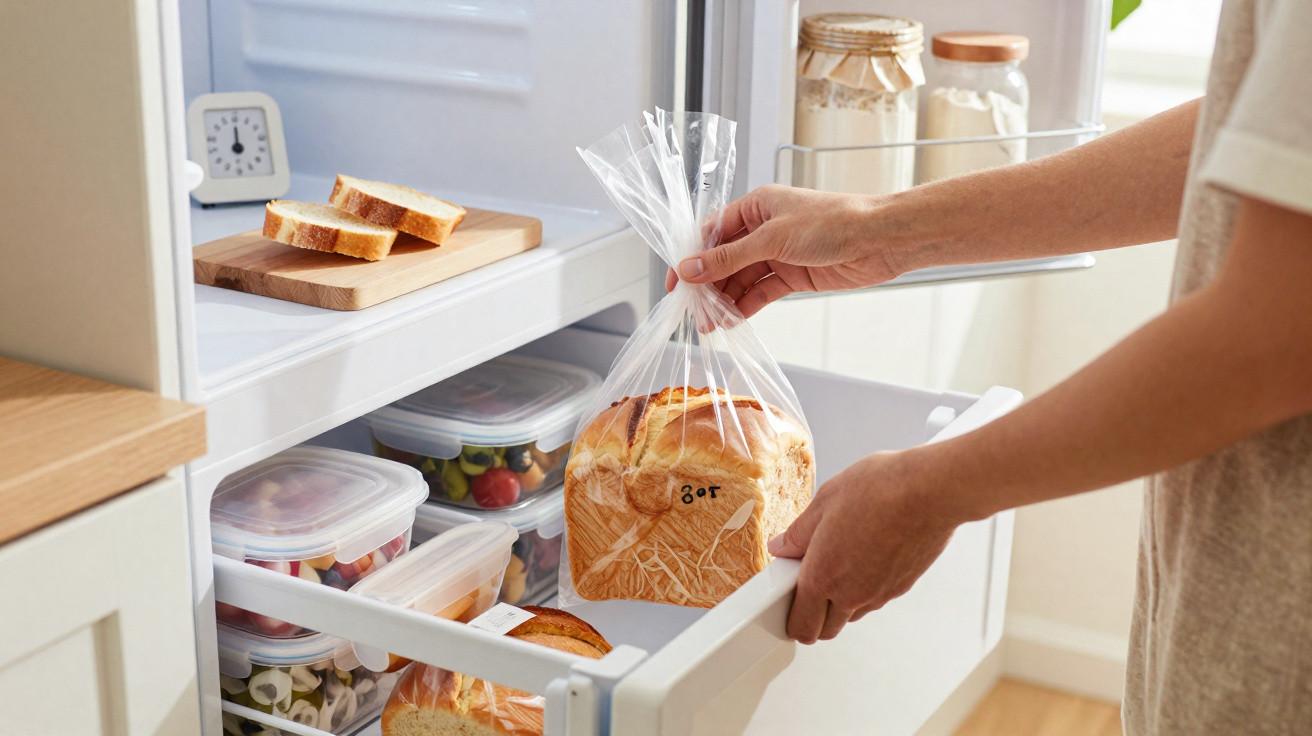
You leave the bakery with freshly baked bread, do not eat it all, put it in the freezer and assume you have avoided waste.
A few days later, the bread returns to the table hard, oddly flavoured and with an unpleasant texture. The freezer itself is rarely to blame; the issue is usually a small detail that many people overlook in the rush of daily life.
The number-one mistake when freezing bread at home
When bread is left over from dinner or a barbecue, the most common response is to put it straight into the freezer, loose and “as it is”. It seems easy, quick and straightforward.
That is exactly where the problem begins. Freezing bread without any protection exposes it to both the cold and the freezer environment.
Without packaging, bread absorbs odours, loses moisture and may even be contaminated by micro-organisms present in the freezer.
The effects become clear when it is time to eat it: a rubbery or overly dry crumb, a lacklustre crust, an “old fridge” taste and, in some cases, even small visible ice crystals.
Fish smell, bread taste
A household freezer tends to contain all sorts of things: raw meat, fish, seasonings, leftover meals, desserts and ice made with soft drinks. Even at low temperatures, aromas travel.
As bread is porous, it behaves almost like a sponge. If it is left unprotected, it can:
- take on the smell of fish or meat;
- develop a slightly sweet taste when stored near desserts;
- become more prone to hard-to-identify yet unpleasant “mixed” flavours.
There is another often-forgotten point: low temperatures do not destroy every bacterium and fungus in the environment. They simply reduce their activity. Bread placed directly in the freezer with nothing around it remains exposed to splashes, crumbs and particles from other foods.
How to freeze bread properly
Protecting bread before freezing does not require chef-level skills or professional equipment. The difference comes from combining suitable packaging with good organisation.
Simple rule: frozen bread needs a barrier against air and against the odours of other foods.
Step-by-step guide to keeping bread tasty
First, allow the bread to cool completely if it has only just come out of the oven. Freezing bread while it is still warm encourages ice to form inside the packaging.
Then follow a few basic steps:
- Slice or cut large bread into portions to make defrosting easier;
- Use freezer bags, which are thicker and more durable;
- Remove as much air as possible from the bag before sealing it;
- Close it securely, preferably with a zip seal or a tight knot;
- Write the freezing date on a label or directly on the bag.
People who buy bread in larger quantities can also make individual portions or portions for a particular meal. That way, only what is needed is opened, without repeatedly defrosting and refreezing the bread.
How long bread can stay in the freezer
Even well-packaged bread does not last indefinitely. Its texture changes over the months, even if the flavour has not yet deteriorated.
| Type of bread | Average freezing time |
|---|---|
| French rolls / baguette | Up to 2–3 months |
| Sliced or sandwich loaves | Up to 3–4 months |
| Wholemeal or grain breads | Up to 4–6 months |
| Very moist breads (cheese bread, brioche, etc.) | Up to 2–3 months |
After this time, bread is more likely to become dry, with a crumbly interior and a “dull” crust. It will not necessarily be harmful, but its quality declines. It is therefore worth labelling it with the date and using it gradually, rather than forgetting a bag at the back of the freezer.
Secrets to defrosting without ruining everything
Freezing bread correctly is only half the process. The other half is how it is defrosted. Rushing can leave bread hard on the outside, cold in the middle or with a gummy crumb.
Practical options for everyday use
- At room temperature: Take the bread from the freezer, leave it in its packaging for a few minutes, then open it and place it on the worktop until defrosted.
- In the oven: This is ideal for restoring crispness. Let the bread defrost for a few minutes, lightly spray the crust with water and place it in a medium oven for 5 to 10 minutes.
- In the toaster: This works well for thin slices. Put them straight from the freezer into the toaster.
When used carelessly, a microwave often makes bread elastic. If there is no other option, use short bursts at medium power and eat it immediately afterwards.
How to store bread without using the freezer
It is not always worth taking up freezer space, especially when there is only a small amount of bread or it will be eaten soon.
A few approaches can help bread stay fresh for longer in the kitchen or fridge.
Fridge: enemy or ally?
The fridge has traditionally been known for drying out bread. This does happen when it is left loose and unprotected on cold, humid shelves.
There is, however, a strategic way to use it: place the bread in a zip-top freezer bag, remove the air thoroughly and store it on the highest shelf, which is usually the least humid. This helps it last for more days without going stale as quickly.
Another choice is to use traditional methods: a clean cotton cloth, a wooden bread box or a bread tin. These materials help balance moisture, preventing the bread from “sweating” while also avoiding too much exposure to dry air.
A thin plastic bag left open on the table speeds up internal moisture and contributes to bread becoming soft on the outside and hard in the middle.
When bread is already stale: throw it away or reuse it?
Even with every precaution, bread sometimes goes past its best. Before putting it in the bin, consider reusing it. “Old” bread can still be very useful in the kitchen.
- Cut it into cubes, season with olive oil and herbs, then bake it into croutons for salads and soups;
- Blitz dry pieces in a food processor to make homemade breadcrumbs;
- Use it in recipes such as bread pudding, French toast, savoury pies or stuffings;
- Turn it into bruschetta by toasting it and adding tomato, cheese or vegetable toppings.
This kind of reuse cuts waste while also producing dishes full of flavour. Many traditional recipes were created precisely to avoid throwing bread away.
What happens to bread during freezing
For anyone who enjoys understanding why things happen, it is worth taking a quick look at what occurs inside bread in intense cold.
The crumb contains water held within the starch structure. When frozen, that water forms ice crystals. If the bread is poorly packaged, these crystals grow too large and break down the structure. When it defrosts, some of the moisture is then lost, leaving the crumb dry or crumbly.
The bread “ageing” process, known as starch retrogradation, also continues at low temperatures, although more slowly. Freezing therefore extends shelf life, but it does not completely stop texture changes.
Good practices to prevent waste and preserve flavour
People who buy bread every day can try purchasing smaller quantities while paying attention to how much the household actually eats. Those who only visit the bakery once a week, on the other hand, rely more heavily on freezing.
One useful strategy is to divide it into three parts: bread for immediate consumption at room temperature, bread in the fridge for the next two days and the rest well packaged in the freezer. This means there will always be decent bread available, without the need for improvisation.
Thinking of bread as more than something to “go with coffee” also helps. Smaller pieces can become the basis for snacks, starters and economical recipes. The habit of treating bread as disposable affects both the budget and the amount of waste produced.



Comments
No comments yet. Be the first to comment!
Leave a Comment