
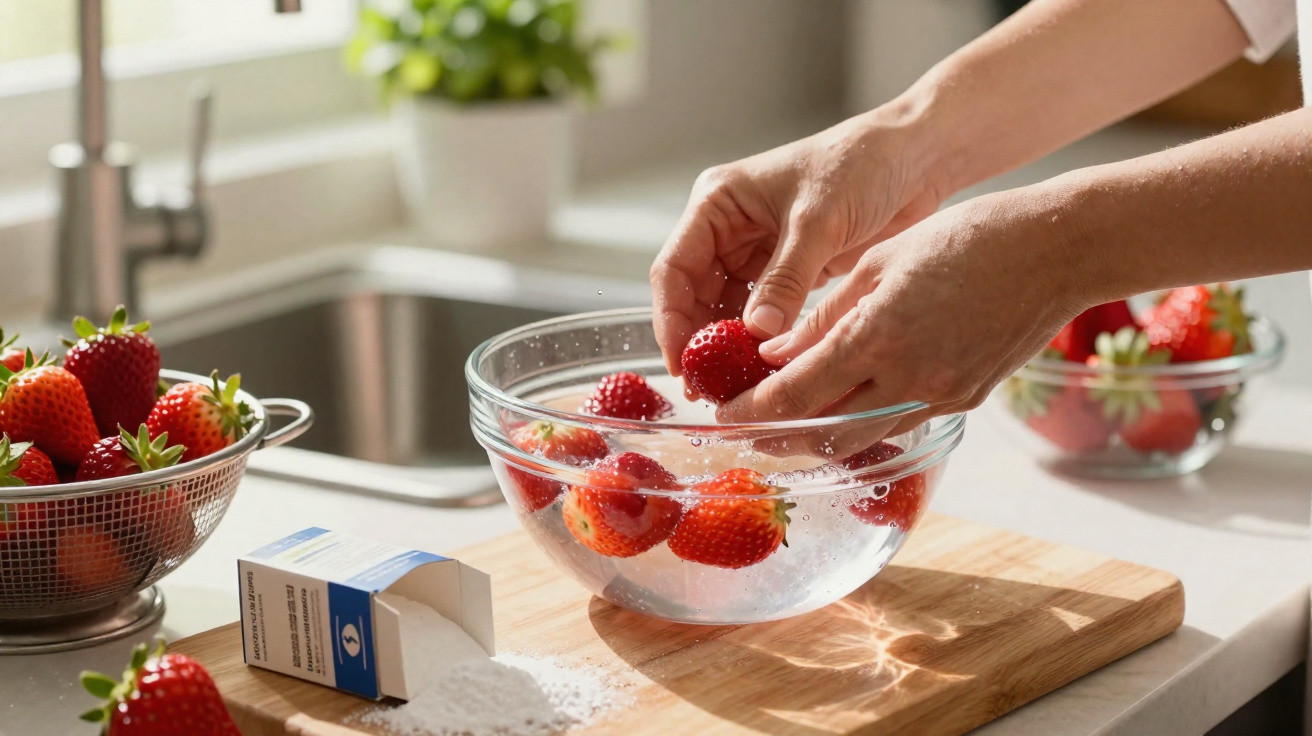
Many people give strawberries only a quick rinse under the tap – then assume they are safe.
That is precisely where the problem can begin.
After a few seconds beneath running water, red, glossy strawberries may look clean and harmless. Modern residue testing, however, presents a very different picture: even fruit that appears flawless often carries an invisible cocktail of pesticides on its skin, which tap water barely removes.
Why strawberries carry such high pesticide residues
In several international assessments, strawberries rank among the fruit types with the highest levels of pesticide contamination. Data from US authorities such as the USDA, along with analyses by organisations including the EWG, have shown the same pattern for years: residues can be detected in almost every conventionally grown sample, often with several active substances present at the same time.
Investigations have reported figures such as:
- 99 % of tested samples containing at least one detectable residue
- around 30 % containing ten or more different pesticide molecules on a single sample
- more than 20 different substances in extreme cases
Frequently detected substances include fungicides such as Carbendazim and insecticides such as Bifenthrin. Many of these agents are designed to withstand rain and sunlight. That is exactly what makes them difficult to remove with a simple rinse.
Strawberries are delicate, so outdoor crops are protected with a whole range of plant-protection products. The downside ends up on the skin.
Why plain water is rarely enough for strawberries
Most consumers consider a quick rinse under the tap sufficient: wash off the visible dust and soil, and the job is done. Yet this approach mainly removes obvious dirt rather than the residues themselves.
The explanation lies in the chemistry. Many modern pesticides are lipophilic, meaning they are attracted to fats, and are formulated to be “rainproof”. They cling firmly to the fruit's waxy outer layer, known as the cuticle. Water runs off this surface without dissolving a significant amount of the molecules.
Studies, including work from the University of Massachusetts, have reached similar findings: plain tap water removes on average only around 10 to 20 percent of measurable residues, mainly those from active substances that dissolve well in water. A brief ten-second rinse removes considerably less.
A common mistake: hulling before washing
The situation becomes even more problematic when strawberries are hulled before they are washed. Removing the green calyx and stem creates an opening into the fruit. Contaminated water, soil or dissolved residues can then enter and spread into areas that are difficult to clean afterwards.
Experts therefore give clear advice: always soak strawberries whole, with the calyx still attached, and hull them only after drying. This offers better protection for the inside of the fruit.
The most effective method: a bicarbonate of soda soak
Far better results can be achieved by soaking the fruit in a solution of bicarbonate of soda, also called baking soda or sodium bicarbonate. It is sold in food shops as “baking soda” or “bicarbonate of soda”. This compound is mildly alkaline, with a pH value of around 8 to 9.
This slightly alkaline environment can chemically break down certain pesticide molecules while also loosening their grip on the skin. In University of Massachusetts tests involving apples, up to 90 percent of measurable surface residues disappeared after roughly 15 minutes in a suitable bicarbonate of soda solution – a stark contrast with water alone.
Bicarbonate of soda is not a magic wand, but in laboratory tests it showed a clearly stronger cleaning effect than water, salt or vinegar solution – without ruining the fruit.
Step-by-step guide for strawberries
These findings are easy to put into practice at home. Here is what to do:
- Fill a large bowl with 1 litre of cold water.
- Dissolve 1 heaped tablespoon of food-grade bicarbonate of soda completely in the water.
- Place the strawberries in the bowl intact, with their calyxes and stems still on.
- Stir very gently so that all the fruit is covered by the solution.
- Leave them for 10 to 15 minutes – do not shorten this time, or the effect will be reduced.
- Remove the strawberries, place them in a colander and rinse for around 30 seconds under running water.
- Leave them to dry in a single layer on a clean tea towel or kitchen paper.
The small seeds on the surface, known as achenes, readily hold on to tiny particles of dirt and residues. A brief rinse often leaves up to 80 percent of these substances behind, whereas a bicarbonate of soda soak releases most of them from the surface.
Vinegar water, salt solution and organic strawberries: what else helps?
There are countless household suggestions, from vinegar water and salt water to specialist fruit washes. Laboratory data provide a clearer way to assess these methods.
How effective are vinegar and salt?
- Vinegar solution (1 part white vinegar to 5 parts water): removes around 60 to 70 percent of surface residues in tests. Its smell may linger, which sensitive noses may notice later in a dessert.
- Salt water, slightly warm: generally achieved 40 to 60 percent. A longer soak can make the fruit softer.
- Plain tap water: as noted, removes only approximately 10 to 20 percent.
In these comparisons, bicarbonate of soda solutions sit at the upper end of the scale. They therefore offer a good balance between effectiveness, cost and treating the fruit gently.
Why washing-up liquid is off limits
Some people reach for kitchen cleaner or washing-up liquid, hoping that grease-cutting products will also tackle pesticides. Specialist institutions advise against this. Cleaning products are not intended for consumption; their own residues may be problematic and can easily get into the strawberry's small crevices or damaged areas.
The rule of thumb is simple: anything that is not explicitly approved as a food or kitchen ingredient has no place in fruit-washing water.
Does this apply to organic strawberries too?
Many shoppers choose organic produce and feel reassured. Organic farming avoids a wide range of synthetic treatments, but it uses other approved preparations. Organic fields can also be contaminated by spray drift from neighbouring land, for example through wind or shared harvesting machinery.
Testing series show that residues can occasionally appear on organic strawberries too – usually fewer residues and different substances, but not necessarily none at all. The cleaning routine of a bicarbonate of soda soak, rinsing and drying is therefore worthwhile here as well.
Whether conventional or organic: thoroughly soaking strawberries measurably reduces the overall contamination – particularly relevant for children.
How to store washed strawberries properly
Another factor is often underestimated: moisture. Washed fruit deteriorates much more quickly if it goes into the fridge while still damp. Mould thrives on the combination of a film of water and sugary juice.
Practical fridge tips:
- Wash strawberries only shortly before eating them, rather than immediately after buying them.
- After soaking, drain them thoroughly and allow them to dry carefully.
- Arrange them in a shallow dish lined with absorbent paper, then cover loosely.
- Avoid bruising, as damaged spots can become entry points for germs.
What terms such as “lipophilic” and “cuticle” mean
Anyone wondering why water has so little effect soon encounters a few technical terms. Lipophilic active substances dissolve more readily in fats or waxes than in water. Strawberry skin has exactly such a thin waxy film: the cuticle. It protects the fruit against drying out, but it also holds foreign substances firmly in place.
At the boundary between the water and this waxy layer, bicarbonate of soda changes the conditions and can partly alter the structure of certain molecules. As a result, a greater proportion comes away from the skin and enters the soaking water instead of remaining attached to the fruit.
Practical ways to improve everyday safety
Anyone looking to reduce exposure in day-to-day life can make adjustments in several areas. Useful combinations include:
- Prefer local produce with shorter transport routes where possible – it often receives fewer post-harvest treatments.
- Choose strawberries from protected cultivation, such as tunnels or greenhouses, when available.
- Ask the retailer about the harvest date and origin instead of relying only on the label.
- Use the bicarbonate of soda soak consistently at home, including for other delicate fruits such as grapes or cherries.
These steps will not automatically make strawberries completely residue-free, as some substances may have moved into the flesh. Even so, the overall load falls significantly – with a simple, inexpensive measure that can be incorporated into any kitchen without much effort.


Comments
No comments yet. Be the first to comment!
Leave a Comment