
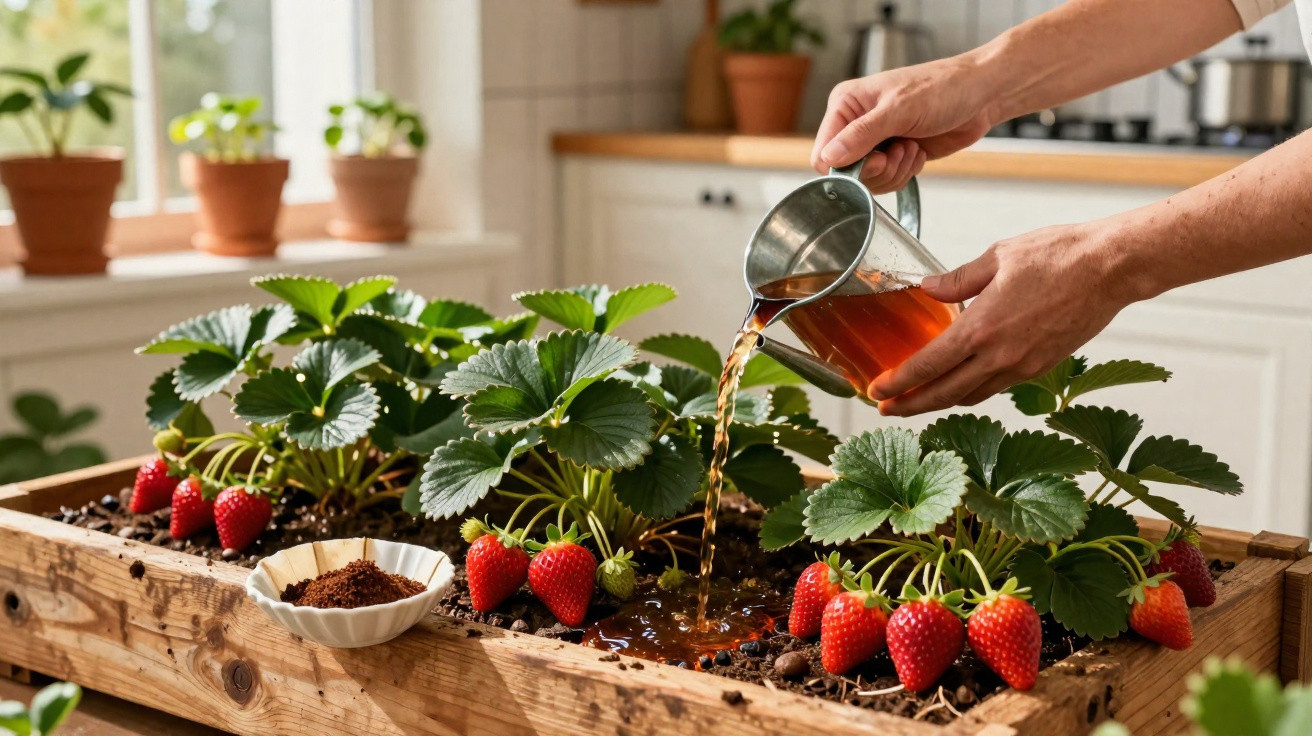
A simple trick using a kitchen leftover can make all the difference.
Anyone planting strawberries in the garden or on a balcony for the first time often faces the same frustration: the plants are covered in flowers, yet the fruit stays small and dry. The issue is frequently not the variety, but what the plants receive in their watering water during spring – or fail to receive. One kitchen waste product that many people throw away every day can help strawberries produce noticeably larger, juicier fruit.
Why strawberries are so hungry in spring
Strawberry plants enter their main growing period between March and May. During these months, they produce fresh leaves, new shoots and, later, the flower buds from which the fruit develops. A generous harvest depends on strong, healthy foliage.
To grow those leaves, plants chiefly need one nutrient: nitrogen. It helps build chlorophyll, enabling the plant to store energy. The more sturdy leaves a strawberry plant has, the better it can supply its fruit with sugar and flavour.
Strong leaf growth in spring usually means more and larger strawberries in summer.
Strawberries also prefer soil that is loose and slightly acidic. A pH level of roughly 5.5 to 6.5 is ideal. Soil in many gardens is neutral to mildly alkaline, however, and strawberry plants can soon become nutrient-deficient and weak in these conditions.
The kitchen leftover that gives strawberries a real boost
The unexpected helper sits on many kitchen worktops every morning: coffee grounds. Dried coffee grounds contain around two per cent nitrogen, as well as small quantities of phosphorus and potassium. With a pH of about 6.2, they fall squarely within the range that strawberries favour.
This means coffee grounds are remarkably well suited to the plants’ needs:
- they provide moderate nitrogen for vigorous leaf growth;
- they help maintain slightly acidic soil;
- they add organic matter and feed soil organisms;
- they improve soil structure over time.
Giving strawberries a diluted “coffee grounds shower” in spring supports the precise stage when the plants are building energy reserves and laying the foundations for large, juicy fruit.
Why applying neat coffee grounds to soil is not a good idea
Many people tip damp coffee grounds directly beneath their plants in a thick layer. Although this may seem sensible, it often causes difficulties. Fresh, wet coffee grounds can:
- form a hard, crusted surface;
- encourage mould growth;
- make it harder for water to penetrate the soil;
- create overly concentrated nutrients in individual areas.
A gentler method that is much better suited to strawberries is to dry the grounds first, then make a type of “coffee tea” for watering. This distributes nutrients evenly through the soil instead of creating a suffocating layer on its surface.
How to make a coffee grounds infusion for strawberries
You need only three things for the watering mixture: dried coffee grounds, water and a container. Spread fresh grounds on a plate or baking tray first and allow them to dry completely, preventing mould from forming.
Step-by-step guide
- Put the dried coffee grounds into a bucket or watering can.
- Fill it with water; room-temperature water is sufficient.
- Leave the mixture to stand for 24 to 48 hours, stirring it occasionally.
- Pour the liquid through a sieve so that particles do not block the nozzle or rose of the watering can.
- Water only the soil around the plants, rather than the leaves or fruit.
As a guide, use around 40 to 50 g of coffee grounds per 1 litre of water. For a standard 5-litre watering can, approximately 200 g is enough. Allow around 250 ml of this solution for each strawberry plant.
| Amount of coffee grounds | Amount of water | Use |
|---|---|---|
| 50 g | 1 litre | for 4 strawberry plants |
| 200 g | 5 litres | for around 20 strawberry plants |
If you have only a few plants on a balcony, simply reduce the quantity of coffee grounds accordingly and prepare the infusion in a small watering can or large jar.
How often strawberries should be watered with coffee water
Even natural products can be overused. Coffee grounds infusion acts as a mild organic fertiliser, so it should be used accordingly. At most sites, one or two applications between March and the end of May will be enough.
A practical schedule is:
- water for the first time once the plants are visibly producing new growth;
- make a second application around three weeks later if the soil is not already strongly acidic.
In areas with an early spring, such as mild lowland locations and wine-growing climates, this is more likely to begin in March. At higher altitudes or in cooler areas, the treatment generally starts in April instead.
When strawberries receive too much nitrogen
Although coffee grounds are relatively mild, excessive nitrogen can still upset the balance for strawberry plants. The plant may then put all its energy into leaf growth, while flowers and fruit lose out.
Too much nitrogen encourages plenty of greenery and few strawberries – the aim is balance.
Possible warning signs of over-fertilising include:
- very large, dark-green leaves;
- lots of runners but hardly any flowers;
- soft plants that are prone to disease.
If your soil is already fairly acidic or heavy, limit yourself to one coffee watering in spring and add mature compost as well. Alongside nitrogen, compost supplies phosphorus and potassium, which are particularly important for flowering, fruit set and flavour.
Coffee grounds as a natural deterrent for pests
Coffee grounds offer one welcome side effect: they alter the scent around the bed. Many insects and small rodents dislike that smell and keep away from the plants.
Practical observations suggest that the following visitors, among others, avoid coffee grounds:
- midges;
- ants;
- slugs;
- wasps;
- mice and rats.
This can reduce pressure from some pests, especially in damp, densely planted corners. It is not a guarantee of complete protection, but it can be one element of an overall resilient approach to plant protection.
Do not underestimate the risk to pets
While coffee grounds can be useful in a strawberry bed, they may be problematic for dogs and cats. Used grounds still contain some caffeine, which is toxic to animals if they eat larger quantities.
Pet owners should therefore:
- avoid leaving uncovered piles of coffee grounds in the garden;
- pour the settled liquid directly into the soil rather than leaving it standing in bowls;
- position balcony planters so that animals cannot easily reach the growing medium.
More tips for genuinely large strawberries
Coffee grounds alone will not create an XXL harvest; they work mainly as a supporting measure. Truly impressive fruit also relies on several additional factors:
- Position: Choose a sunny to partially shaded, sheltered spot that is not directly beneath trees.
- Soil: It should be loose and rich in humus, without waterlogging; work sand and compost into heavy soil.
- Watering: Keep the soil evenly moist, particularly while the plants are flowering and forming fruit, but avoid leaving them with “wet feet”.
- Mulch: Straw or grass clippings keep fruit clean and help protect it from rot.
- Age of plants: Renew plants gradually after three to four years, as yields decline after this point.
Gardeners who follow these basics and use coffee watering sparingly in spring often notice a clear difference as early as the following season: stronger plants, more flowers, and larger, more evenly sized fruit.
For beginners, it is worth trying the coffee trick on one group of plants while caring for another group in the usual way. This makes it possible to compare exactly what the method achieves in your own garden. In many cases, the kitchen leftover in the watering water proves to be a surprisingly effective ally on the path to a plentiful strawberry harvest.






Comments
No comments yet. Be the first to comment!
Leave a Comment