
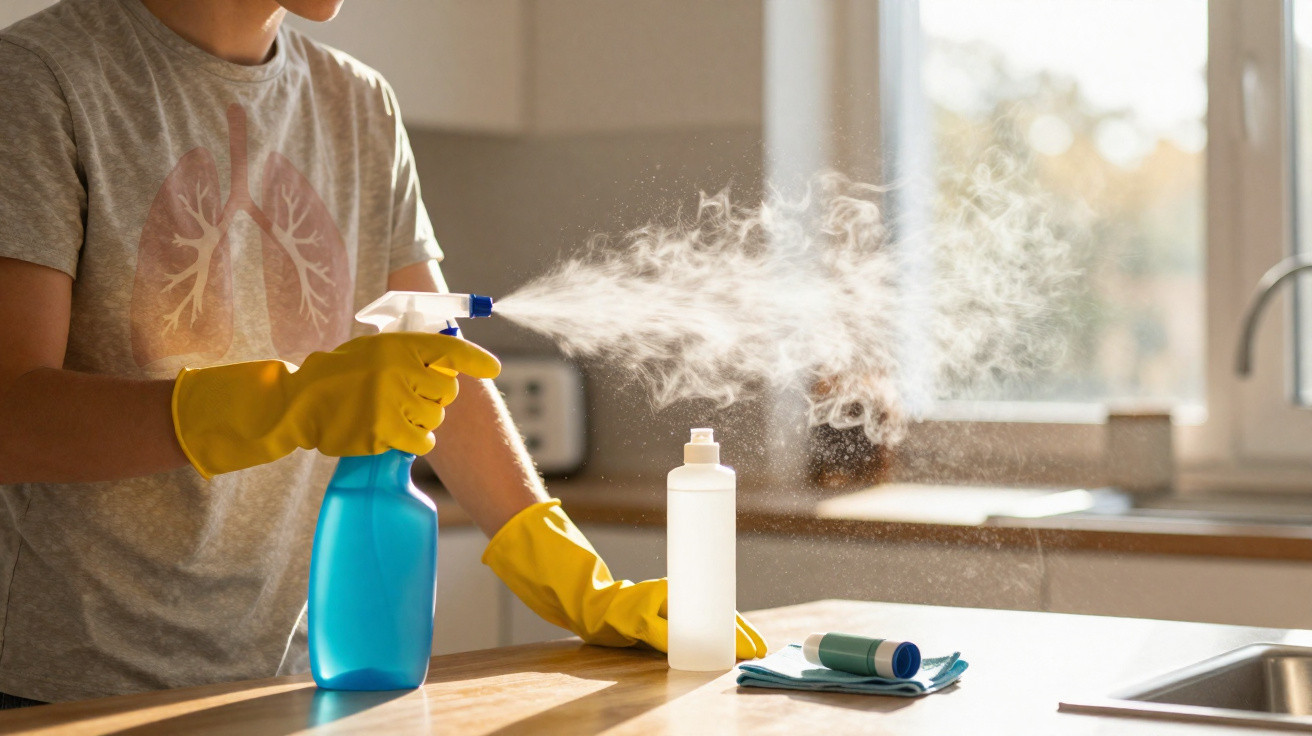
Spray disinfectants are used almost everywhere, from kitchens and bathrooms to schools and hospitals, often with little consideration of their potential effects.
However, fresh research indicates that how these cleaners are applied could be more significant than many people appreciate. Laboratory experiments found that inhaling widely used cleaning chemicals produced substantially greater lung injury than ingesting identical substances.
The results are not a reason to abandon disinfection. They do, though, expose an important weakness in existing safety assumptions, particularly around what occurs after chemicals are sprayed into the air.
What happens after spraying
In experiments involving mice, injury occurred at doses well below those linked with ingestion studies.
Gino Cortopassi of the University of California, Davis (UC Davis) connected this damage with ingredients found in commonly used disinfectants.
Chemical concentrations in the blood fell within the broad range previously observed in people, connecting exposure through the lungs with the chemical burden already measured beyond laboratory conditions.
That similarity cannot determine the level of risk to humans, but it makes the exposure route the central issue that the remaining evidence needs to address.
More than just surface cleaners
These disinfectants are part of a chemical group known as quaternary ammonium compounds, or QACs, which are frequently included in cleaning products.
By themselves, QACs do not readily become gases. When sprayed, however, they form minute droplets that can be inhaled and travel deep into the lungs.
Nor are QACs limited to cleaners. They also occur in products including herbicides, nasal sprays, mouthwashes, dryer sheets and fabric softeners, so people may encounter them more regularly than they recognise.
Their extensive use has prompted concern. One study detected QACs in 80 percent of those tested, and higher concentrations were associated with lower energy production within cells.
Tracking exposure in blood
The latest study showed that blood levels of these chemicals declined rapidly following exposure. This points to swift movement, with the chemicals entering through the lungs before circulating through the bloodstream.
As a result, when blood is sampled is important. Testing too long after exposure could indicate low levels even where concentrations were considerably higher soon after inhalation.
Although findings in mice cannot entirely forecast risk in people, they can clarify how sprayed cleaners may pass from indoor air into the body.
Some disinfectant sprays are more harmful
The research also identified meaningful variation between chemicals and between individuals.
Didecyl dimethylammonium chloride, one ingredient examined, was more damaging than benzalkonium chloride when each reached the lungs at an equivalent dose.
It resulted in more mouse deaths and produced greater quantities of protein and debris in lung fluid, both clear indicators of more extensive injury to the air sacs. Immune cells arrived sooner as well, while tissue specimens taken later revealed increased swelling and disruption.
These variations indicate that similarly labelled products may not present identical risks. The researchers further observed that male mice were more likely than female mice to die at matching exposure levels.
Blood findings provided one potential reason. Female mice seemed to transfer benzalkonium chloride from the lungs into the bloodstream more rapidly, potentially shortening the time that the chemical remains in lung tissue and causes harm.
Yet this trend did not completely account for the effects of the second chemical, so differences related to sex are not yet fully understood.
How lung damage begins
When these compounds are swallowed, much of the material remains outside the body, whereas inhalation has very different consequences. Sprayed droplets that enter the lungs directly contact fragile tissue designed for rapid gas exchange, leaving the lungs particularly susceptible.
The researchers believe mitochondria, the cell components responsible for producing energy, may be involved in the damage. These disinfectants seem to interfere with those systems.
Without sufficient energy, cells find it difficult to sustain protective barriers. Fluid and immune cells can then seep into lung tissue, worsening inflammation and injury.
This mechanism has not been completely verified in humans, but it offers an explanation for why inhaled exposure acts so differently from ingestion.
Evidence from real-world settings supports a similar concern. In healthcare environments, QAC exposure has been associated with a 7.5-fold rise in physician-diagnosed asthma.
A separate study involving 73,262 U.S. nurses linked high disinfectant exposure with chronic obstructive pulmonary disease (COPD).
Neither study demonstrates that the same outcomes arise in homes, but both suggest that repeated inhalation may involve genuine respiratory hazards.
Questions still remain
Human exposure generally consists of repeated low-level contact over months or years, rather than a single acute dose given to mice.
The timing of sampling is also relevant, since the chemicals decreased rapidly in mouse blood and might appear less substantial when samples are collected later.
Only two ingredients were assessed by the researchers, meaning other chemicals in this family could act differently in the lungs.
These limitations mean the study cannot resolve human risk, while also identifying the experiments now most needed.
The risk of airborne cleaners
Airborne droplets represent the crucial change: the same disinfectant may pose a very different risk when it is sprayed rather than poured or wiped on a surface.
This distinction is particularly relevant in homes, schools, hospitals and transport systems, where regular cleaning can leave droplets circulating through shared indoor air.
“We have to question whether we really want to have all of these QAC-based disinfectant sprays in the environment,” said Cortopassi.
The findings do not call for disinfection to stop entirely, but they do challenge the longstanding belief that inhaled exposure is insignificant.
Instead of being solely a surface-cleaning matter, cleaning chemistry increasingly appears to be an airway-exposure issue driven by airborne droplets.
Future research must examine long-term exposure levels that reflect human conditions. Even so, this mouse study already makes the risks linked to spraying harder to disregard.


Comments
No comments yet. Be the first to comment!
Leave a Comment