
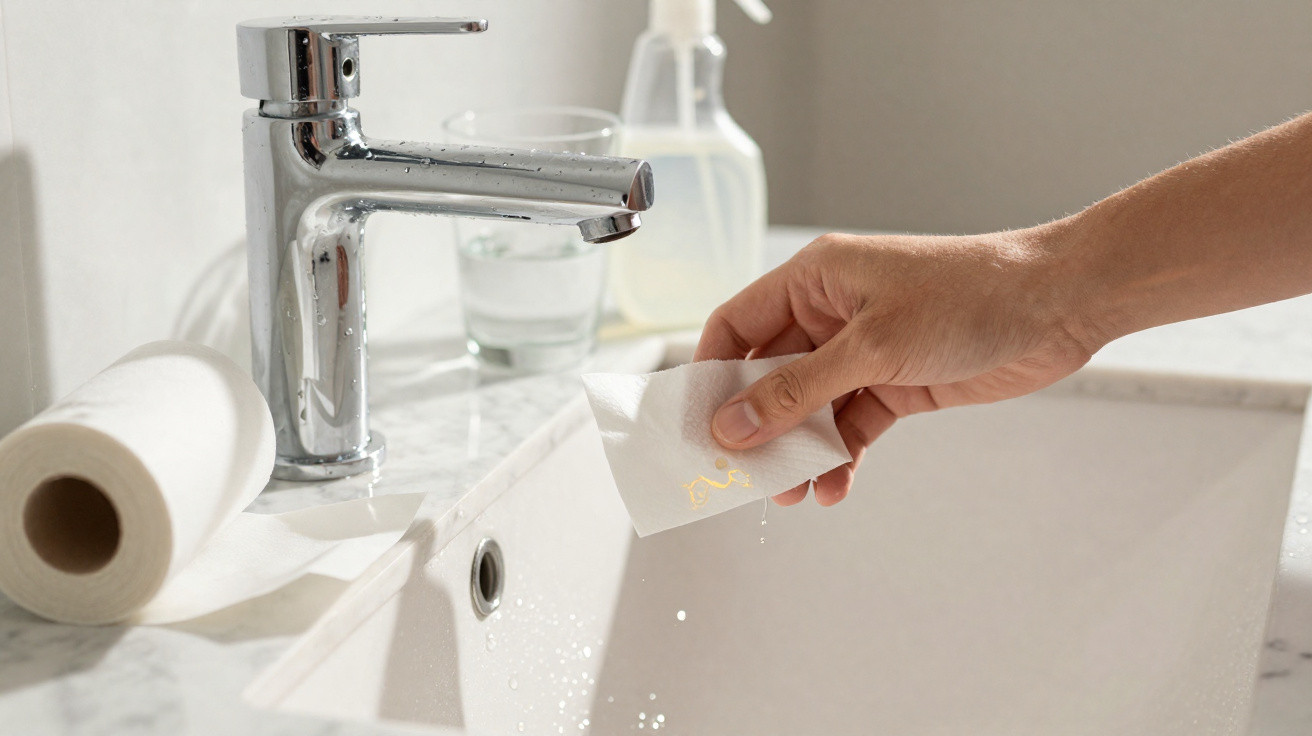
A completely unremarkable roll of baking paper can solve the problem almost effortlessly.
Many households know the pattern: taps have just been cleaned, yet after one or two showers they look dull again and are covered in limescale marks. Expensive specialist cleaners promise shine, smell strongly, can damage surfaces and cost a considerable amount over time. A kitchen tip now circulating in forums and on social media is remarkably straightforward – and can keep taps visibly clean for several days.
Why limescale sticks so stubbornly to taps
Limescale forms when tap water contains high levels of minerals, particularly calcium and magnesium. Experts call this “hard water”. When the water evaporates on taps and fittings, these minerals remain behind as whitish marks or a dull film.
The effects soon become obvious:
- Shiny chrome takes on a grey, lacklustre appearance.
- Small, hard rings form around the base.
- The water stream splashes unusually because the aerator is partly blocked.
Inside the aerator insert, limescale builds up like a small crust. This may reduce water flow or turn a clear stream into uneven drips. Anyone who automatically reaches for harsh bathroom cleaners may restore the shine in the short term, but risks leaving surfaces dull and damaged over time.
Natural staples such as vinegar, lemon juice or bicarbonate of soda generally remove limescale reliably, but they need time to work and require thorough rinsing afterwards. Many people therefore want a method that is more preventative and does not involve a lengthy cleaning routine every time.
“The clever solution does not start with a thick limescale ring – it starts much earlier, with the first faint haze left after drying.”
Baking paper as a secret weapon: how it prevents new marks
The surprising helper is baking paper: the heat-resistant kitchen paper normally used to line a baking tray. It has a very thin, slightly slippery coating that stops dough and cheese from sticking. This same quality can also help with taps.
On a dry chrome or stainless-steel surface, the smooth, lightly coated layer works like a miniature polishing film. Gently rubbing with it lifts fine limescale residue and water marks without scratching the surface. At the same time, it leaves an almost invisible hydrophobic film on the metal, making water droplets less likely to cling.
As a result, water beads run off more quickly, do not spread into large pools and leave noticeably fewer deposits as they dry. Many users report that their taps remain presentable for around five to seven days before fresh marks start to appear.
How the baking paper trick works step by step
- Dry the tap completely: Use a dry microfibre cloth to wipe away every droplet and trace of moisture, including around the base and at the back.
- Prepare the baking paper: Tear off a piece of baking paper and loosely scrunch it into a soft ball.
- Polish gently: Rub the spout, lever, base and, if applicable, the shower head using light circular movements with the paper ball – around one minute is enough.
- Buff afterwards: Go over the surfaces briefly once more with the microfibre cloth so that everything shines evenly.
It takes only a few minutes per tap. By making it a weekly habit, you create a kind of invisible protective layer that significantly slows the formation of new limescale.
Where the baking paper trick works well – and where it does not
This method is particularly suitable for smooth, shiny finishes such as polished chrome or stainless steel. For black or matt taps, first carry out a careful test in an inconspicuous area. Some matt coatings are more sensitive to friction and may develop a patchy appearance.
Natural stone also requires caution. Surrounds made from marble, limestone or travertine should not be rubbed with baking paper. The greasy protective layer may soak into open pores and leave unattractive stains.
“Baking paper is not a replacement for thorough descaling – it simply extends the glossy period between two intensive cleans.”
When a proper descaler is still needed
If the tap is already heavily coated in limescale, a thorough clean remains unavoidable. Typical signs include thick white rings, an angled or very weak water stream, or an aerator that looks as though it has been filled with sand.
In this situation, the sensible process is:
- Unscrew the aerator: Carefully remove the insert and place it in lukewarm vinegar for several hours.
- Treat heavy deposits: Soak kitchen roll in vinegar, wrap it around the taps and leave it to work.
- Use alternative products: Anyone who dislikes the smell of vinegar can use citric acid or a paste made from bicarbonate of soda and a little water instead.
- Rinse thoroughly: Afterwards, wash all treated parts well with clean water so that no acidic residue remains.
Only once the tap is free of thick deposits can baking paper work properly as a weekly care method. The shine then lasts noticeably longer, without the need for harsh products.
Everyday habits that slow limescale even further
Those living with hard water can substantially reduce limescale with a few small routines. Reaching for a cloth briefly after showering can make a surprisingly big difference.
These habits have proved useful, for example:
| Habit | Benefit |
|---|---|
| Wipe the tap after use | Water does not dry on the surface, resulting in fewer marks |
| Clean the aerator every few weeks | A more even stream, less splashing and fewer deposits |
| Use baking paper once a week | A protective film and longer-lasting shine without specialist cleaner |
| For very hard water: use a special aerator | Anti-limescale versions make it harder for deposits to stick inside |
In areas with extremely hard water, some households even consider compact water-softening systems. These devices filter some of the minerals from the tap water. This not only reduces cleaning work in the bathroom, but also protects the washing machine, dishwasher and boiler heating element.
How the hydrophobic film works – briefly explained
The word “hydrophobic” literally means “water-repellent”. On a water-repellent surface, droplets form small beads instead of spreading widely. The faster these beads run off or can be wiped away, the fewer minerals are left behind.
Baking paper transfers precisely this kind of lightly water-repellent layer onto the metal in an extremely thin form. It cannot be seen with the naked eye, but it is enough to alter how the surface becomes wet. Rather than drying in a broad layer, the water gathers into tiny droplets that are easy to wipe away. This reduces the typical cloudy limescale film that would otherwise form after every shower.
Practical examples for the bathroom and kitchen
The trick does not work only on a bathroom basin tap. It can also have an effect in the kitchen, on the sink, on the small tap of a drinking-water filter or on a shower head. Anyone who uses baking trays regularly does not need to throw away a used sheet of baking paper straight away; it can quickly be used to polish taps first.
For busy people, a set routine is ideal: once a week, perhaps on cleaning day or after preparing the main weekend meal, briefly go over all taps with baking paper. The additional time required remains minimal, while the everyday cleaning tasks avoided can add up considerably.
This does not eliminate the need for cleaning products altogether, but it does extend the intervals between major descaling sessions. Anyone sensitive to the pungent smell of cleaning products also gains a little extra comfort from this simple kitchen aid – while still keeping shiny taps in view.
Comments
No comments yet. Be the first to comment!
Leave a Comment