
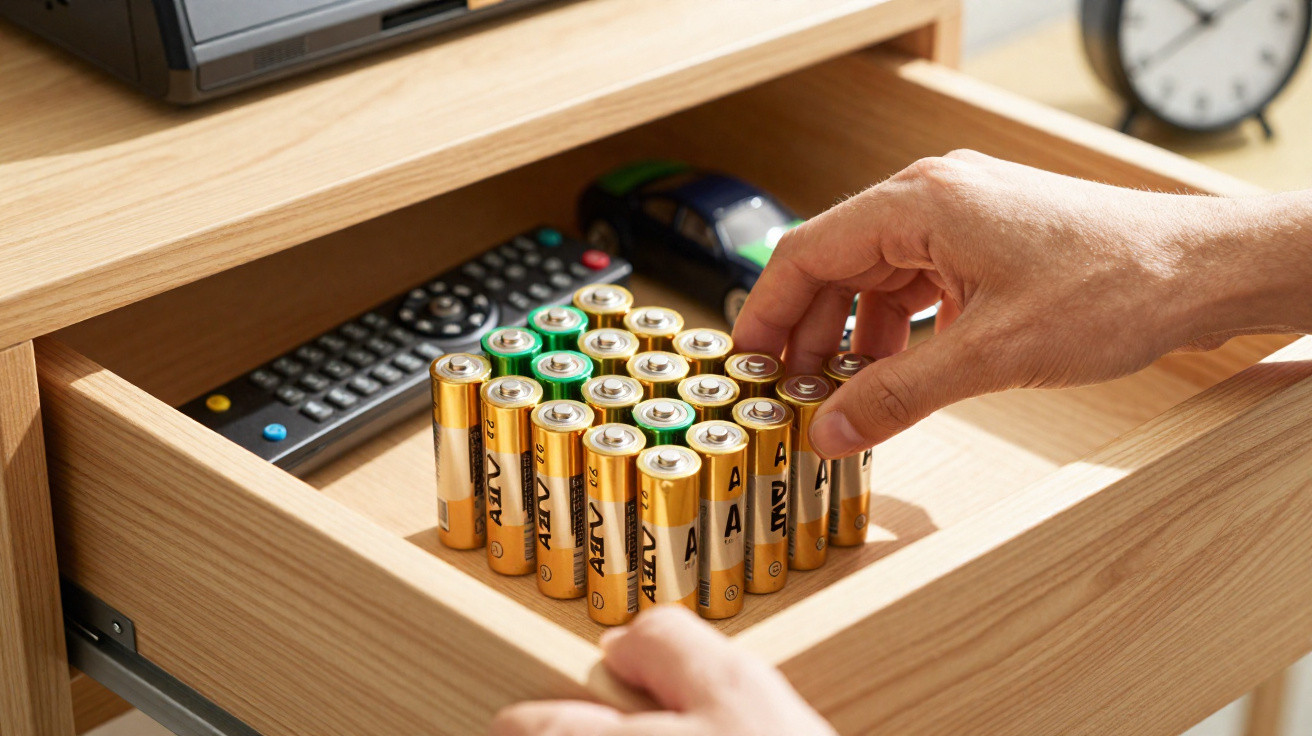
Almost everyone has opened a remote control or a toy and spotted the marking “2 x AA” beside the battery compartment. Yet few stop to consider where this combination of letters, found on nearly every electronic device at home, actually comes from.
Where the letters on batteries come from
The letter-based classification emerged from a need to standardise the components used in radios, torches and other household devices during the 20th century. Before this system existed, each manufacturer could use its own battery format, making replacements more difficult and production more expensive.
The solution was a straightforward scale: A, B, C and D identified cylindrical batteries from the smallest to the largest. Over time, even more compact formats were introduced, leading to the AA battery, the AAA battery and the AAAA battery, all following the same miniaturisation principle.
- Versatility: the AA battery is well suited to devices with low to medium power demands, from remote controls to portable radios.
- Availability: it is readily available in supermarkets, pharmacies and electronics shops throughout the UK.
- Technology choices: it comes in standard alkaline versions as well as rechargeable nickel-metal hydride models.
- Compatibility: it is used in toys, wireless mice, torches and countless other everyday small devices.
The size that became a household favourite
Of all the available formats, the AA battery became the most popular because it offers a balance between size and power. Two or four batteries will often last a long time in simple devices, without being expensive or taking up too much room in the compartment.
That balance is why AA batteries appear in almost every kind of portable electronic item, from musical instruments to wall clocks. It has become a byword for convenience for anyone who simply wants to solve the problem and get on with their day.
Why A and B batteries have virtually disappeared from drawers
Before buying a replacement AA battery, it is worth checking the device packaging or manual, which normally gives this information near the battery compartment. This small precaution prevents incorrect purchases and equipment malfunctions.
A standard that is almost a century old
The old A and B batteries
They were widely used in valve radios and the earliest generations of household electronics, when separate sets of batteries powered different parts of the same circuit.
With the arrival of semiconductors and the miniaturisation of components, these formats became limited to restoring vintage equipment and a handful of highly specific hobbies.
Meanwhile, C and D batteries remained in use in areas requiring greater energy capacity, including large torches and some motorised toys. The AA battery, however, adapted perfectly to newer, more compact designs.
Details that matter when replacing a battery
Keeping AA and AAA batteries separately in dry, well-ventilated places, away from heat sources, helps preserve their charge for longer. Combining new and used batteries in the same device can also reduce overall performance.
Another simple measure is to remove batteries from devices that will not be used for long periods. This helps avoid leaks that can damage both the compartment and the device itself.
The future of a standard that is almost a century old
Despite the growing use of lithium batteries in smartphones and laptops, the AA battery remains relevant in 2026, powering thousands of simple products that still rely on a standard created nearly a century ago.
Ultimately, those small letters printed on the side of a battery represent a history of standardisation that made life easier for anyone who simply wanted to replace a remote-control battery without any fuss.
Did you find this topic interesting? Share it with someone who also enjoys discovering the small details behind everyday objects.






Comments
No comments yet. Be the first to comment!
Leave a Comment