
The first time I properly saw it was on a Tuesday evening, in that odd post-dinner quiet when the dishwasher is humming and everyone else has wandered away. I switched on the unforgiving overhead light and faced them: kitchen cabinets that had once been a gentle cream, but were now a lifeless, tacky beige. Dark rings of fingerprints and cooking splashes surrounded the handles. The lower cupboards bore unexplained marks at children’s height, which might have been jam or something far less identifiable.
I traced a finger along the edge of a door and felt the sluggish resistance of grease and dust fused over time. A sponge with washing-up liquid hardly shifted it. Degreaser made the cabinets appear worn, almost scratched. They were more or less clean, but still unpleasant to touch.
Then an old kitchen liquid, sitting unnoticed in plain sight, quietly made all the difference.
The liquid by your stove that your cabinets secretly love
Most of us pass this bottle countless times each day, seeing it only as an everyday cooking essential. It may sit beside the hob or be tucked behind the olive oil and vinegar, reserved for stir-fries and salad dressings. But when used on a greasy, tired cabinet door, it can feel like pressing reset.
That supposedly “forgotten” liquid is ordinary vegetable oil: sunflower, rapeseed, grapeseed, or even the neutral bottle bought on offer and left unfinished. For cabinets that feel chalky, grimy or oddly sticky, a very small amount of oil can take the surface from resistant to smooth with a few careful wipes. It does not loudly announce a “new kitchen”, but it gently suggests “someone cares about this place”.
A reader once sent me a photograph that could have come from almost any well-used home. The cupboards above her hob were yellowed, matt and exhausted-looking. Grease had formed dark shadows around the knobs, and no magic sponge seemed able to remove them. She had used hot soapy water, a shop-bought degreaser and even a bicarbonate of soda paste. Although the marks became lighter, the doors were left looking uneven and rough, as if their finish had disappeared.
While speaking to her grandmother on the phone one Sunday, she mentioned the problem. The older woman laughed and said, “You’re scrubbing the life out of them. Wipe them with oil, then talk to me.” That evening, she tipped a teaspoon of inexpensive sunflower oil onto a soft cloth and tried it on one door. The result seemed uncanny. The finish became smoother, the colour grew richer, and the stubborn rings blended into an even, warm sheen.
There is less magic involved than quiet chemistry. Cabinet grime combines airborne oil, dust, tiny food particles and the effects of hands touching the surface every day. Powerful cleaning products may break down the dirt, but they can also remove part of the original finish, making wood or laminate look dry and feel coarse. Vegetable oil works in two ways: it helps lift the greasy film that remains while conditioning the parched surface underneath.
Wood, along with many laminate finishes, responds positively to this gentle conditioning. Much like skin washed too frequently, cabinets take in a very fine coating and settle. Dull sections become more even, fine hairline scratches are less obvious, and the unpleasant tacky sensation fades away. When applied sparingly, oil does more than clean - it restores how the surface feels beneath your fingertips.
How to use vegetable oil to revive tired kitchen cabinets
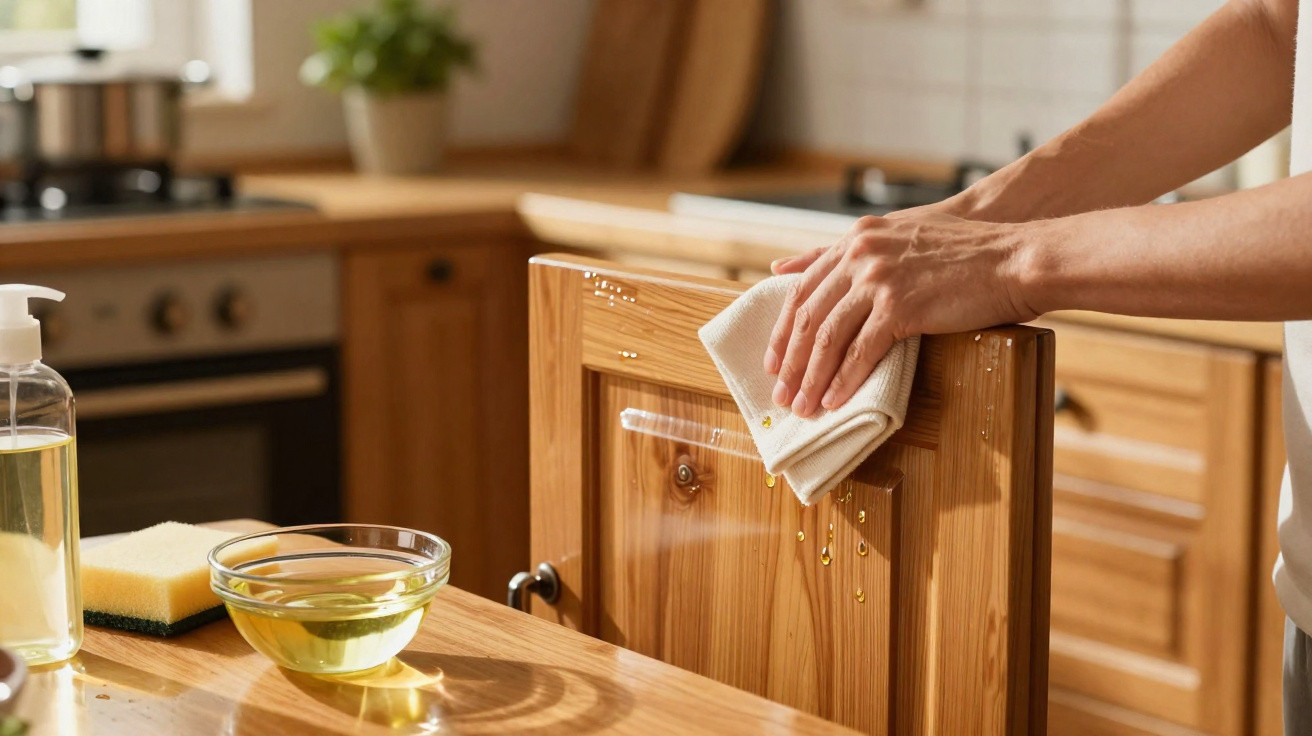
The process is almost deceptively straightforward, perhaps explaining why it is rarely discussed. First, wash the cabinets normally with warm water, a drop of washing-up liquid and a soft sponge; avoid abrasive scourers. Remove visible food residue and grease, then dry every surface thoroughly using a clean towel. The oil stage will not work properly if the cabinets are still wet.
Next, put only a few drops of vegetable oil on a soft microfibre cloth. Do not create a puddle or saturate the cloth. Aim for a lightly moisturised effect, similar to applying hand cream. Treat small areas at a time and follow the grain if your cabinets are wooden. Rub the oil in using soft circular movements, then buff straight away with a second dry cloth until the door no longer appears oily and has only a subtle satin finish.
This is the point at which people most often overdo it: extra oil does not create extra shine. Instead, it leaves residue, allows dust to cling sooner and produces the peculiar film on which you could write your name a week later. The aim is to use barely any at all. Spread and buff patiently, and one teaspoon should be enough for several cupboard doors.
Where cabinets are bright white laminate, begin with a test in an inconspicuous area. Certain finishes respond beautifully to this approach, while others are better off with cleaning alone. If the doors already have a thick coating of commercial polish, a gentle deep clean may be required before you start anew. Most of us know that moment of realising that years of “quick fixes” have built up into a single sticky, glossy layer.
“I thought the oil tip was one of those internet myths,” a reader told me. “But my lower cabinets felt so rough that I figured I had nothing to lose. I did one door, just one, and it suddenly matched the color I remembered from when we moved in. Not brand new, just… normal again.”
- Begin small – Test one less noticeable door, or the inside of a cupboard, before treating everything. This lets you see how your own cabinet material responds without any pressure.
- Keep your touch light – A few drops of oil, thoroughly spread and thoroughly buffed, are far better than a heavy coating that remains on the surface and collects dust.
- Combine it with mild cleaning – Use gentle soap and water first, then condition with oil only once the cabinet is fully dry.
- Do it infrequently – Once or twice annually is usually sufficient; cabinets do not need an oil spa treatment every week.
- Pay attention to handles – These areas collect the most grease and fingerprints, so clean them carefully before applying oil to prevent grime being sealed in.
Why this small kitchen cabinet ritual can alter how your kitchen feels
There is often a moment after the final door is finished and you step back when the room seems subtly changed. Light falls more softly across the panels. The colour appears deeper and more settled. When you run your hand along a cupboard edge, there is no drag and no hidden grit catching against your skin. Instead, there is simply a smooth, quiet surface doing its work without protest.
You may begin to notice the smaller changes: the lift in mood when the first thing you see each morning is not a blotchy, sticky cupboard door but a finish that appears cared for; or how cooking seems less frantic when the backdrop is calm and clean. Cabinets sit at eye level and hand height - you look at and touch them dozens of times daily, often without realising it.
| Key point | Detail | Value for the reader |
|---|---|---|
| Forgotten kitchen liquid | Neutral vegetable oil, applied lightly and buffed thoroughly onto clean, dry cabinets | Turns sticky, dull doors into smoother, softer-looking surfaces without harsh chemicals |
| Simple two-step method | A mild soap-and-water wash first, followed by a minimal conditioning coat of oil | Straightforward to repeat, inexpensive and made with items already found in most kitchens |
| Long-term effect | Occasional oil treatment helps guard against dryness, uneven patches and a “chalky” texture | Makes the kitchen nicer to see and touch, while postponing expensive repainting or replacement |
FAQ:
Question 1 Can I use olive oil on my cabinets instead of neutral vegetable oil? Technically, yes, but olive oil is usually heavier, has a stronger scent and may turn rancid more quickly. A light neutral oil, such as sunflower, rapeseed or grapeseed, is generally the safer choice and is less likely to leave a lasting odour.
Question 2 Will this method work on very old, peeling cabinets? Oil cannot repair flaking paint or a damaged finish. It may slightly enhance the appearance and feel of worn sections, but where the surface is actively peeling, repainting or replacement is required.
Question 3 How often should I repeat the oil treatment? Once or twice per year is sufficient for most kitchens. Honestly, nobody carries this out every day. Let touch and appearance guide you rather than the calendar.
Question 4 Is there a risk of making the cabinets more flammable? A thin layer of vegetable oil that has been thoroughly buffed into cabinets is not comparable to oil-soaked cloths or pools of oil. For normal household use, the practical fire risk is extremely low, particularly when you clean regularly and avoid product build-up.
Question 5 What if my cabinets feel sticky after oiling? This usually means too much product was used or the surface was not buffed sufficiently. Wipe over it again with a clean, dry microfibre cloth, applying a little more pressure. If necessary, wipe once using a slightly soapy damp cloth, dry it thoroughly and repeat with much less oil.
Comments
No comments yet. Be the first to comment!
Leave a Comment