
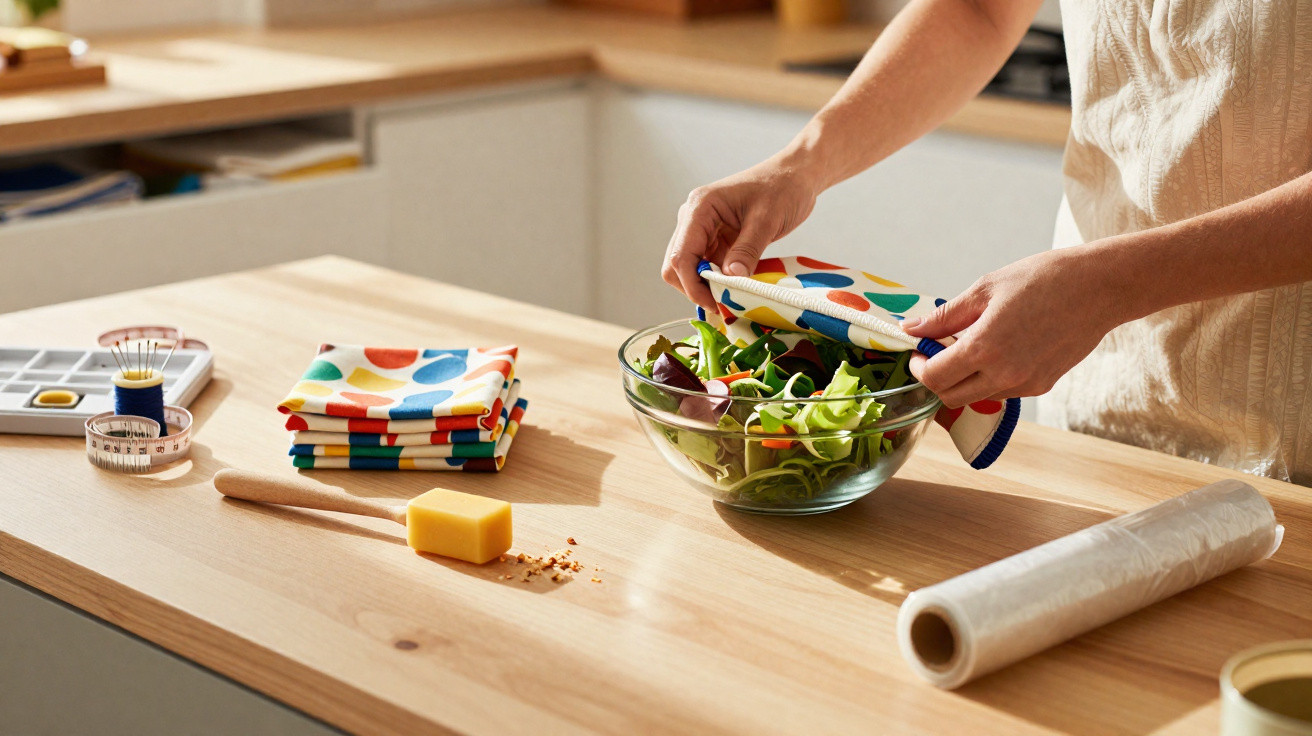
Old fabric scraps, overflowing drawers – yet cling film still ends up in the shopping trolley.
In 2026, this habit is changing in many homes.
More and more people are reaching for a sewing machine instead of a roll of plastic. Seemingly useless offcuts can be turned into colourful covers for bowls and oven dishes in just a few minutes. It may initially sound like a craft project, but in 2026 it is becoming a genuinely useful everyday solution – with no plastic waste and a surprising amount of convenience.
Goodbye plastic: why fabric covers are suddenly appearing everywhere
Kitchens are full of unfinished salads, cut fruit and leftover bakes. For decades, reaching for cling film has been routine. The issue is that it is used once and thrown away – often several times a week.
At the same time, pressure to reduce packaging waste is growing. Laws targeting single-use plastic are becoming stricter, local authorities are encouraging people to create less waste, and many supermarkets are placing greater emphasis on loose produce and reusable containers. Fabric covers fit perfectly into this picture: they cover bowls, keep odours contained and can be washed and reused countless times.
Instead of using dozens of metres of cling film every year, a small set of handmade covers is enough for many years.
The principle is simple: old tablecloths, bedding or leftover sewing fabric are transformed into circular covers with elastic – like a shower cap, but for bowls. They fit tightly around the rim, protect food in the fridge and look far nicer than crumpled cling film.
How to make a fabric cover step by step
Anyone who has sewn on a button can make a fabric cover. A basic sewing machine is entirely sufficient, although it can even be made by hand. Most covers take less than 15 minutes to produce.
Materials: what you actually need
- Fabric scraps, ideally cotton, such as old bedding, shirts or tablecloths
- A ruler or tape measure
- Fabric scissors
- A sewing machine, or a needle and thread
- Flat elastic, around 5 mm wide
- A safety pin or threading tool
Those who want to go a step further can use specially coated cotton or treat the fabric with beeswax. This makes the cover less permeable to moisture and easier to wipe clean.
Sewing instructions in brief
- Measure the diameter of the bowl or dish.
- Add four centimetres – this allowance accounts for the curve and the hem.
- Cut a fabric circle to this size.
- Turn a hem of around 1.5 centimetres inwards all the way around and sew it in place, leaving an opening of roughly 2 centimetres.
- Cut the elastic to the circumference of the bowl minus around 2 centimetres.
- Use the safety pin to thread the elastic through the channel, then knot or sew the ends together.
- Close the opening in the fabric – and it is ready.
Thanks to the elastic, the cover now sits snugly around the edge of a bowl, serving dish or oven dish. It can be put on and removed in seconds, without the annoying folding and sticking involved with film.
Why coated fabric and beeswax work so well
Anyone who enjoys experimenting can significantly improve the performance of fabric covers without using complicated chemicals. Two approaches have become established: coated cotton and beeswax-treated cloths.
Coated cotton: durable and practical for everyday use
Coated cotton has a very thin layer of acrylic or polyurethane over the fabric. This makes the material less absorbent, so liquids are less likely to seep through and odours remain contained more effectively.
The combination of coated cotton and tightly fitted elastic slows down air exchange, keeps moisture in the food and stops the entire fridge smelling of onions.
After use, the covers can simply be wiped with a damp cloth or washed in the machine at a low temperature. That is entirely adequate for salads, pasta dishes or bakes.
Beeswax: turning fabric scraps into flexible wax wraps
No coated cotton at home? Beeswax provides similar results. The method is straightforward:
- Cut cotton fabric to the required size.
- Sprinkle it lightly with beeswax pellets.
- Place it on a baking tray and melt it in the oven at around 80 °C for a few minutes, until the wax has spread.
- Leave it to cool – the fabric will become firmer and slightly sticky.
These wax wraps can be placed over bowls and secured with an elastic band, or pressed directly over smaller containers. The warmth of your hands helps the cloth mould itself to the shape. The advantage is that beeswax has a mildly antibacterial effect, while the wrap remains flexible and can be used many times.
How many metres of cling film can fabric covers really save?
In many homes, several rolls of cling film are used in the kitchen each year. Every roll contains several dozen metres of thin plastic, which ends up in the general waste after use. Anyone who starts covering leftovers almost exclusively with fabric covers can reduce this use considerably.
A practical calculation looks like this: a small set of three or four covers works remarkably well for normal daily use. One for bowls containing salad or dough, one for medium-sized leftovers, one for large serving bowls, and perhaps another for oven dishes. Many users report that, with sets like these, they only rarely need film at all, such as for unusually shaped items or freezing.
| Use | Conventional option | With a fabric cover |
|---|---|---|
| Bowls in the fridge | Cling film, aluminium foil | Fabric cover with elastic |
| Letting dough rise | Film or a plate used as a lid | Reusable fabric cover |
| Marinades and salads | Film, often replaced several times | Wipe-clean fabric cover |
| Leftovers from lunch | Takeaway lid, film | Cover or wax wrap |
There is a financial benefit too: households that buy hardly any cling film and aluminium foil over several years save money from the household budget, despite the small initial time investment for sewing.
Care, durability and hygiene in everyday use
A common concern is whether fabric in the kitchen is hygienic. The answer largely depends on how it is cared for. If covers are washed regularly or thoroughly wiped down, there is little reason for concern.
- Standard fabric covers: simply wash them at around 30 °C with the rest of the laundry.
- Coated cotton: a damp cloth is often enough; use a gentle wash cycle if necessary.
- Beeswax wraps: wipe only with cool water and mild washing-up liquid; do not put them in the washing machine.
Anyone using several sizes can rotate them much like tea towels. This keeps everything clean without requiring anyone to think about the washing machine all the time. If there are visible stains or strong odours, the cover goes into the wash, or a wax wrap is discarded.
What sewing beginners should know – and how children can join in
For anyone still struggling with a sewing machine, fabric covers offer a relaxed introduction. Cut out a circle, sew a hem, thread through the elastic – there are few more basic skills needed. Those who prefer can first make a trial piece from an old pillowcase before using more attractive fabrics.
The project becomes particularly interesting when children help out. They can choose fabrics, draw the circles, thread elastic bands or assist with decorating. In this way, they learn through play how waste can become something useful. Many families report that, since then, children themselves make a point of reaching for the colourful cover instead of the plastic roll in the fridge.
More clever ways to use fabric scraps
Once people have made their first covers, they quickly find further uses for old textiles. Larger pieces can become fabric bags for the supermarket, bread bags for the bakery or reusable make-up remover pads. Small strips can be braided into cords for fastening jars or bottles.
Gradually, this creates a small system of reusable helpers that noticeably reduces the number of disposable products used in the kitchen. The benefit is that everyday routines barely need to change. The salad still goes into the same bowl – only the lid has changed.
Comments
No comments yet. Be the first to comment!
Leave a Comment