
At the end of the month, the surprise did not come from the shower or the air conditioning.
The saving was hiding in the laundry room.
After taking a closer look at her energy use, one householder noticed an unexpected fall in her electricity bill. Her use of the heater was unchanged, and nothing had altered with showering or lighting. The only quiet change was a monthly washing-machine habit: an empty cycle with white vinegar, carried out faithfully once a month.
The discreet culprit adding to your electricity bill
Why a washing machine can become an energy drain
Most of the energy used by a washing machine is not spent turning the drum. It goes on heating the water. This is where the heating element, known as an “immersion heater”, comes in: the metal component that raises water from 20 °C to 30, 40 or 60 °C, depending on the programme.
The issue starts with water quality. Areas with “hard” water, which is rich in minerals such as calcium and magnesium, encourage limescale to form. During every wash, especially on hot cycles, a thin mineral coating settles on the heating element.
Over time, this film builds up into a hard crust. What may seem like a minor technical detail then becomes a quiet financial problem.
A limescale layer of just 1 mm can increase a washing machine’s energy consumption by around 10% to 15% per cycle.
When the heating element works against the machine
In practical terms, limescale acts like a thermal coat around the heating element. Rather than passing heat straight into the water, the element must first heat the mineral crust.
The machine’s thermostat does not “know” that the element is insulated. It simply detects that the water has not yet reached the selected temperature and keeps the power on for longer. The result is more heating time and more kilowatt-hours on the bill, with no visible benefit for the user.
As the build-up continues, matters get worse: efficiency drops, the water takes longer to heat and, in many cases, the element eventually overheats and burns out. Depending on the model, replacing this part can cost almost as much as a second-hand machine.
The cycle that cuts up to 15% from the energy used in each wash
How a monthly habit became a real saving
This invisible process is exactly why many people have adopted a simple routine: an empty cycle once a month, with only white vinegar in the drum.
The reasoning is straightforward. Once limescale is dissolved, the heating element can again sit directly against the water. Heat transfer improves, heating time falls and the machine uses less energy to achieve the same result.
By restoring the heating element’s efficiency, consumption per wash tends to return to its original level, cutting by up to 15% the energy used for heating.
For anyone doing laundry several times a week, this difference starts to show on the bill when repeated month after month.
Why white vinegar works so well
The inexpensive acid that outperforms costly products
Supermarket shelves are full of eye-catching limescale removers. Many are expensive and contain chemical ingredients whose purpose shoppers may not even know. At home, however, one straightforward product can often do the job: white vinegar, also called distilled vinegar.
It contains acetic acid, which reacts with the calcium carbonate in limescale and gradually dissolves it. This reaction frees the metal surface of the heating element without attacking the metal or rubber seals, provided it is used in moderation rather than every day.
- Average price: less than R$ 5 per litre in many supermarkets
- How it works: an acidic reaction that breaks down limescale
- Simple composition: water + acetic acid, with no strong fragrances
- Versatile use: also works on kettles, taps and showers
When heat helps the cleaning process
Combining vinegar with high temperatures strengthens the effect. The hotter the water, the more quickly the crust weakens. That is why this household trick is not simply a matter of pouring in vinegar and selecting any programme.
The target is the heating stage of the cycle. At this point, the heating element reaches high temperatures and the vinegar, already in contact with the metal, reacts with the mineral deposit.
Step-by-step: the empty cycle that removes limescale
What you need for the “miracle cycle”
No special tools or products are required. This maintenance can be done using items already found in most homes.
- 1 litre of white vinegar (8% to 14% acidity)
- A completely empty washing machine, with no clothes inside
- A long hot-water programme (60 °C or 90 °C)
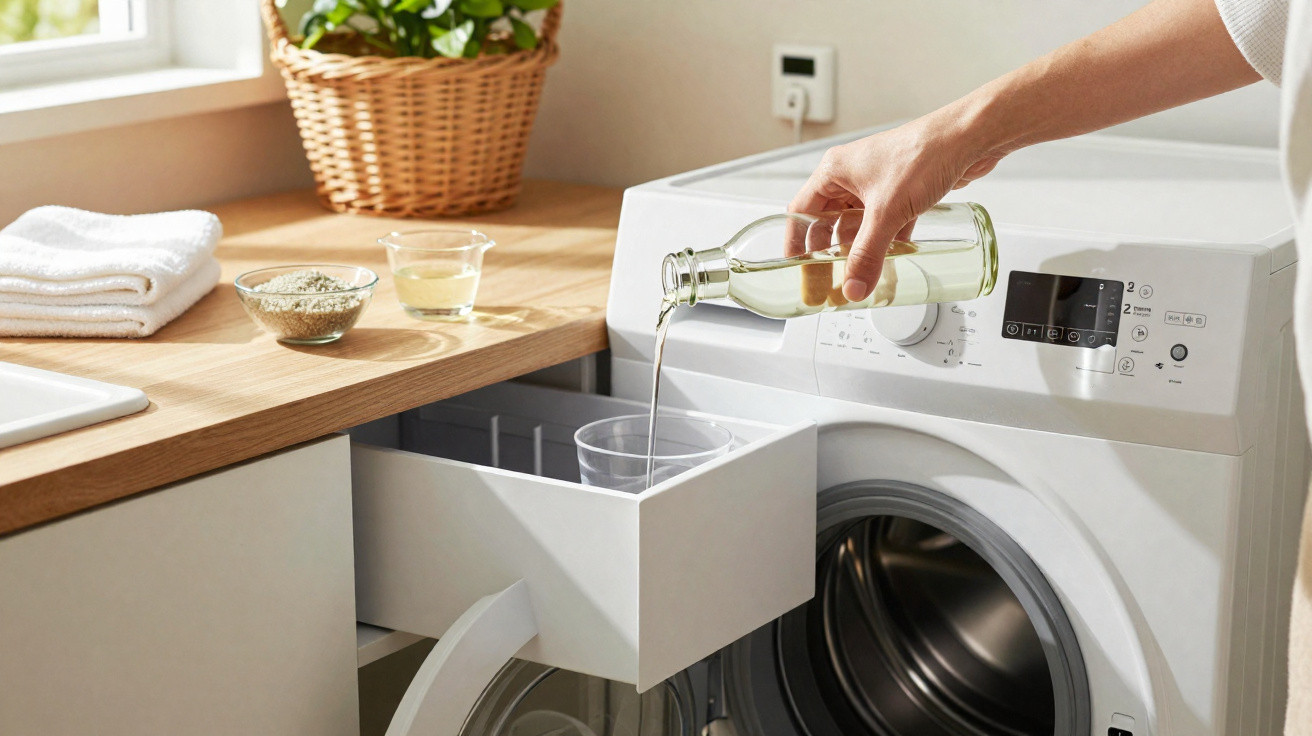
Where to pour the vinegar and which programme to select
The most important detail is where the vinegar goes. Pouring it into the detergent drawer is a common mistake. There, the product may be diluted or drained away too early.
To reach the heating element directly, pour the vinegar into the drum.
- Check that there are no clothes in the machine.
- Pour 1 litre of white vinegar directly into the drum.
- Choose a long 60 °C or 90 °C cycle; strong spinning is unnecessary.
- Start the machine and allow the programme to run to the end.
As it remains concentrated in the lower section, the vinegar collects precisely around the heating element. When heating begins, contact is at its greatest and the attack on limescale is much more effective.
| Cycle frequency | Expected effect |
|---|---|
| Every 6 months | Reduces thick crusts, but allows intermediate deposits to build up |
| Every 3 months | Supports basic maintenance and is suitable for slightly hard water |
| Once a month | Prevents reaching the “critical millimetre” of limescale and keeps consumption stable |
Turning a one-off trick into an energy-saving routine
Why doing it monthly makes a difference to the bill
Limescale does not develop overnight, but it does not stop forming either. The water used for every wash brings in fresh minerals. Without maintenance, the layer grows until the extra energy use becomes significant.
Mentally scheduling an empty cycle each month - or adding it to a mobile calendar - creates a preventive barrier. The heating element never becomes covered by a thick layer, and the machine continues to operate close to its original factory efficiency.
Prevention costs one litre of vinegar per month; fixing the problem can cost a new heating element or even an entire machine.
Energy savings and a longer service life
When a heating element remains coated in limescale, overheating becomes more likely. This repeated strain wears down the component and may speed up faults in sensors and the electronic control board.
By keeping surfaces clean, the machine runs more “lightly”. The thermostat reaches the right temperature faster, the motor is not kept running for unnecessary periods and the mechanical assembly experiences less stress. All of this lowers the likelihood of premature faults.
Other practical effects that few people mention
Odours, bacteria and cleaner clothes
A hot 60 °C or 90 °C cycle, even with no laundry inside, helps tackle detergent residue and bacterial colonies that thrive when washing is routinely done at 30 °C or 40 °C. Machines that operate only at low temperatures often build up a mixture of detergent, fabric grease and moisture.
After a few months, this results in the unpleasant smell noticed when opening the drum. Vinegar and hot water reduce this slimy layer, known as biofilm, restoring a more neutral smell inside the machine and preventing the odour from transferring to fabrics.
A quick example: what this could mean in real terms
Consider a typical situation:
- A machine used 5 times a week
- Each cycle uses an average of 0.8 kWh, with more than half linked to heating
- With a dirty heating element, consumption rises by around 10% per wash
Over one month, that amounts to roughly 20 cycles. This 10% increase would mean about 1.6 kWh of additional electricity. Over a year, more than 19 kWh is wasted solely because of limescale. In households doing more washes, that figure rises further. The saving may not look enormous on its own, but when combined with other household adjustments, it becomes very worthwhile.
The same principle applies to other appliances that heat water, including electric kettles, dishwashers and steam irons. When people regularly descale several appliances, the combined effect on their energy bill and on the lifespan of each item is far more noticeable.


Comments
No comments yet. Be the first to comment!
Leave a Comment