
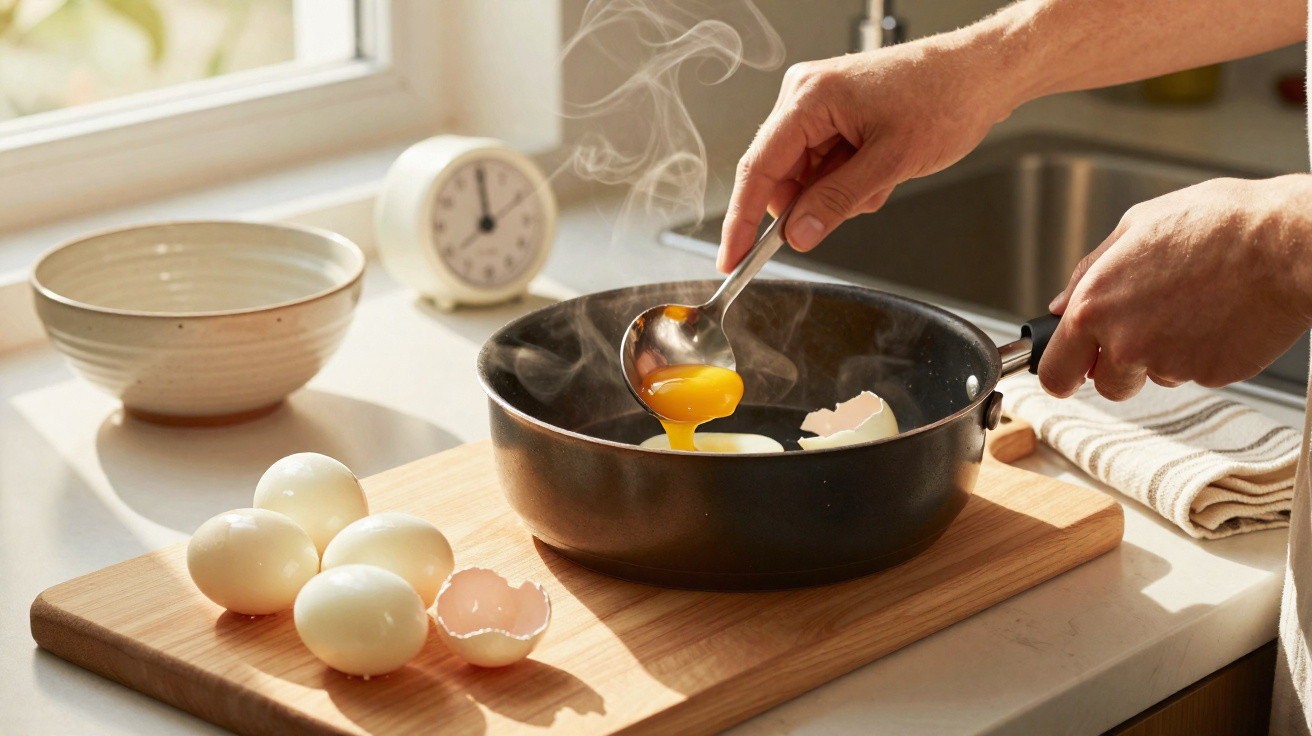
A straightforward kitchen idea suddenly makes the job remarkably easy.
Anyone who regularly cooks hard-boiled eggs will recognise the frustration: the shell crumbles, the white tears away and the finished egg looks as though it has been nibbled. A trick using an entirely ordinary utensil is currently attracting attention in France – and it works surprisingly well in UK kitchens too.
Why hard-boiled eggs can be so difficult to peel
Before getting to the solution, it is useful to understand the issue. Eggs do not all behave alike when peeled. Some release their shells with barely any resistance, while others seem almost permanently stuck to them.
The key factor is freshness.
- Very fresh eggs: harder to peel, as the egg white sticks to the shell membrane
- Eggs that are a few days old: noticeably easier to peel
- Eggs stored for longer: generally unproblematic, provided they are still within date
The fresher an egg is, the more firmly its inner membrane clings to the white. As the egg cooks, the white sets and bonds with this fine membrane. When you peel it, the membrane breaks into tiny pieces, inevitably pulling away some of the egg white too.
For that reason, many home cooks instinctively choose slightly older eggs for salads, sandwiches or buffet platters. But what happens when there are only very fresh eggs in the fridge, or guests arrive at short notice?
“With one simple piece of cutlery, troublesome eggs suddenly become a pleasure to peel.”
The spoon trick for hard-boiled eggs
The good news is that there is no need to leave eggs sitting around for days first. What matters is what happens inside the pan during cooking – more precisely, the way the eggs move in it.
The trick comes from an Instagram video by chef Anatolii Dobrovolskyi. In it, he demonstrates how an ordinary tablespoon placed on the bottom of the pan changes the entire cooking dynamic.
How to use the spoon method step by step
- Put the eggs in a pan.
- Place a standard metal tablespoon on the base of the pan.
- Arrange the eggs so that they sit on or beside the spoon.
- Cover them completely with cold water.
- Bring the water to the boil, then turn down the heat.
- Simmer for 10 to 12 minutes, depending on the level of doneness you prefer.
- Drain the water and immediately cool the eggs under cold water.
The difference becomes clear when peeling them afterwards: the shell cracks into large pieces and comes away from the white almost in one piece. Instead of painstaking picking, you can have a smooth, nearly flawless egg in your hand within seconds.
What really happens in the pan
The spoon does not create magic; it simply brings physics into the kitchen. As the water boils, the eggs start moving. Without a spoon, they tend to roll around the pan unpredictably, briefly knocking into one another or the sides before settling again for longer periods.
Adding a tablespoon to the bottom of the pan changes those movements. The eggs bump into the metal more frequently and more deliberately, because the spoon acts as an obstacle that they repeatedly strike.
These many small impacts create micro-movements between the shell, membrane and egg white. This produces two effects:
- The egg white does not set completely stuck to the inside of the shell.
- The membrane loosens slightly from the white and is more likely to remain attached to the shell later.
“The impacts against the spoon stop the egg white, membrane and shell from fusing into an inseparable whole.”
When you tap the egg afterwards, the shell is already lightly fractured and the membrane yields in larger sections. You can then remove it with the shell almost like peeling away a thin film.
How to peel eggs perfectly
The spoon method works particularly well alongside several familiar kitchen tips that many people know but do not always apply consistently.
These details make the difference
- Use enough water: The eggs should be well covered, so they can move freely.
- Cool them rapidly after cooking: Put the eggs into very cold water straight away, or cool them under cold running water.
- Use the right peeling technique: Tap the egg all around on the worktop, roll it gently, then usually begin at the wider end, where there is often a small air pocket.
- Do not wait too long: Many eggs are easiest to peel while they are still slightly warm.
- Try peeling under water: Some people swear by peeling eggs under water, as this can help the shell and membrane release more easily.
Combining these steps with the spoon trick will generally give you very even-looking eggs. It is especially worthwhile when appearance matters: for egg salad with neat slices, devilled eggs, sandwich platters or a breakfast buffet.
When the extra effort is especially worthwhile
For a quick evening meal, a slightly damaged egg may not be the end of the world. In other situations, however, a perfectly peeled egg brings considerably more satisfaction.
Typical occasions include:
- Brunch with guests, where eggs should be neatly sliced and decorated
- Easter, when eggs are dyed, filled or arranged on platters
- A packed lunch or meal at home, with eggs as an eye-catching feature
- Weekly meal prep, where the eggs need to look appetising in storage boxes
Every crack is visible on devilled eggs or egg halves served as finger food. This is where the spoon trick has a clear advantage: the surface stays smoother, the yolk is less likely to shift, and the filling can be added neatly.
What if it still does not work?
Naturally, no two eggs respond in exactly the same way. Shell thickness, the hens’ rearing conditions, their feed and storage all play a part. If the spoon method still leaves you with peeling problems, a few extra measures may help.
- Make a small hole: Before cooking, pierce the wider end with an egg pricker. This can reduce stress cracks and make peeling easier.
- Add bicarbonate of soda or salt to the water: A teaspoon in the cooking water slightly changes the pH, which may make the shell more brittle.
- Shake it vigorously for a few seconds: Put a cooked egg with a little water into a glass, cover it and shake it briefly. It works, although it is noisier and rougher than the spoon method.
If you find that one particular type of egg is always especially difficult, it may be worth choosing another brand or carton next time you shop. The differences are greater than many people realise.
Why fresh eggs benefit most from the spoon trick
Fans of farm shops and farmers’ market eggs will know the situation well: the eggs are exceptionally fresh and taste excellent, but behave very differently in the pan from standard supermarket eggs.
The spoon method helps in two ways here. First, it reduces the strong bond between the membrane and the egg white. Second, it slightly compensates for differences in size and shell thickness, because the micro-movements in the pan affect all of the eggs in a similar way.
Anyone who has previously hesitated to cook very fresh eggs can approach the task far more confidently with this trick. Rather than ending up as a sad broken piece in a salad, the egg can appear on the plate in attractive, smooth slices.
Practical everyday uses
This technique fits easily into everyday cooking because it requires no specialist equipment. A tablespoon is available in virtually every kitchen. There is no added effort and no extra washing-up – after cooking, the spoon can simply go into the dishwasher.
Anyone who regularly cooks for several people, such as families that eat plenty of eggs for breakfast, can make this trick part of their usual routine. Once it becomes habitual, it is almost automatic: spoon into the pan, eggs in, add water, turn on the hob – done.
It is particularly useful for people who like to prepare food in advance: pre-peeled eggs keep well in the fridge for two to three days when stored in a sealed container. With the spoon method, they not only look good during that time but are also quicker to prepare, because the tiresome peeling is no longer an issue.

Comments
No comments yet. Be the first to comment!
Leave a Comment