
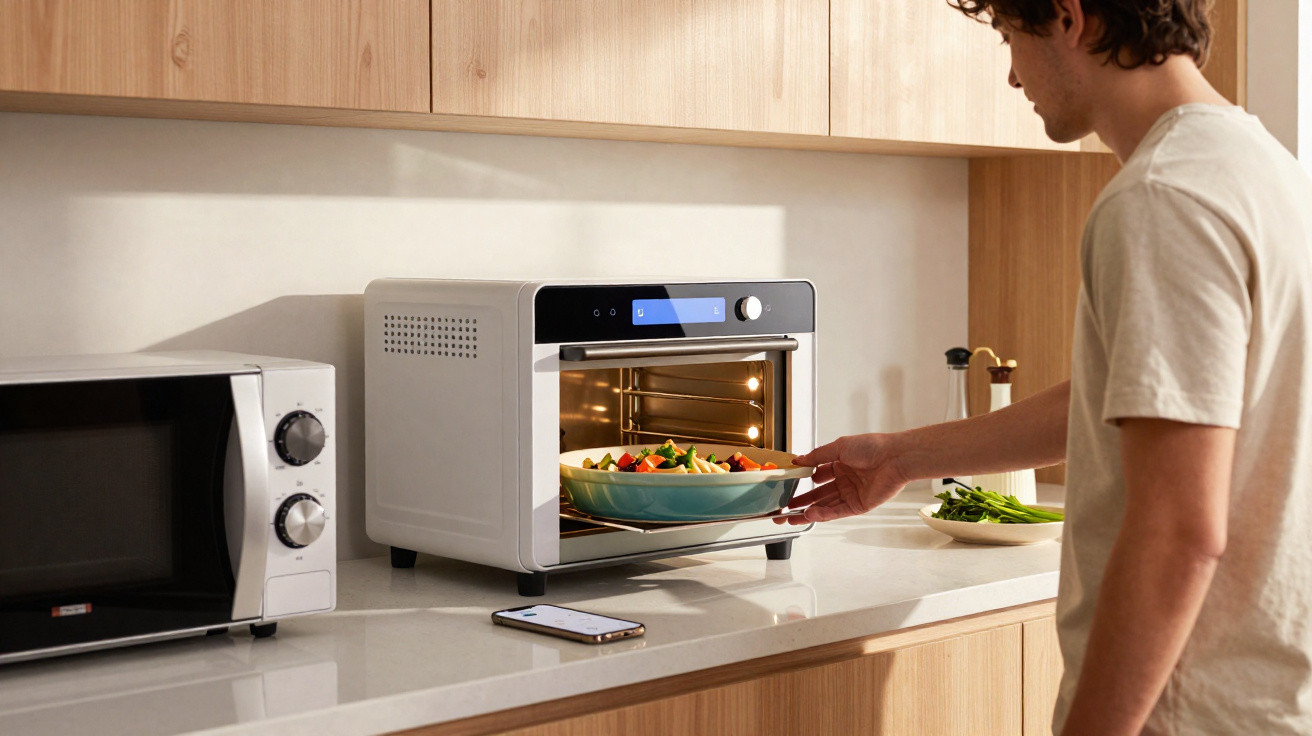
No more bowls that are lukewarm in the middle and scorching at the edges; less of that “it’ll do, we’ll manage” attitude. TikTok videos keep rolling in, sales figures are soaring, and major kitchen brands are starting to swallow a little harder. A new class of appliance claims it can reheat, cook and crisp in one move, without yesterday’s compromises. Some are already calling it “post-microwave”. Others, more cautiously, watch in silence as this unusual oven puts on its illuminated display.
One weekday evening, in a suburban kitchen somewhere, a mother places a dish of lasagne on the table with a faintly incredulous smile. Dinner has just come out of a sleek countertop oven packed with sensors, designed to cook at microwave speed while delivering the result of a proper oven.
The children tap the gratin to test the crust. Their father lifts the plate to check whether the centre is cold, an old reflex shaped by decades of unreliable reheating. Steam rises evenly, with no frozen patch in sight. The meal took under ten minutes.
A small icon on the display shows the time, temperature and even the selected level of crispness. The family does not know it yet, but the appliance on their worktop looks very much like the microwave’s future replacement.
The smart oven aiming for the microwave’s crown
This challenger already has a name circulating in fashionable kitchens: the smart countertop oven, typically driven by rapid convection, infrared heat and intelligent sensors. It resembles a compact oven, yet behaves like a microwave with a brain.
Cameras and thermal sensors inside the appliance monitor food as it cooks in real time. The machine alters the heat, fan speed and even the source of that heat. Select “leftover pizza” or “salmon, 200 g”, and it takes care of the rest.
At its best, it toasts, roasts, bakes and reheats with almost absurd ease. Even on an off day, it outperforms the disappointing, soggy plate revolving inside a humming 1990s box.
The figures tell a story of their own. Across the US and UK, smart oven and high-speed countertop oven sales have surged over the past three years, frequently recording double-digit growth while conventional microwave sales remain flat.
Social media feeds are packed with before-and-after images: pale, rubbery microwave leftovers beside golden, blistered dishes that look almost restaurant-standard when made in these newer appliances. It strikes a chord because nearly everyone has eaten a microwaved meal that felt like a diminished version of what it should have been.
Early adopters tend to report the same pattern: after the appliance arrives on the worktop, the microwave door gets opened less and less. It begins with pizza and roasted vegetables, then moves on to casseroles, whole fish and even breakfast. The habit changes quietly, without any grand declaration.
Technically, the secret lies in speed without aggression. A microwave bombards the water in food, heating it quickly but often unevenly. The smart oven instead combines powerful heating elements, convection airflow and, in some cases, light-based technology to apply intense yet controlled heat.
Since the sensors genuinely “see” the food, the oven does not merely follow a timer. It responds to what is happening on the surface and, in some models, at the centre too. The aim is straightforward: microwave-fast heating with a professional oven-style finish.
That changes the unwritten rules of weekday cooking. No longer must you choose between “quick and mediocre” and “good but slow”. Instead, a new question emerges: what if speed could still feel like a proper meal?
How to use a smart oven so it can replace your microwave
The first meaningful step is remarkably simple: move the old microwave. Shift it into a corner, unplug it or even put it in a cupboard for a week. When the smart oven occupies the best spot, your hand will naturally reach for it first.
Begin with one task: reheating leftovers. This is where the contrast is clearest. Choose the reheat setting, select the dish type - pasta, pizza or stir-fry - and allow the automatic programme to do its job.
Experiment a little. Use the “crisp” or “air fry” functions at the moments when you would normally give up and settle for a limp plate. The sooner you achieve one or two genuinely impressive results, the sooner your mind begins to regard the old microwave as a back-up rather than the main appliance.
Routine follows next. Turn to the smart oven whenever you would usually microwave a coffee or warm a single slice of food. For certain jobs, it may take an extra minute or two. The payoff appears on the plate: no more searing edges surrounding a cold centre.
Many people find batch cooking easier: roast additional vegetables on Sunday, then give them a brief high-heat blast in the smart oven during the week. On a hectic evening, that five-minute roast-and-reheat can feel like cheating time.
Be realistic about your routines. If you mainly use a microwave for popcorn and melted butter, the adjustment will feel substantial. If it is your default appliance for every meal, however, a smart oven may quietly reshape your evenings.
The most significant error new owners make is using a smart oven as though it were an ordinary oven: identical trays, positions and timings. Airflow is crucial. Leave room around the food, and do not overfill the basket “just this once”. Otherwise, you lose the crispness that persuaded you to buy it.
Another frequent mistake is dismissing pre-sets through pride. These appliances have been trained through thousands of cycles; they generally know what a portion of lasagne needs. Manually setting the temperature and time from scratch on every occasion is like buying a smartphone but using it only to make calls. Let’s be honest: nobody really does that every day.
Charred edges, crumbs smoking at the bottom and soggy chips because the oil was not blotted away: these things happen. Treat the first fortnight as a test drive rather than a final judgement. This is the point at which no-microwave cooking is either embraced or abandoned.
“The first time our smart oven reheated roast chicken without drying it out, my teenage son asked if we’d ordered takeout,” confides Emma, 42, who swapped her microwave after a kitchen renovation. “That’s when I realized this wasn’t just another gadget. It was changing what we expected from fast food at home.”
To keep expectations realistic, here are several everyday checks that can make the difference between a smart oven gathering dust and one that genuinely replaces the microwave:
- Take a two-week “microwave break” and ensure all reheating is done in the smart oven.
- Attach a brief cheat sheet to the fridge with the best settings for pizza, pasta, roasted vegetables and frozen meals.
- Use the oven once each weekend for something enjoyable - biscuits, wings or garlic bread - to create positive associations.
- Clean the crumb tray and filters every week so it does not begin smoking at the worst possible moment.
- Discuss what works with the household, then adjust pre-sets and favourites to suit.
What this change really means for our kitchens
Behind the glossy technology, there is something more personal at work. The microwave came to symbolise a particular approach to eating: quick, practical and not especially proud. You heat it, eat it and carry on. If it delivers on its promise, the smart oven shifts that balance slightly.
Leftovers suddenly stop feeling like a punishment. Gratin remains gratin rather than becoming a soggy imitation of itself. Pizza gets its crackling base back. Vegetables still have colour the following day. This will not turn every Tuesday into a dinner party, but it does reduce the emotional burden of “second-rate food”.
On a busy weekday evening, that matters more than specifications or wattage. It can be the difference between automatically eating in front of the television and quietly deciding to sit at the table for ten minutes.
At a wider level, companies are already betting that the post-microwave kitchen will be modular and intelligent: smaller multifunction ovens on the worktop, induction hobs that communicate with them, and fridges that suggest precise programmes when you scan leftovers.
Smart ovens represent only the first visible wave. If they truly take over, microwave meals will need to evolve too: less plastic, more textures designed to crisp, and instructions reading “smart oven, 6 minutes on high air roast” beside the familiar “microwave 800 W, 4 minutes”.
It also prompts a quiet question about energy use. These ovens often draw more power per minute than a microwave, yet operate for shorter cycles and can remove the need to switch on a large built-in oven. The real equation depends on cooking habits, not simply the label on the box.
Perhaps the most compelling aspect is cultural. For a generation raised with grim office microwaves and disappointing Tupperware, an appliance that treats leftovers with respect feels strangely radical. It recognises that your time is limited, yes, but that your meal can still deserve a plate rather than merely a container.
On a Sunday evening, when the coming week looks long and busy, you may find yourself sliding a tray of vegetables and halloumi into that softly humming little box, watching the heat move behind the glass. There is nothing heroic about it. You are simply shifting the boundary between survival mode and something a little warmer.
We have reached a stage where merely “good enough” kitchen technology no longer satisfies. The microwave once seemed miraculous before becoming invisible furniture. These new smart ovens arrive with promises and hype, but also with a very practical ability to alter the taste of Tuesday’s leftovers.
In one group chat, someone will boast about flawless chips without deep-frying. In another home, an older parent discovers they can cook safely again without bending down to a large oven. Somewhere else, a young couple decides against ordering delivery because their countertop appliance can turn out roasted vegetables in nine minutes.
What is certain is that the fight for that section of worktop has only just begun. The microwave won the first round of fast cooking. The question now hanging in the air, between two beeps and a rapid preheat, is simple: how long will we accept speed without soul when a shoebox-sized appliance begins to offer both?
| Key point | Details | Why it matters to readers |
|---|---|---|
| Reheating quality | Smart ovens use convection and radiant heat for reheating, so lasagne, pizza and roast meats emerge hot throughout with a crisp surface rather than rubbery edges. | It makes leftovers feel like “real food” again, potentially reducing food waste and making home-cooked meals more appealing than last-minute delivery. |
| Speed vs. microwave | Microwaves remain quicker for liquids and very small portions, but smart ovens come close: 6–10 minutes for full plates when using pre-sets and high-intensity modes. | This helps you decide whether the compromise is worthwhile on busy evenings, and where a smart oven can realistically replace existing habits. |
| Energy and footprint | Most smart ovens draw 1,500–1,800 W, but their smaller cavity and shorter preheat mean they often use less electricity than a full-size oven for the same dish. | It offers a clearer picture of running costs and whether replacing “large oven + microwave” with one smart appliance could simplify bills and free up space. |
FAQ
Can a smart oven really replace a microwave for everything? Not completely. For warming a mug of coffee or a bowl of soup in less than two minutes, the microwave still wins on outright speed. The smart oven excels at reheating meals, crisping leftovers, cooking small trays of vegetables, fish or chicken, and preparing frozen food with improved texture. Many households keep a small microwave as a back-up, but use it much less.
Are these ovens harder to clean than a microwave? They require slightly more care, as crumbs and fat splashes can burn onto the heating elements. Most models include removable trays and baskets that are dishwasher-safe, while quickly wiping the interior after greasy food prevents odours and smoke. In practice, a five-minute clean once a week keeps them in good condition.
Do smart ovens work well in small kitchens or studio flats? Yes, provided you measure carefully. Many units are roughly the size of a large toaster oven and can occupy the space previously used by a microwave. You simply need sufficient room around them for ventilation. For people without a built-in oven, they often become the main cooking appliance, managing everything from toast to roast chicken.
What about safety for children or older relatives? Most smart ovens remain cooler externally than traditional ovens, and their doors often lock or pause the cycle when opened. Interfaces usually feature clear icons and straightforward pre-sets, although touchscreens may initially be confusing. For older users, sticking to a few stored programmes such as “reheat plate” or “toast” keeps operation simple and safer than bending down to a large gas oven.
Are they worth the higher price compared with a basic microwave? The value depends on how frequently you cook and reheat food at home. If you mostly defrost bread and warm milk, a microwave is cheaper and sufficient. If you regularly eat leftovers, frozen meals or quickly roasted dishes, the improvement in taste and texture offered by a smart oven may repay the cost through fewer takeaways and more enjoyable meals at home. Many people find that spreading the price over three to five years feels reasonable for something used every day.



Comments
No comments yet. Be the first to comment!
Leave a Comment