
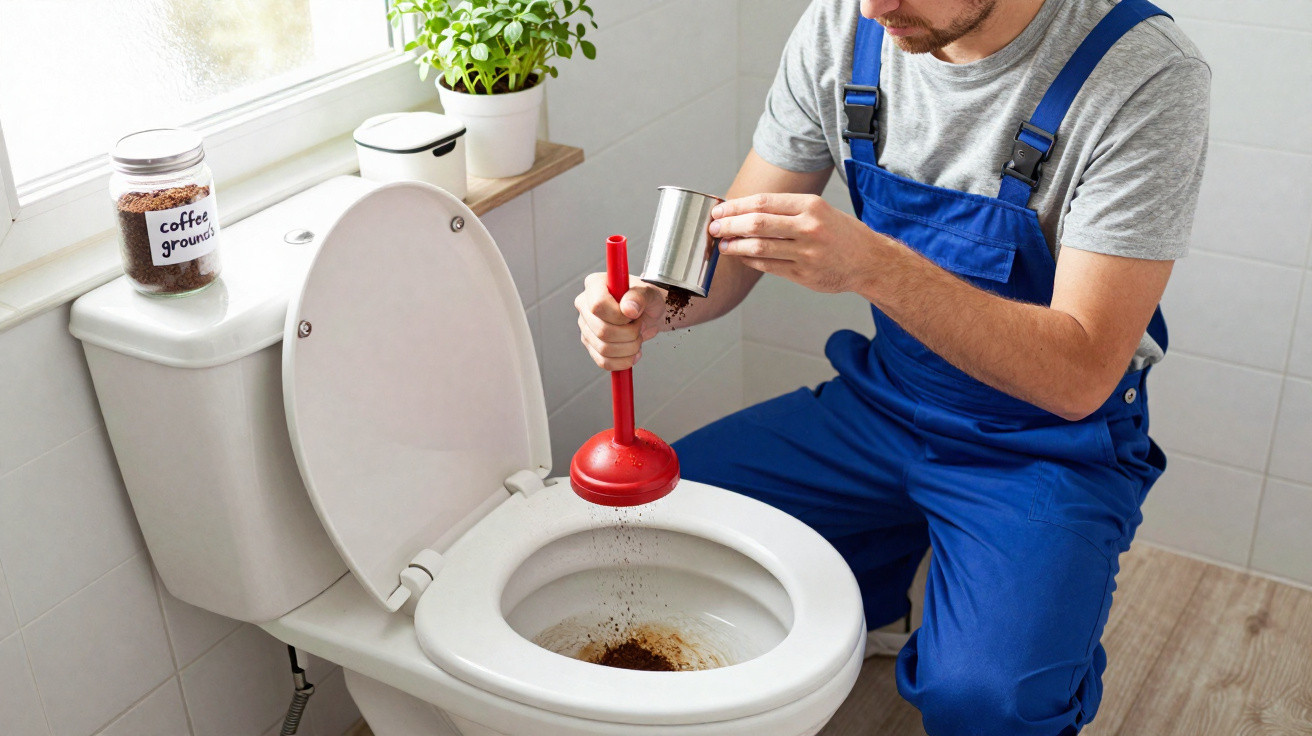
The bathroom carries a faint coffee smell, as though somebody has attempted to turn the toilet into a Starbucks rubbish bin. The homeowner, a young professional with eco-friendly detergent on the shelf and bamboo toothbrushes in a jar, is honestly baffled. “But I read on TikTok that coffee grounds are natural, so it’s better than chemicals,” she says.
Mark plunges and twists, muttering as he works, before unscrewing a pipe that releases a thick black sludge. There is nothing glamorous about it, and it is certainly not green. He has encountered this situation so often this year that he no longer keeps track.
The habit is catching on quickly, and the people clearing up the consequences are beginning to make their voices heard.
Why coffee grounds in the toilet are driving plumbers mad
The pattern normally begins in much the same way: someone wants to be “more eco” and decides that the toilet is the safest, most discreet way to dispose of their waste. Coffee grounds seem innocent enough. They are brown, organic and smell of brunch. Short social-media clips show people tipping damp grounds straight into the bowl, sometimes paired with a self-satisfied “zero waste mornings” caption.
On the face of it, the result can look pleasing. The dark whirlpool vanishes with the flush, the porcelain appears cleaner and there is a feeling that something clever and responsible has been done. It seems like a small secret trick known only to the internet. Plumbers viewing those clips know precisely how the story finishes - and it does not end with a cleaner planet.
What the footage never reveals is what happens inside the pipework. Coffee grounds form clumps when they come into contact with cold water, particularly in older pipes with slightly rough interiors. They combine with fats, hair, limescale and “flushable” wipes that do not genuinely break down. At best, the drainage system slows; at worst, it comes to a halt. That eco-friendly gesture can suddenly require a power auger, a truck and a bill that is anything but sustainable.
Plumbers throughout the UK and the US have been quietly gathering their own horror stories. A London emergency plumber says call-outs for blocked toilets involving coffee residue have “noticeably increased” over the past two years. One small Manchester firm reports that a problem it once saw every few months now appears once or twice a week, often in flats occupied by young tenants following green influencers.
One Bristol couple had been putting espresso grounds down the toilet every day for almost a year. Initially, there was no problem. Eventually, the flush became slower, gurgling and mildly hesitant. They took no action. Then, one Saturday, the bowl filled up instead of draining. After opening the line, the plumber found a thick, sticky “coffee plug” measuring half a metre. The couple had to leave the flat for a deep clean and pay hundreds of pounds for an emergency crew.
These are not merely unusual one-off incidents. Utility providers in several cities now identify coffee grounds, alongside wipes and fats, as causes of sewer blockages and smaller “fatbergs”. Some wastewater reports even include coffee among the increasing components of sludge removed from pumping stations. That supposedly eco-friendly flush travels much further than the bathroom.
At the centre of the trend is a mistaken idea of what “eco-friendly” means. Coffee grounds are not toxic, and that is often as far as people consider the issue. Yet being eco-friendly is not solely about the substance itself: it also concerns where it ends up, how it behaves there and its effect on shared infrastructure. In a toilet or sink, coffee does not somehow turn into compost. It becomes a gritty material that adheres, settles and accumulates.
Plumbing is built to handle human waste and toilet paper that dissolves readily. It is not a miniature river capable of carrying sand away. Each bend, joint and slight dip in a pipe creates a spot for grounds to gather. Add soap scum and a little grease from washing pans, and the result is a paste that sticks like wet cement. Gradually, the waterway narrows until pressure takes over and the system blocks.
The eco label used across social feeds appeals to a genuine wish to improve. People are fed up with plastic, harsh chemicals and unseen pollution. Throwing coffee away in the bin can feel wasteful, while tipping it into the toilet can seem like sending it “back to nature”. Pipes, however, are not nature. They are a delicate and thoroughly human compromise beneath our floors, and hashtags mean nothing to them.
What to do with coffee grounds if you actually care about the planet
There is good news: coffee grounds can be dealt with in genuinely useful ways that do not involve plumbing or guilt. One easy option is to regard them as slow, brown gold for plants. Allow the grounds to dry slightly, then sprinkle a light layer over garden beds or mix a small amount into potting compost. Do not create thick heaps that form a crust - use only a light dusting. Tomatoes, roses and hydrangeas generally benefit from the additional organic matter.
No garden? A simple countertop compost caddy suits most kitchens. Put coffee grounds in with vegetable peelings, eggshells and tea leaves, then transfer the contents to a larger outdoor compost bin where possible. Even flat dwellers may find that community gardens or certain council food-waste collections accept grounds. The principle is straightforward: direct them towards soil rather than sewers. If none of these options works for your life at present, the bin remains far less harmful than the toilet.
In ordinary homes, amid chaotic mornings and half-cold mugs, few people have time for flawless eco rituals. Let’s be honest: nobody really does that every day. We have all had the moment when the coffee overflows, the alarm goes off and everything ends up in the sink. That is precisely why habitual reflexes matter. Rather than using the toilet as a quick escape route, keep a small, inexpensive strainer in the sink. It stops grounds from slipping away, allowing you to tap them into the bin or compost later. No fuss, no lecture and no flood.
Some of the most common errors come from positive intentions. Many people think coffee grounds “clean” drains by scouring away deposits. In fact, they act more like gravel running into a narrow funnel. A dense mass of grounds can become stuck at the first bend, especially in older terraced homes or converted flats with awkward pipework. Combining grounds with oil - as can happen with cold-brew preparations - is worse still. The sticky mixture cools into a kind of brown glue within the pipes.
Others believe the practice must be safe because their toilet has accepted a few flushes of grounds without an obvious problem. Plumbing is not like a light switch: issues develop silently over time. A family may dispose of grounds this way for months before suffering a disastrous back-up on a bank holiday, when nobody answers the phone. The plumbers I spoke to say that many blockages would be prevented by one straightforward rule: if it is not bodily waste or proper toilet paper, keep it out of the bowl.
“People think, ‘It’s just coffee, what harm can it do?’” says Andy, a plumber from Leeds with twenty years under his belt. “What they don’t see is the inside of a pipe that looks like it’s been filled with wet brick dust. By the time I arrive, the eco part of the story is long gone, and they’re paying for me, my tools and an industrial jetter.”
A few practical safeguards can reduce the strain on both your pipes and your conscience:
- Allow coffee grounds to cool, then put them in the bin or compost rather than flushing or rinsing them away.
- Fit a sink strainer to catch loose grounds from cafetières, moka pots and reusable pods.
- Avoid “DIY scrub” recipes that wash coffee down drains; wipe any residue into the bin first.
This does not have to be done perfectly. Moving even half of your coffee grounds from the toilet to the bin can make a meaningful difference over a year. The aim is not to become a zero-waste saint. It is to prevent hidden issues that another person - often equipped with a wrench and a wet vacuum - will have to resolve.
What plumbers wish eco-minded households knew
Plumbers are not opposed to eco-conscious habits. Many quietly recycle, compost and keep older vans on the road for longer to avoid the emissions involved in replacing them. Their frustration comes from watching the same myths lead to the same emergencies in different postcodes. A trend founded on a sliver of truth - coffee is natural, chemical-free and compostable - becomes distorted as it moves across platforms and languages. By the time it reaches a brief viral video, every trace of nuance has disappeared and the toilet is presented as an all-purpose disposal chute.
There is also a class and generational aspect that receives little attention. Renters in urban flats, connected to narrow pipes shared with dozens of neighbours, are inundated with eco tips better suited to detached homes with gardens. A reusable pod system in a studio flat with 1970s plumbing does not perform in the same way as an expensive machine in a new-build home. When a blockage occurs, it is usually the tenant rather than the influencer who pays. Resentment grows in exactly that gap between online ideals and offline outcomes.
The oddly human element of this story is the way it combines guilt, aspiration and a touch of magical thinking. Nobody pours coffee into a toilet while thinking, “Let’s wreck the sewers today.” People are trying, awkwardly, to meet the pressure to be “good” consumers. They buy bamboo, refill detergent bottles and install low-flow showers. Within that mindset, putting coffee in the bin can feel like failure, as if every small action must carry moral justification. Taking a step back and speaking to those who deal with the consequences exposes that illusion.
So where does this leave us? Probably somewhere in the middle: between social media’s polished eco fantasies and the damp reality beneath the floorboards; between trying to do the right thing and accepting that the least glamorous choice - a small black bag in the kitchen bin - can also be the most responsible. The plumbers raising the alarm are not asking anyone to stop caring about the planet. They are simply asking that our concern extends to the unglamorous world of pipes, sewers and shared infrastructure.
Perhaps the most radical thing to do before pressing “share” on the next zero-waste tip is to ask one simple question: where does this actually end up? If the truthful response is “stuck in a U-bend” or “scraped from a pumping station at 3am by an exhausted worker in waders”, perhaps it is not truly eco after all. Trends fade and videos disappear. The sludge they leave in our systems is likely to remain far longer.
That is the uncomfortable, slightly muddy truth behind your morning espresso.
| Key point | Details | Why it matters to readers |
|---|---|---|
| Coffee grounds don’t dissolve in water | Ground coffee behaves like fine gravel in pipes. It absorbs water, swells slightly and settles in low points and bends rather than breaking down. | This explains why “it flushed fine” does not mean it has gone; it may be sitting in your plumbing and quietly forming a blockage. |
| They combine with fats to form tough clogs | When grounds come into contact with cooking oil, butter or dairy residue, they create a thick, sticky mass that adheres to pipe walls and captures additional debris. | It demonstrates how kitchen and bathroom habits interact, turning everyday rinsing into an expensive call-out months later. |
| Simple alternatives prevent most problems | Let grounds cool, scrape them into a bin or compost caddy, or use small quantities in soil or as an abrasive cleaner that is wiped into the bin. | It offers realistic, low-effort choices so readers can remain environmentally conscious without risking a flooded bathroom. |
FAQ
Can I flush a small amount of coffee grounds just once? Technically, a tiny quantity will not destroy your plumbing overnight, but each flush adds to anything already resting in the pipes. If your system is old or partly narrowed by limescale or earlier blockages, that “one time” may be the final straw.
Is it safe to rinse my cafetière or filter in the sink? Only after tipping most of the grounds into the bin or compost. Then wipe the pot quickly with kitchen paper to collect the remaining residue before rinsing, so that a thick slurry is not sent directly into narrow kitchen pipes.
Do coffee grounds really help clean drains? No. It is a persistent myth. Their gritty feel in your hands leads people to assume they scour pipes, but inside plumbing they act more like silt, settling and trapping grease and hair.
What should I do with coffee grounds in a small flat with no garden? The easiest approach is to let them cool and put them in the bin. Where your area offers food-waste collection or has a nearby community garden, store the grounds in a small container and take them there each week.
Are “flushable” products mixed with coffee grounds a bigger problem? Yes. So-called flushable wipes, dental floss and cotton pads already resist breaking down. If they catch in a pipe and meet coffee sludge, they create dense knots that are far harder and more expensive to remove.

Comments
No comments yet. Be the first to comment!
Leave a Comment