
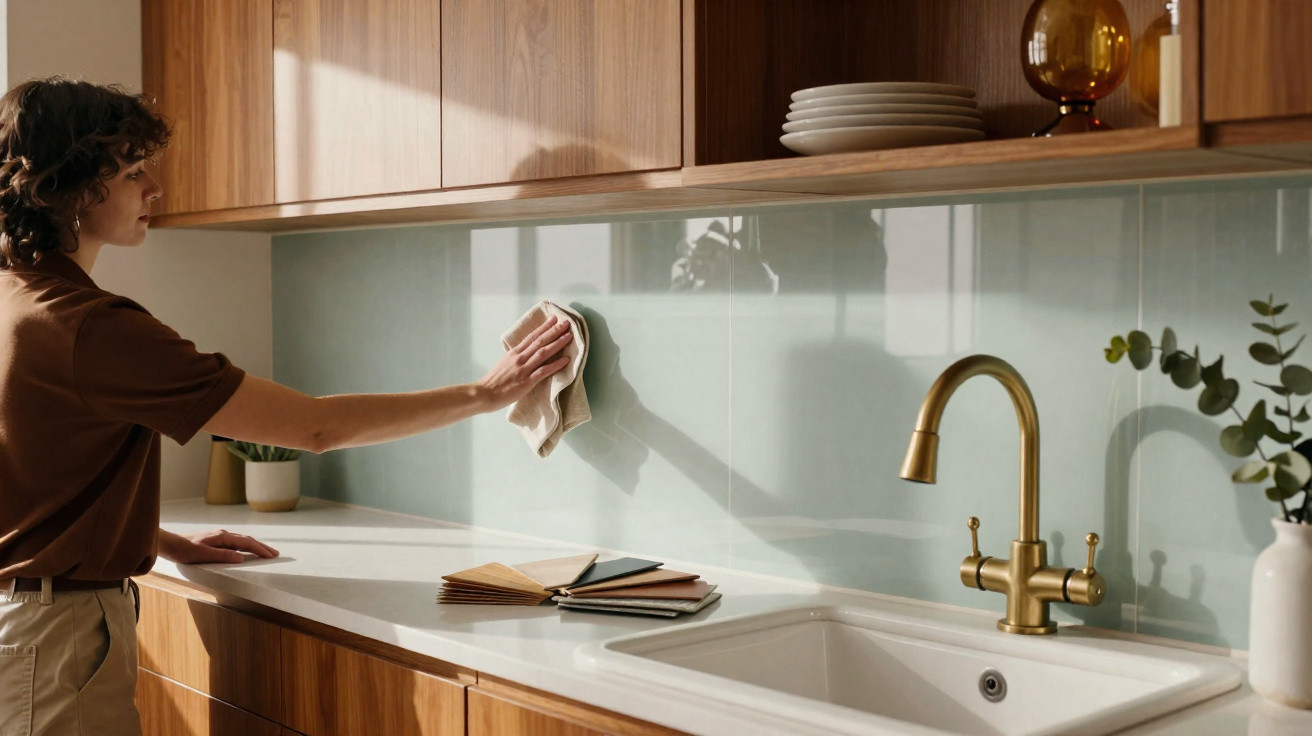
Kitchens are entering 2026 amid a quiet break with the past: people have had enough of the same smooth white tiles found in every neighbour’s home.
With budgets under pressure but a growing desire to transform a room without ripping out the entire house, a familiar feature from the 1970s is returning to the heart of kitchen design. It is neither cabinetry nor flooring, but the wall strip between the worktop and wall units: the splashback, which is reshaping kitchen projects.
The end of the overly neutral kitchen and the return of smoked glass
Kitchen refurbishment requests for 2026 reveal one wish in almost every conversation with architects: moving beyond all-white schemes and finishes that fade into the background. Metro tiles, which dominated the previous decade, are beginning to feel tired for homeowners seeking a more individual home.
Against this backdrop, a material that seemed to have been retired is making a strong comeback: the smoked-glass splashback, also known as tinted glass. An icon of 1970s flats, it has returned in a more polished, understated form and is becoming a favourite for quick kitchen refurbishments in 2026.
The same strip of wall that was once purely practical becomes the kitchen’s focal point, with controlled shine and a sophisticated retro touch.
Rather than recalling the heavy, dark-brown surfaces of the past, today’s palette is considerably more refined: soft anthracite grey, golden bronze, translucent black, and even smoky greens and blues. The idea is not to “go back in time”, but to introduce a vintage note while retaining a contemporary feel.
Why smoked glass is the number-one kitchen choice for 2026
Style: turning an overlooked wall into a feature panel
Designers increasingly treat the splashback as a statement panel, almost like artwork. Smoked glass works as a subtle filter between light and surface. It reflects light without creating a full mirror effect, adds depth and can make a kitchen appear slightly larger – an important advantage in compact layouts.
Its gentle sheen produces a warmer atmosphere, rather than a “laboratory kitchen” feel. In kitchens open to the living room, smoked glass can link the two spaces, as it visually relates to materials often found in social areas, including timber panelling, metals and dark stone.
For anyone tired of a flat white kitchen, smoked glass provides contrast, shade and visual texture without becoming excessive.
Practicality: easy care and solid durability
Smoked glass also scores well in everyday use. Its smooth surface has no grout lines where grease or mould can collect. Cleaning generally requires only:
- a microfibre cloth;
- glass cleaner or diluted mild washing-up liquid;
- no abrasive products that could scratch it.
When made from toughened glass, it copes well with heat behind the hob and oil splashes. Its darker tone also makes grease marks and water spots less visible than on clear glass or polished stainless steel.
Cost is another factor attracting buyers: in many cases, it is less expensive than covering an entire wall in natural stone or premium porcelain tiles. As panels can be made to measure, the design suits both full refurbishments and smaller interventions.
Where smoked glass works best in the kitchen
Material combinations that work well
Successful integration relies on contrast: glass is smooth and cool to the touch, so it pairs particularly well with warmer, textured surfaces. Architects have been repeating several winning combinations:
- Rustic timber kitchen + grey or bronze smoked glass to refresh the look without losing its country charm.
- “Hospital-white” kitchen + bronze smoked glass and brass or brushed-gold handles to bring warmth to the room.
- Small, dark kitchen + darker smoked glass, a light worktop and strong under-cabinet lighting to manage the sense of depth.
In minimalist kitchens, translucent black smoked glass creates a continuous line with dark appliances, such as black hobs and ovens, making the whole scheme look more coordinated.
How to stop the kitchen looking too heavy
The main concern for people considering smoked glass is making the kitchen overly dark. A few measures can keep the balance right:
| Situation | Risk | Suggested solution |
|---|---|---|
| Narrow kitchen with no window | Making the space feel even tighter | Choose light smoked glass (soft grey) and off-white cupboards |
| Dark furniture and grey flooring | An overly weighty look | Select a light worktop and warm lighting beneath the cabinets |
| Kitchen open to a small living room | One combined space feeling like a “tunnel” | Use smoked glass on only part of the wall, paired with a painted section |
Targeted lighting makes a real difference. LED strips beneath wall units or recessed into the ceiling can make the glass “light up”, highlighting reflections and reducing the impression of shadow.
Smoked glass for a quick refurbishment: take it step by step
For those unwilling to take on major building work, smoked glass offers a relatively straightforward, high-impact option. In many cases, a panel can simply be fitted over the existing wall finish, provided the substrate is secure.
Common uses in smaller refurbishments include:
- a strip only behind the hob, protecting the wall most exposed to grease;
- a panel behind the sink, replacing badly dated tiles;
- a window surround, turning the opening into a feature.
Tenants and those with smaller budgets can also find screw-fixed panels or removable systems that allow the material to be taken along when moving home. Panels made from acrylic or laminate that imitate smoked glass are also available, serving as a visual trial before investing in a permanent scheme.
The principle is simple: replacing only the splashback can be enough to make a kitchen look new, without changing the cupboards or flooring.
Technical details that are rarely discussed
Despite its visual appeal, installing smoked glass requires attention to certain technical points. Inaccurate measurements create gaps at the edges, which are especially visible because of the material’s sheen. Electrical planning matters too: cut-outs for sockets and switches in the glass need millimetre precision.
The fixing method is another consideration. In kitchens with substantial temperature changes or slightly uneven walls, the installer must assess whether to use specialist adhesives, metal supports, or both together. Poor installation can lead to cracks or panels coming loose over time.
Terms worth knowing before requesting a quote
Two concepts frequently arise in discussions with glass suppliers and often cause confusion:
Toughened glass: this undergoes a thermal process that improves mechanical and heat resistance. If it breaks, it shatters into smaller, less sharp pieces. It is therefore the most suitable choice for areas exposed to intense heat, such as behind a hob.
Laminated glass: this consists of two or more sheets bonded with an internal interlayer. In a kitchen refurbishment, it is generally considered when additional acoustic performance or security is required, although toughened glass is sufficient for a standard splashback in most cases.
It is also worth asking about paint applied to the rear. In many schemes, the colour is painted onto the back of the glass, where it is protected from abrasion. This affects both durability and the final shade, which varies according to the glass thickness and the colour of the wall behind it.
Practical scenarios: who benefits most from a smoked-glass splashback
Certain types of homes are especially likely to benefit from this trend:
- Bedsits and studios: a kitchen open to the living area needs to look good even when it is not in use. Smoked glass helps to “dress” the wall, almost like a television panel, making it feel less like a utility area.
- Holiday rental homes: property owners want quick visual impact for listing photographs. A striking splashback changes the images without requiring structural work.
- Older 1970s and 1980s flats: smoked glass creates a pleasing dialogue with the building’s origins, but in an updated version, avoiding the awkward contrast between an older communal area and an ultra-clinical interior.
There are limits, of course. Families who cook heavy fried foods every day may find splashes on the smooth surface bothersome, even though cleaning is simple. People who are particularly sensitive to reflections may prefer more matt finishes, such as rustic mosaic tiles or textured natural stone.
For many kitchens, combining materials is the answer. Using smoked glass on part of the wall and washable paint or neutral ceramic on another section makes it possible to try the trend without committing the entire area. If the glass proves practical over time, the clad area can always be extended.



Comments
No comments yet. Be the first to comment!
Leave a Comment