
The laundry basket was finally empty, yet the hallway told a different story through its smell.
Whenever the washing machine door opened, a faint sour odour escaped, rather like a damp towel left in a gym bag. The rubber seal felt slimy, with a stubborn greyish strip lodged in its fold. Technically, the appliance still worked, but that freshly washed-laundry feeling had vanished weeks earlier.
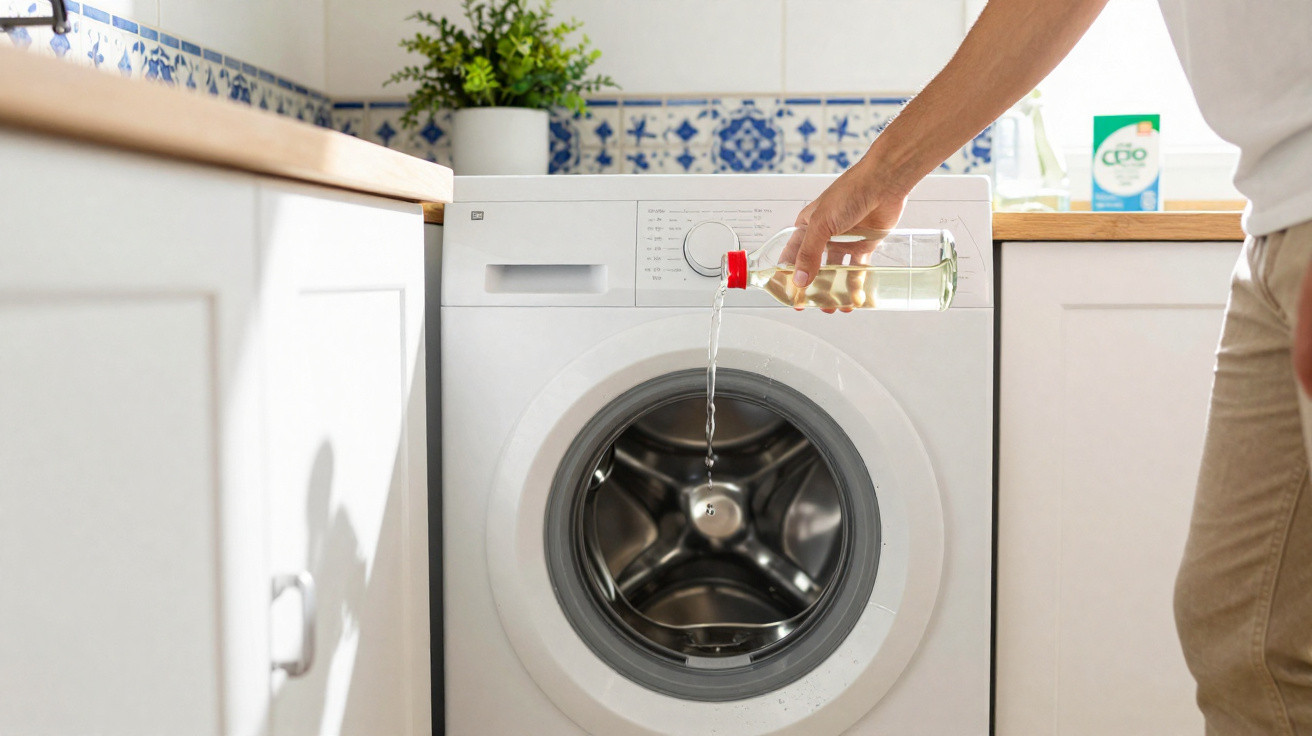
That evening, rather than putting on another load, someone tipped a large glass of clear vinegar directly into the drum, closed the door and started a hot empty cycle. It seemed almost wasteful, as though a wash was being spent on clothes that did not exist. But once the programme ended and the door was opened, the air felt lighter: less “old socks”, more “nothing at all”.
Clearly, something had shifted inside the metal drum - something most of us neglect until the odour forces us to notice.
Why your washing machine quietly collects grime and odours
From the outside, a washing machine appears clean, glossy and almost blameless. Its interior has a very different existence. Each wash leaves a minute coating of detergent, fabric conditioner, skin cells and minerals from tap water. One cycle makes little difference; a hundred cycles create a rather different picture.
Your machine rarely has a chance to “breathe”. Its door remains closed, the rubber seals stay moist, and the detergent drawer can become a centre for slime. In time, this sticky deposit holds on to dirt and bacteria. That is when laundry emerges technically clean but with a strangely stale smell.
We tend to blame the detergent, the fabric conditioner brand or even the weather. Far less often do we suspect the machine itself, quietly becoming the laundry-room version of an uncleaned shower. Once that smell has taken hold, no “extra rinse” setting will rescue the situation.
One UK study by a home-appliance servicing firm found that more than 60% of household washing machines had visible mould or residue in the detergent drawer or rubber seal. These were ordinary homes, occupied by ordinary people who felt they cleaned “enough”. The technicians’ photographs are not something you would want to look at just before dinner.
A Manchester mother of two explained that supposedly “fresh” school uniforms had begun to develop a musty odour, particularly during rainy periods when she washed more frequently. She changed detergent three times, moved to scented beads and even tried drying clothes outdoors for longer. Nothing helped. The cause only became clear when a repair engineer pulled back the door seal and revealed the blackened slime inside.
What is remarkable is not the grime itself, but how effectively it disappears from everyday view. You do not usually pull back the rubber seal, take apart the drawer or shine a torch into the drum holes. You simply trust the machine - until it greets you with the scent of stagnant water whenever you walk past.
Logically, a washing machine is an ideal miniature chemistry laboratory. It combines surfactants from detergents, organic matter such as sweat, skin and hair, fats from fabric conditioner, heat and moisture. Then there are minerals such as calcium and magnesium in hard water. With every cycle, microscopic deposits develop on concealed surfaces.
These deposits form what technicians call “biofilm”: soap scum, limescale and microorganisms bonded together. As a surface becomes rougher, fresh dirt adheres more easily. Gradually, the drum, pipes and seals change from smooth steel and rubber into a slightly tacky environment where grime readily settles.
Vinegar is useful here because of chemistry, not magic. As a mild acid, it can dissolve limescale and loosen soap residue while remaining gentler than harsh industrial cleaners. Sending hot water through the machine with vinegar in the drum begins to break up that biofilm. An empty programme allows the liquid to circulate throughout the appliance, without clothes absorbing it or getting in the way.
How to run an empty vinegar cycle that works properly
The process is straightforward, almost deceptively so. Begin with a completely empty drum: no towels “just because” and no socks to “avoid wasting the cycle”. The machine needs to concentrate solely on cleaning itself. Tip about 2 cups (roughly 500 ml) of white distilled vinegar straight into the drum. Do not use the detergent drawer or fabric-conditioner compartment; put it directly into the heart of the appliance.
Choose the longest, hottest programme available on your machine. Modern models often label this “cotton 90°” or “drum clean”. If your machine only offers a 60°C programme, select that instead. Press start and leave it to run. You may notice a slight vinegar smell during the cycle, but its sharpness will disappear. What remains is the cleaning effect.
Let us be honest: nobody genuinely does this every day. Most people only consider it once the smell is unmistakable, or after a repair bill provides a wake-up call. If you deep-clean the machine once every one to three months, you are already doing better than average. Treat it as a reset rather than another household task.
The most frequent error is overdoing it. Adding a whole bottle of vinegar will not make the machine cleaner; it merely wastes product and may put strain on certain rubber components over time. Keep to the 1–2 cup range. Another familiar mistake is combining vinegar and bleach in one cycle. That mixture can produce irritating fumes, and no one needs a chemistry experiment in a small utility room.
Some people also expect one heroic vinegar wash to solve every issue. They complete a hot cycle, inspect the door seal and become disappointed when stains remain. Frustration then sets in, along with the urge to scrub harshly with whatever is under the sink. A gentler, more patient method is more effective: repeat the vinegar cycle next month, wipe the areas you can reach and allow improvement to happen gradually rather than forcefully.
“The first time I did a vinegar cycle, I thought nothing had changed,” admits Claire, 34, who lives in a small flat with a tiny laundry corner. “Then I realized my towels didn’t smell weird after drying inside. That’s when it clicked: the machine, not the detergent, had been the problem all along.”
After the empty cycle, a few modest habits can extend its benefits. Leave the door slightly open to allow the interior to dry. Every so often, remove the detergent drawer completely and rinse it beneath hot water. Use a soft cloth to wipe the rubber seal, especially the lower section where water tends to collect.
- Use less detergent than the cap recommends if your water is not extremely hard.
- Avoid fabric conditioner on towels and sportswear to limit sticky deposits.
- Run a hot wash at least every few weeks rather than relying solely on eco 30° cycles.
- Clean the filter at the bottom of the machine twice a year.
- Repeat a vinegar deep-clean every 1–3 months, according to how much washing you do.
What changes after you “reset” your washing machine
A proper vinegar cycle does not usually produce a dramatic before-and-after image. The drum may look almost identical. Still, a subtle change often follows. Clothes come out with a more neutral scent, allowing the fragrance of your detergent to smell cleaner and less “muddy”. Towels feel less weighed down, as though their fibres can breathe again instead of holding a layer of old product.
Practically speaking, a cleaner appliance can operate more efficiently too. Heating elements free from limescale transfer heat more effectively and require less energy to reach the correct temperature. When water can move freely through pipes and nozzles, rinsing improves. Technicians quietly note that many supposedly “mysterious” fault codes are connected to years of unnoticed build-up inside a machine.
There can be a small mental change as well. At first, running an empty programme feels odd, perhaps even wasteful. Then it becomes clear that you are caring for the appliance that supports everyday life. During a busy week, laundry that truly smells clean is not a luxury; it is a matter of sanity. We have all had the experience of picking a “clean” T-shirt from the pile and wondering why it already smells worn.
There is no need to become obsessive or turn the utility room into a laboratory. An occasional vinegar wash is simply a way of checking in with your machine and considering what it has quietly been swallowing for months. Usually, the answer is: more than you think.
And when visitors borrow a towel or sit beneath your freshly washed sofa throw, you will not have that small inner voice wondering whether they can smell hidden mould in the drum. Just air. Just clean. And an appliance that finally feels cared for as well.
| Key point | Detail | Benefit for the reader |
|---|---|---|
| Empty hot cycle with vinegar | Run 1–2 cups of white vinegar on the hottest, longest cycle with no laundry | A simple, low-cost way to dissolve build-up and neutralise odours |
| Regular light maintenance | Leave the door ajar, rinse the drawer, wipe the seal and clean the filter | Stops smells returning and extends the machine’s lifespan |
| Less product, better results | Reduce detergent and fabric-conditioner doses, alternating with hot washes | Prevents fresh residue forming, while clothes feel lighter and fresher |
FAQ:
- How often should I run an empty vinegar cycle? For a family machine used several times a week, once every 1–2 months works well. If you live alone or wash less, every 3 months is usually enough.
- Can vinegar damage my washing machine? When used in moderation (1–2 cups per cycle, not daily), white vinegar is safe for most modern machines. Constant overuse or very high doses are not recommended.
- Do I pour vinegar in the drum or detergent drawer? Tip it directly into the drum for a deep-clean cycle. You can occasionally use a smaller amount in the fabric-conditioner compartment to help with limescale, but the main reset happens in the drum.
- Will vinegar completely remove mould from the rubber seal? It can help loosen it and slow its return, but stubborn, old mould may also require gentle scrubbing with a cloth and a second vinegar cycle. If the seal is badly damaged, replacement may be the real solution.
- Can I mix vinegar with bicarbonate of soda or bleach in the same cycle? Do not mix it with bleach, as this can create irritating fumes. If you wish to use bicarbonate of soda, run it in a separate cycle or add a small amount directly to the drum with laundry, never with bleach.



Comments
No comments yet. Be the first to comment!
Leave a Comment