
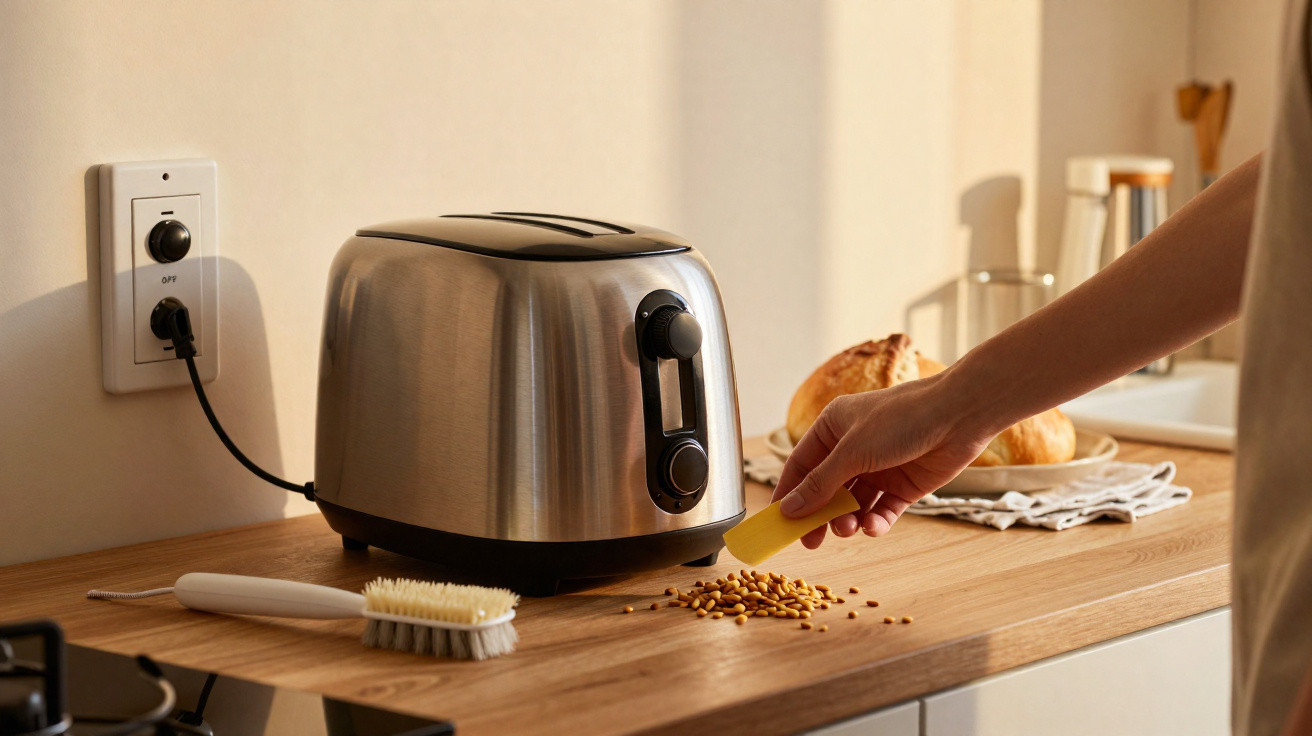
Most kitchens contain a quiet collection of useful appliances. They speed up food preparation, help meals run smoothly and seem entirely harmless while switched off. However, one of the most basic devices can become hazardous overnight, particularly when heat and crumbs combine unfavourably.
The overlooked danger of a simple toaster
A toaster appears innocuous. It has no rotating parts, visible flame or elaborate electronics. Nevertheless, exposed resistance coils heat up just millimetres away from dry, dusty crumbs. Under the wrong conditions, that combination can create the ideal circumstances for a small fire to start.
Unplugging a toaster at night removes two risks at once: accidental heating and a silent trickle of standby electricity.
Why is this more important at night? The kitchen is still, and nobody is monitoring the worktop. A minor defect, jammed lever or smouldering crumb may worsen without being seen. Although the likelihood on any individual night is low, the consequences of one event are substantial beside the five seconds it takes to remove the plug.
Why crumbs and coils are a bad combination
A toaster browns bread quickly by using nichrome wires that glow red hot. These wires are positioned close to a crumb tray, where dry and flammable fragments collect. As time passes, the tray fills, lint-like debris builds up inside and airflow is reduced. Pockets of heat can then develop. A neglected crumb trapped against a coil may blacken before producing a spark.
Clean the crumb tray regularly. Heat loves dry crumbs. Crumbs love to hide.
Plenty of problems begin during ordinary daytime use. The lever may jam, or part of a slice may snap off and rest against a wire. The toaster then cools and appears inactive, but it remains connected to the mains. A later power surge, slight mechanical movement or a curious child can re-energise the circuit when nobody is available to respond.
Standby electricity and circuit strain
Some toasters leave their electronics ready even while they are “off”. This standby consumption is modest but continuous. It contributes to the normal load on a kitchen circuit that may already power the fridge, chargers and lights. Ageing sockets and damaged cables do not cope well with persistent strain. The outcome could be a hot plug, worn socket or an electrical arc that leaves black marks on the faceplate.
Warm outlet? That’s a warning sign, not a quirk. Stop using the socket until you fix the cause.
What to do before going to bed
Adopt a brief routine that you can repeat every evening. It lowers the risk while also keeping the worktop clean.
- Disconnect the toaster after its final use each day. Loosely coil the lead so that it cannot hang down or catch on anything.
- Empty the crumb tray only once the appliance has cooled completely. Shake its contents into a sink or bin rather than onto the worktop.
- Position the toaster well away from curtains, kitchen roll, wooden chopping boards and the bottoms of cupboards.
- Plug it directly into a wall socket. Do not use extension leads or power strips for appliances that generate heat.
- Test the lever and cancel button. If either one catches or sticks, do not use the toaster until it has been repaired or replaced.
- Dispose of a toaster with a cracked casing, burnt plug or frayed lead. Its age is no reason to keep using it.
Cleaning and positioning a toaster to prevent fires
Space and ventilation are important. Keep roughly a hand’s width of clearance around the toaster, particularly behind it. Do not put it away until it is cold. Clear crumbs from the worktop so they cannot work their way beneath the appliance. Avoid turning the toaster upside down and shaking it, as this may move internal components and cause mechanisms to jam. Use the tray instead, together with a small brush where necessary.
Create a repeating monthly calendar reminder for a short thorough clean: unplug the toaster, take out the tray, gently brush the interior and check the lead. This five-minute task removes the genuine fuel behind the risk: built-up debris.
Leads, sockets and suitable safety equipment
Kitchen sockets should be earthed and protected by a residual-current device. Use the built-in test button every month. If a plug sits loosely or leans in the socket, contact an electrician. A sound socket holds a plug firmly; a faulty one can arc.
To limit false alarms, fit a photoelectric smoke alarm in or close to the kitchen. Keep a small, easily accessible Class ABC fire extinguisher nearby as well. If the toaster begins to smoulder, disconnect the power first and then act carefully. Do not try to remove trapped bread with a knife. Unplug the appliance, allow it to cool and use wooden tongs afterwards.
If you want the toaster ready for the morning
For some households, breakfast depends on a familiar routine. If remembering to unplug feels difficult, fit a smart plug programmed to cut the power each night. Schedule it to switch off at bedtime and restore power at dawn. This preserves convenience while still reducing the overnight danger. Select a plug rated for the toaster’s wattage and locate it where the manual control is easy to reach.
Automation helps, but a visible unplugged cord sends the clearest signal: safe for the night.
Other small appliances that need a second check
Although toasters are especially prone to crumb-related ignition, other countertop appliances also merit an evening check. This table lists common causes of concern and a straightforward action.
| Appliance | Typical risk trigger | Bedtime action |
|---|---|---|
| Toaster | Crumbs close to hot coils, jammed lever | Unplug, empty the crumb tray and leave clear space around it |
| Electric kettle | Failed automatic shut-off switch, mineral build-up | Unplug, descale regularly and use a wall socket |
| Coffee maker | Warming plate left on, blocked vents | Switch off and unplug, then clean the brewing path |
| Air fryer | Grease residue near the heating element | Unplug, then wipe the basket and cavity after use |
| Multicooker | Dirty sealing ring, unattended keep-warm setting | Unplug, inspect the ring and store with the lid off |
What happens inside a toaster when heat becomes sensitive
The wires in a toaster resist the flow of electricity, and that resistance produces heat. Energy then transfers to the air and bread surface through infrared radiation. The brown colour develops through the Maillard reaction, which works best in dry heat. Dry crumbs undergo the same chemistry, but they contain less moisture to take in the heat. As a result, they can reach ignition more quickly. Electrical defects create a further route to danger: a poor connection increases local resistance, raising the temperature at a plug or terminal. This is why discolouration near a pin or even a faint burning smell requires immediate attention.
Signs that your toaster should be replaced
- Patchy browning, or a side that never warms up, can indicate a failing element.
- A lever that springs back or will not stay down may point to a worn latch or a blockage caused by crumbs.
- Burn marks on the lead, plug or casing indicate heat occurring where it should not.
- A tingling feeling when touching the toaster body may signal an earthing fault.
Practical additions to use tonight
Put a heat-resistant silicone mat beneath the toaster to collect crumbs and protect the worktop. Keep a small worktop brush and bin nearby to make tidying up simple. Attach a brightly coloured label to the lead as a reminder to unplug it. You could also set a brief photo reminder on your phone titled “Kitchen off?” displaying the disconnected lead and unlit control panel. Visual prompts are easier to remember.
A quick energy cost check
The standby use of one toaster will not ruin a household budget, but the habit can multiply. One connected appliance today may become five tomorrow. Unplugging heat-producing appliances reduces wasted electricity and limits idle warmth in a room already susceptible to warm areas. A lower background load also gives the main fridge circuit a less demanding night.
The safest nighttime kitchen is boring: cool surfaces, dark indicators, silent outlets-and a toaster that’s fully unplugged.






Comments
No comments yet. Be the first to comment!
Leave a Comment