
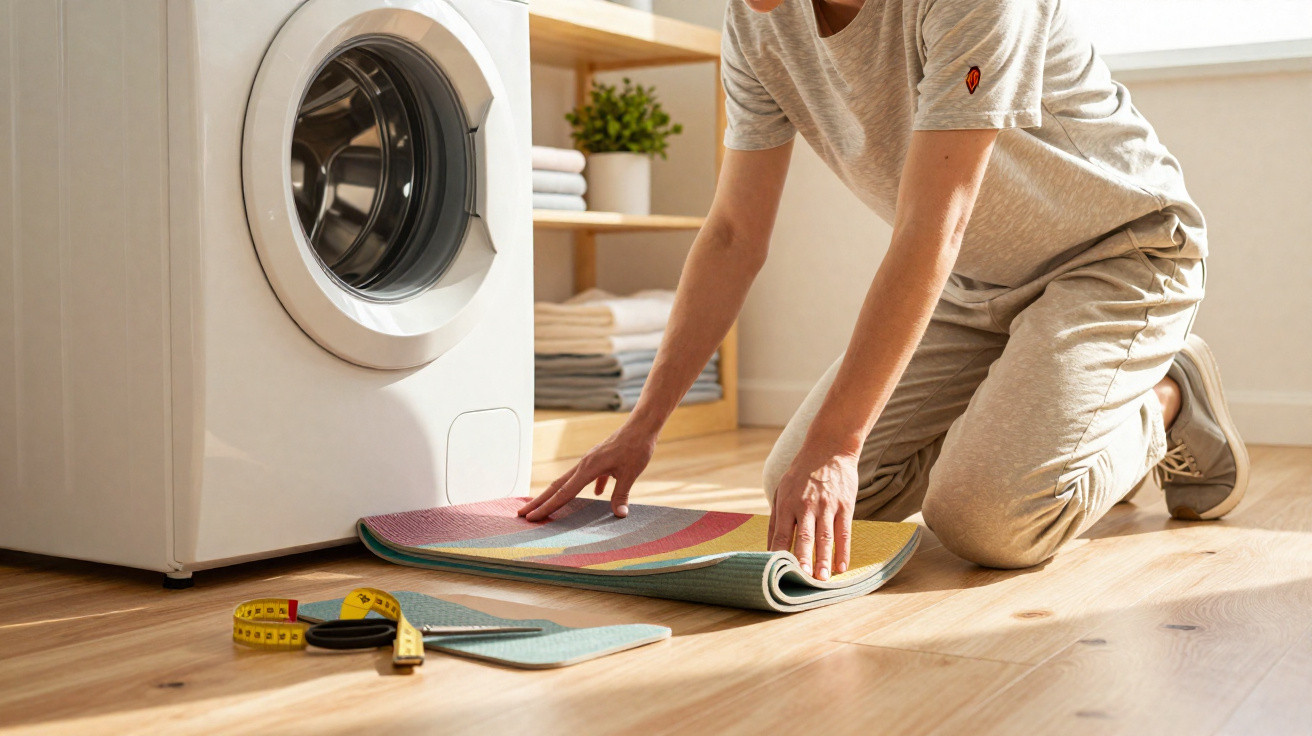
A spin cycle that resembles a helicopter is not something you should simply accept. It is the result of weight, vibration and unsuitable flooring having a noisy conversation. The answer may be sitting rolled up in a cupboard: that old yoga mat you used twice before forgetting it existed.
When my washing machine reached maximum spin, the entire kitchen buzzed like a cheap drum performance. My neighbour downstairs sent one short message - “Is that your washer or an earthquake?” - and I looked at the trembling white appliance with the mild embarrassment of someone who has put off an obvious job. Then I noticed the hallway: a purple yoga mat lay crumpled beside the shoes, still lightly dusted with talc from a fitness phase that never truly took hold. The thought was simple: use a mat, rather than call a mechanic.
Why a washing machine roars - and how a yoga mat reduces the noise
Usually, the washing machine is not the main source of the noise; the floor and walls are. As the drum rotates, its feet pass energy into the surface below, effectively turning the room into a loudspeaker. Hard tiled floors act like a stage, boosting every knock caused by an uneven load or a chassis that is slightly out of level.
Many current washing machines reach 70–80 dB during spinning, comparable to a hoover heard close up. That is not harmful, but it can feel unending. In homes with suspended floors, vibration moves through the joists, transforming a low rumble into household thunder. Most of us have paused the telly because the rinse cycle decided it wanted attention.
The principle is straightforward: limit vibration where it begins and the room becomes quieter. Yoga mats are dense, gently cushioned and made to absorb impacts without sliding about. This makes them an inexpensive, adaptable barrier between a washing machine and the floor. Rather than sending energy directly into the tiles, the foam and rubber layers dampen it. Less vibration leaves the machine, so less sound returns to the room.
Make an old yoga mat into a washing machine hush kit
Cut the mat into four squares of about 10 × 10 cm. Fold or stack them to create two layers under each foot. Put one stack beneath every adjustable foot, carefully push the machine back, then level it again. Where the mat is thin, use three layers beneath the rear feet and equalise the height at the front until the spirit level bubble is precisely centred.
Cut a longer piece and attach it to the skirting board behind the appliance, using the thickness of the mat. It works as a buffer, preventing the casing from rattling against the wall. Fit two slim strips around the inlet and waste hoses wherever they meet a hard surface; these soft collars stop them from buzzing. Then try a short spin cycle with two towels. If the machine still moves forwards, sand the floor-facing side of each square to improve its grip.
Realistically, hardly anyone checks whether their washing machine is level every week. That is perfectly all right. Focus on the easy improvements, while steering clear of familiar mistakes. Do not add so many layers that the feet become unstable. Do not cover ventilation spaces beneath the appliance. Also, prevent the pad edges from curling by cutting tidy corners, so they cannot catch when the machine is pulled out. The first quieter spin can feel surprisingly moving, like rain finally fading after a long afternoon.
Common errors, easy fixes and one-minute checks
A common error is placing the entire washing machine on a full yoga mat without considering its level. A full sheet can work well, provided the floor is even and you re-level the chassis afterwards. If there is a slight hollow in the floor, choose individual squares instead, allowing every foot to sit on its own small foundation.
Another mistake is expecting foam to solve everything. It cannot repair a failing bearing or a broken shock absorber. Grinding noises or metal-on-metal contact point to a separate issue. For ordinary humming, however, modest improvements add up: a more stable position, a grippy layer beneath the feet and hoses that sit more quietly. Give any foot that seems slack a half-turn, then fit a pad. Level, then load.
“Vibration isn’t the enemy,” as a repair tech once told me. “Uncontrolled vibration is.”
- Quick check: press the front corners of the washing machine. Does it rock? If it does, adjust the feet until it remains steady.
- Pad recipe: use two layers under each foot; add a third layer only where the floor is uneven.
- Hose hush: place a 2 cm strip wherever plastic touches a wall or cabinet.
- Do not obstruct drainage or airflow beneath the appliance.
- Final test: run a short spin with two towels and leave cabinet doors open to identify rattles.
How a quieter washing machine changes the room - and why it matters
The aim is not complete silence, but a softer sound. Once the washing machine no longer broadcasts vibration through the floor, the kitchen feels less tense and more like a proper room again. You notice the drum’s gentle whirr rather than the building’s complaint.
If you already have a mat, this solution costs nothing; if not, it costs only pennies. It is clean, reversible and uncomplicated. There is no drilling, expanding foam or dubious gadget that seems ingenious until it fails. Simply add cushioning in the useful places, and the machine may finally settle down.
Will it eliminate every sound? Not when the bearings have failed or the shock absorbers are worn. Even so, a yoga mat may provide months of extra comfort for a washing machine that is otherwise in good condition. Pass the idea on to a friend living above a shop, or a neighbour whose baby naps at 3. Quiet can benefit everyone.
| Key point | Detail | Benefit for the reader |
|---|---|---|
| Isolate the feet | Two stacked yoga-mat squares beneath each foot | Quickly reduces vibration transferred into the floor |
| Prevent contact points | A mat strip behind the washing machine; soft collars around hoses | Eliminates rattles that cannot be fixed by levelling |
| Re-level after adding padding | Small turns of the feet to balance the new height | Stops the machine walking and keeps the solution secure |
FAQ:
- Will a yoga mat void my warranty? No. You are not altering the washing machine; you are simply putting pads under its feet. Leave ventilation and drainage routes clear, and there should be no issue.
- Which mat material works best? TPE and rubber are ideal. PVC is acceptable, although it may slip on glossy tiles, so sand the underside or add a thin layer of rubber.
- Is a full-size mat under the whole washer a good idea? It can be on level floors. On uneven flooring, use pads beneath the feet so the washing machine remains correctly supported and level.
- How much quieter will it get? You should notice a clear reduction in low-frequency rumble and fewer rattles. It will not be silent - only calmer and less booming during spin.
- What if the washer still bangs? Look for uneven loads, loose transit bolts on a new machine or worn shock absorbers. Pads are useful, but don’t block the vents or overlook mechanical faults.





Comments
No comments yet. Be the first to comment!
Leave a Comment