
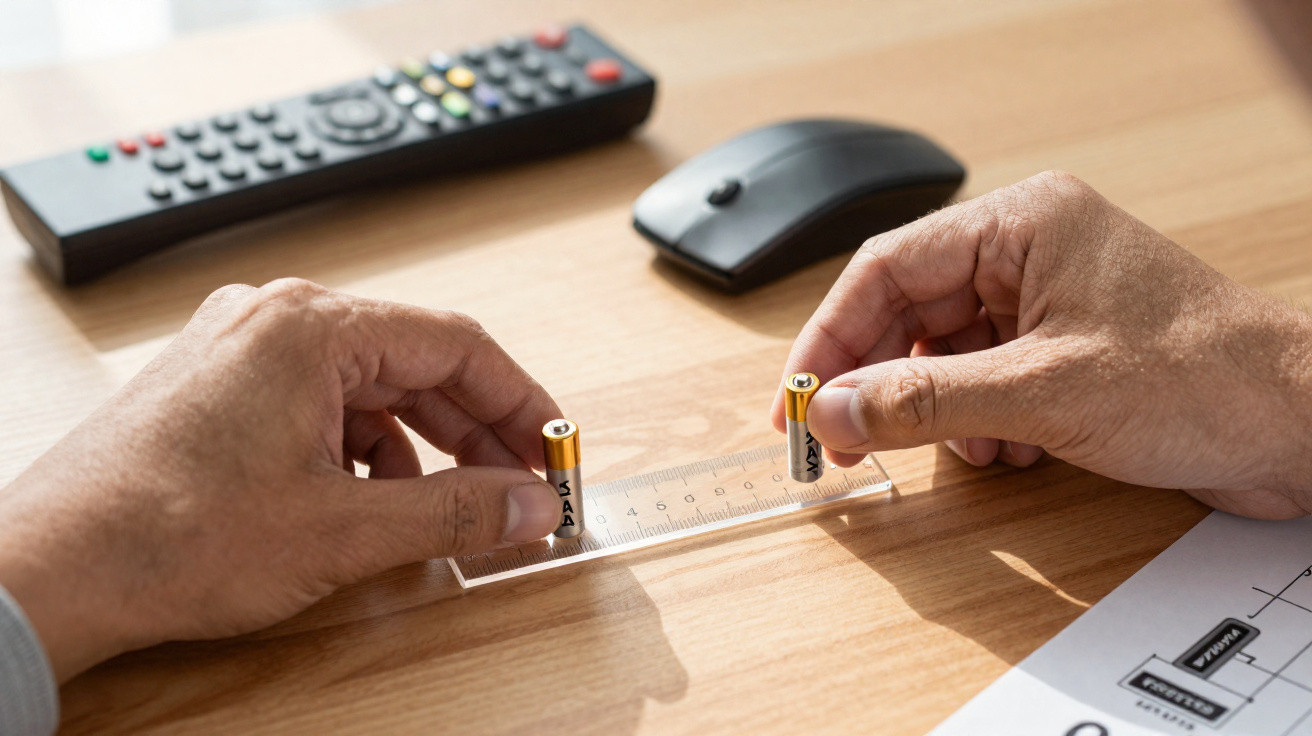
Anyone who has replaced a remote control battery will be familiar with the AA and AAA labels, yet few people know where they originated. Behind this simple alphabet lies a standardisation system that has spanned decades and remains unchanged in today’s devices.
The unseen scale that sorts the world’s batteries
The practice of identifying batteries with letters arose from a need to bring order to the electronics market during the last century. Before then, manufacturers could use their own formats, making battery replacement an inconvenience for consumers.
Standardisation introduced a scale running from A to D for cylindrical batteries, ordered from the smallest to the largest. As devices became more compact, formats such as the AA battery, AAA battery and even AAAA emerged, all following the same miniaturisation principle.
- Standard dimensions: letters such as AA and AAA define a battery’s precise height and diameter, which remain the same across different brands.
- Worldwide availability: these batteries are sold in supermarkets, pharmacies and electronics shops around the globe.
- Different technologies: alkaline and rechargeable nickel-metal hydride versions, known as NiMH, are available under the same designation.
- Broad compatibility: toys, wireless mice, TV remote controls and torches use the same AA battery standard.
Why do these two little letters fit almost everything?
The AA battery became so popular because it offers a balance between power and compact dimensions. Two or four cells are enough to run a large share of household devices for extended periods.
That balance explains its presence in such a varied range of products, from remote controls to wireless keyboards. The AAA battery, meanwhile, is used when even less room is available, such as in headphones and smaller toys.
The overlooked detail in battery sizes
Not every letter in the battery alphabet has stood the test of time. The older A and B batteries, for instance, have all but vanished from everyday use, although they played an important part in this history.
The battery left in the past
What happened to A and B batteries?
These batteries were widely used in valve radios and the first household electronic devices, at a time when each part of a circuit required its own power source.
With the arrival of semiconductors, devices began using less energy and required smaller formats. This created an opportunity for the AA battery to rise, while A and B batteries became largely limited to collectors and restorers.
This shift illustrates how advances in electronics shape the sizes of batteries we use, even though most people never notice the process in everyday life.
When the wrong battery stops a device working
Using the correct battery type prevents malfunctions and can even avoid damage to equipment. Most products state the required standard, with markings such as 2 × AA beside the battery compartment.
It is also best not to combine new and used batteries in the same device, and to store AA batteries and AAA batteries separately in dry, well-ventilated places away from excessive heat.
Lithium is gaining ground, but the AA battery remains relevant
Even as lithium batteries have become widespread in mobile phones and laptops, the AA battery remains relevant in 2026, powering thousands of simple products that still rely on this standard created almost a century ago.
Ultimately, the discreet letters printed on the packaging represent decades of industrial standardisation. The next time you replace a remote control battery, you will know exactly why it has that name.
Interested in discovering what other everyday details conceal? Share this content with anyone who also enjoys understanding where things come from.






Comments
No comments yet. Be the first to comment!
Leave a Comment